

Teams behaviour T6
Be Wonderful to Work With
Would you want to work with you? Make colleagues feel noticed, valued and supported through small, daily acts of kindness and respect.
Jump to T6 resources ↓What this behaviour looks like
Small acts, outsized impact
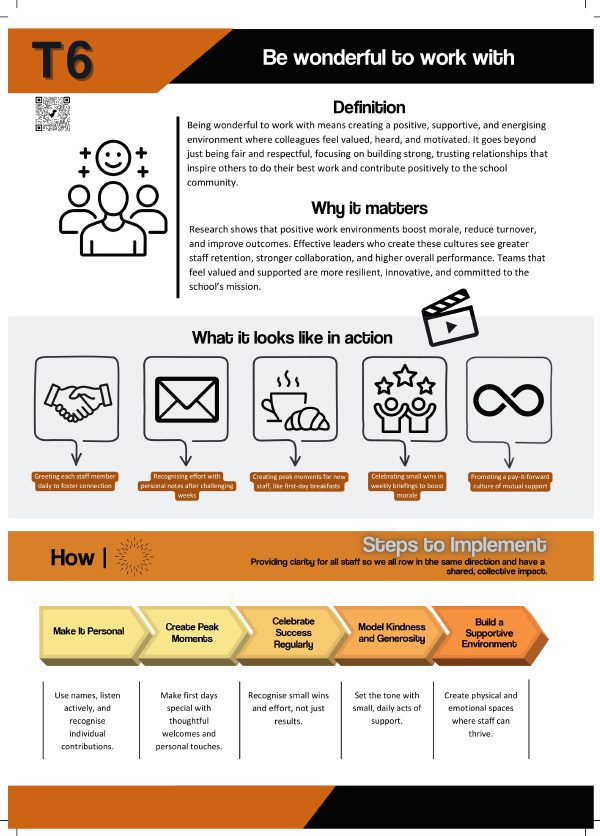
A leader notices people: greeting colleagues by name, recognising effort after hard weeks and making a new colleague's first day memorable. They stay warm and reliable under pressure and encourage staff to support one another, so kindness becomes the norm.
A practical example
A colleague needs an answer before leaving
Hard to reach“I am too busy for this now. Send another email and I will try to look later.”
Warm and reliable“I can see you need an answer before you leave. I have five minutes now to understand it. If it needs longer, I will meet you at 3.30 and let you know by four what I can do.”
See that the colleague needs an answer before leaving.
Offer five minutes now to understand the problem.
If it needs longer, meet at 3.30 and reply by four.
Choose a moment when pressure makes you abrupt or hard to reach. Rehearse a warm, clear response and a promise you can realistically keep.
T6 · Resources for your setting
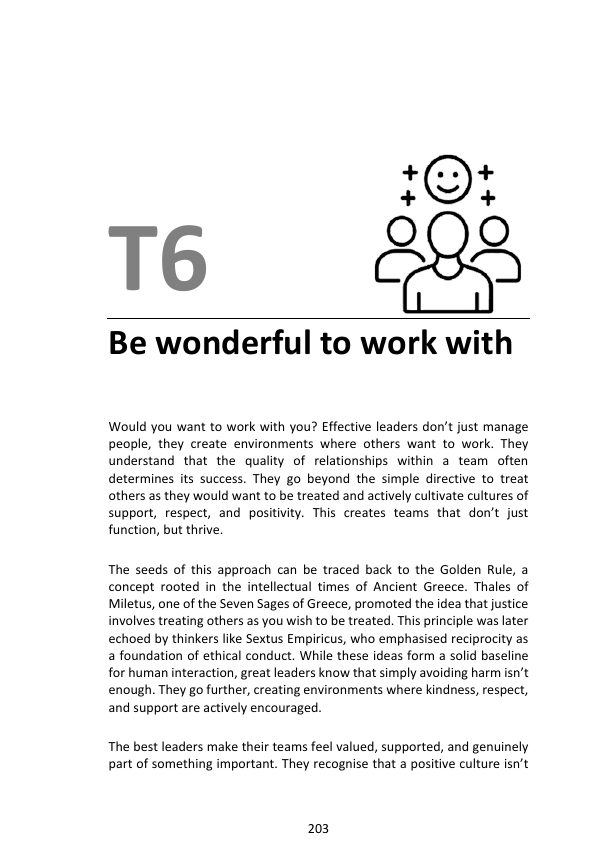
Put ‘Be Wonderful to Work With’ into practice
Develop your own practice or lead the learning with your team. Use the chapter and workbook to explore the behaviour, then choose the resources that fit your next step.
Apply · Your leadership practice
Put it to work
Use the T6 Playbook to turn the behaviour into practical action on a real leadership challenge.
- Practical toolkit and coaching prompts
- A practice script to rehearse your approach
- A 90-day plan to guide your next steps
Members only · Explore membership →
Apply · Learning with your team
Lead a team session
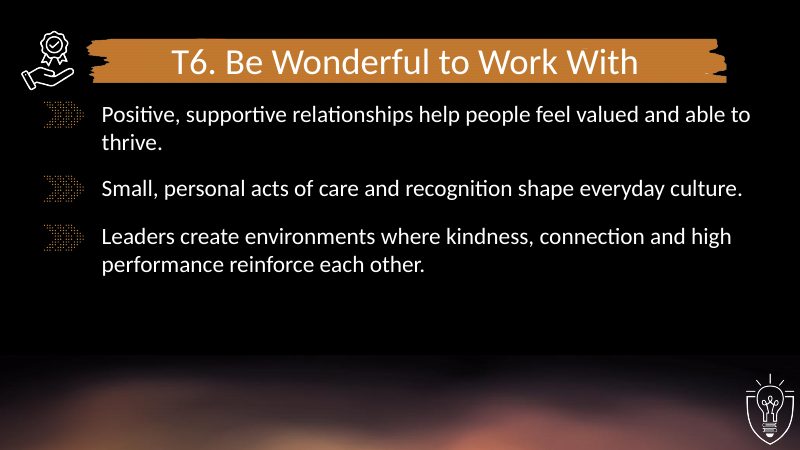
Use the T6 INSET PowerPoint to help colleagues explore the behaviour and plan how to put it into practice.
- Editable slides to adapt to your setting
- Speaker notes to support facilitation
- Discussion, rehearsal and planning
Members only · Explore membership →
Worked examples
See T6 applied in eight leadership contexts
Choose your role to explore the challenge, the leader’s response and the intended result. Members can read the complete example and download an editable Word copy.
In a primary school
In a secondary school
Across schools
Selected worked example
In a primary school · Headteacher
Repairing a broken promise of help
Sonia · Headteacher · 232-pupil village primary school
Worked example at a glance
Repairing a broken promise of help
The challengeA Year 4 teacher asked for help with low-level disruption. The headteacher said 'leave it with me', then did not return for four days, and the teacher had to chase during a difficult week.
What the leader doesThe headteacher acknowledges the broken promise, asks what help the teacher wants, rehearses the classroom reset with them and replaces 'leave it with me' with three questions: what help, who owns the next step, and when.
What success looks likeBy day 30 every leadership promise should have a named action and time, with nobody chasing; by day 60 staff seeking help should keep ownership of their work; by day 90 part-time and support colleagues should report equally dependable contact.
Trevor · Deputy Headteacher for staff development · 372-pupil junior school
Worked example at a glance
Giving feedback that is kind and clear
The challengeAn experienced Year 5 teacher's warm questioning accepts choral or volunteered answers, so quieter pupils' understanding is unknown. The deputy has raised it twice but softened it until the change was unclear.
What the leader doesThe deputy head names the specific practice and its effect on pupils without undoing earlier praise, hears the teacher's view, agrees one rehearsal and is open about the evidence and when coaching would become accountability.
What success looks likeBy day 30 the teacher should consistently gather evidence from every pupil before independent work; by day 60 coaching records should name an observable change and review date; by day 90 staff should find feedback respectful and unambiguous.
Aisha · Religious Education Lead and Year 2 teacher · 276-pupil infant school
Worked example at a glance
Recognising quiet classroom expertise
The challengeA Year 1 teacher and teaching assistant adapted an RE discussion routine and participation rose. The RE lead praised the class display instead, then shared their resource without asking permission.
What the leader doesThe RE lead names their specific professional judgement and its impact on pupils, acknowledges sharing too quickly, learns their reasoning and agrees with them whether and how the practice is shared.
What success looks likeBy day 30 every shared RE example should state its purpose, adaptation and contributor permission; by day 60 part-time staff and teaching assistants should provide half the examples discussed; by day 90 colleagues should feel their expertise is recognised.
Janine · Headteacher · 1,190-pupil secondary school
Worked example at a glance
Putting right a terse email
The challengeThe headteacher emailed the data manager demanding a correction by 10.00, brought the deadline forward without explanation, copied in two senior leaders and overlooked the examination return already due that morning.
What the leader doesThe headteacher goes to see the data manager, acknowledges the message was disrespectful, hears what they were carrying, makes a clear priority decision and agrees how urgent requests can be safely challenged.
What success looks likeBy day 30 every urgent request should state the real deadline and what can move; by day 60 priority conflicts should be raised early and decided the same day; by day 90 high-pressure periods should feel calmer, with quality assurance no weaker.
Marcus · Assistant Headteacher for timetabling and cover · 1,280-pupil secondary school
Worked example at a glance
Explaining a disruptive room change
The challengeA part-time geography teacher had three of four weekly lessons moved by a one-line email. The change solved a room conflict but cut preparation time and created a childcare difficulty.
What the leader doesThe assistant head acknowledges the impact, explains the constraints honestly, invites anything that could change the decision, offers practical mitigation and sets up a fair, accessible route for future timetable queries.
What success looks likeBy day 30 every significant timetable change should state its purpose, duration and query route; by day 60 disruption should be shared fairly across full-time and part-time staff; by day 90 changes should feel clearer and fairer, with cover no slower.
Yvette · SEND Transition and Pastoral Lead · 1,360-pupil secondary school
Worked example at a glance
Restarting a transactional transition
The challengeThe first two messages to the parent of a Year 6 pupil with SEND chased documents and stated attendance rules. The parent had already repeated sensitive information twice, and nobody had mentioned the pupil's strengths.
What the leader doesThe pastoral lead calls to recognise the pupil's strengths, listens without asking for another full retelling, agrees one coordinated contact route and keeps expectations high while addressing practical barriers.
What success looks likeBy day 30 every priority family should have one named contact and a strengths-based first conversation; by day 60 duplicate requests should fall by at least 75%; by day 90 families should report greater clarity and belonging, with transition attendance improving.
Deepa · Head of Food Preparation and Nutrition · 860-pupil secondary school
Worked example at a glance
Stopping goodwill becoming the plan
The challengeThe head of department agreed a complex Year 10 pastry practical for the next day without asking the technician, then forwarded it at 4.40 pm. The technician has absorbed similar changes with only general thanks.
What the leader doesThe head of department withdraws the assumption, acknowledges the workload and professional impact, lets the technician's evidence decide what is safely feasible and introduces one booking route for all practical requests.
What success looks likeBy day 30 all practical requests should use one route with a recorded feasibility decision; by day 60 late changes should fall from nine per half term to no more than two; by day 90 the technician's contribution should be specifically recognised.
Greg · Trust Director of Estates and Operations · six-school trust
Worked example at a glance
Repairing an abrupt emergency message
The challengeDuring two heating failures, the director sent a site lead an abrupt instruction that did not say what work could stop or when updates would come, or credit their earlier report flagging the fault.
What the leader doesThe director calls to hear the impact, acknowledges the site lead's expertise and preventive report, keeps the safety standard clear and agrees that urgent requests will state priority and the next update time.
What success looks likeBy day 30 every urgent operations request should state priority, displaced work and next update time; by day 60 all six site leads should feel safe raising challenge; by day 90 preventive work should be recognised as consistently as crisis response.
The complete Playbook is for members
Turn this example into action
Read the full toolkit, coaching and practice scripts, and 90-day plan. Members can view the PDF here and download an editable Word copy.
Further reading

Recommended book
Radical Candour – Kim Scott (2017)
This text supports the behaviour by demonstrating how combining care and challenge builds strong, productive relationships.
References from the Everyone Succeeds book
- Heath, C. and Heath, D. (2017) The Power of Moments: Why Certain Experiences Have Extraordinary Impact. New York: Simon & Schuster. Buy on Amazon ↗
- Alexander, B.K., Coambs, R.B. and Hadaway, P.F. (1978) 'The effect of housing and gender on morphine self-administration in rats', Psychopharmacology, 58(2), pp. 175–179. View article ↗
- Curry, O.S., Rowland, L.A., Van Lissa, C.J., Zlotowitz, S., McAlaney, J. and Whitehouse, H. (2018) 'Happy to help? A systematic review and meta-analysis of the effects of performing acts of kindness on the well-being of the actor', Journal of Experimental Social Psychology, 76, pp. 320–329. Read free ↗
Not sure where to start? Take the free self-diagnostic to choose one to three behaviours to focus on.
As an Amazon Associate, Everyone Succeeds earns from qualifying purchases.