

Leadership behaviour L2
Be Positive
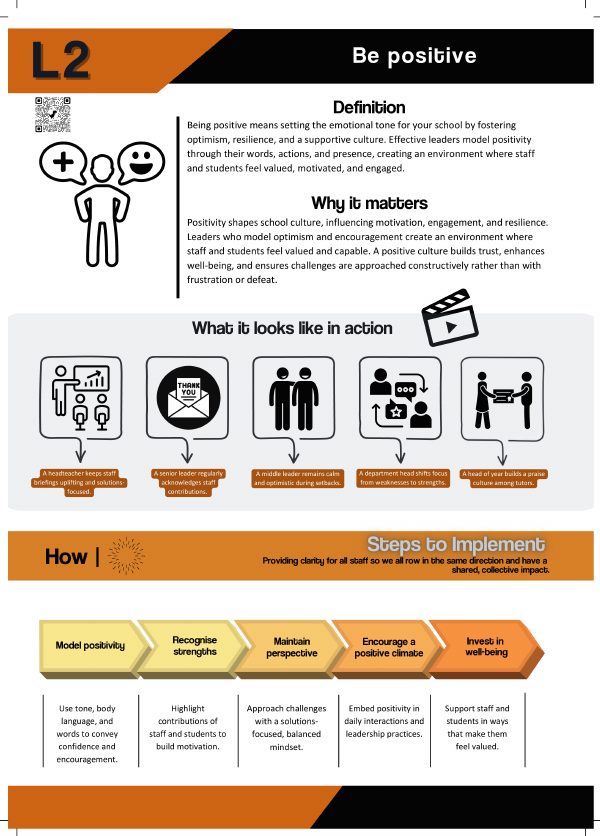
You set the emotional tone. Positivity grounded in honesty and real strengths helps staff and pupils tackle challenges constructively, not with frustration.
Jump to L2 resources ↓What this behaviour looks like
Honest facts, real hope
A leader sets an uplifting, solutions-focused tone in briefings, recognises the specific strengths of colleagues and pupils, and stays calm through setbacks. Challenges are named honestly, so the encouragement is believed and people feel genuinely valued.
A practical example
Sharing a small rise in attendance
Listing the problems“Persistent absence is still too high. We all need to push harder on attendance this term.”
Honest and hopeful“Attendance has risen by 0.6 percentage points. Thank you for making the first-day calls more personal. Persistent absence in our priority group is still too high. Let's build on those conversations and agree one practical next step with each family.”
Credit the more personal first-day calls behind the 0.6-point rise.
Say plainly that priority-group persistent absence is still too high.
Build on those calls: one practical next step per family.
Script a short message with one sign of progress, one honest challenge and one next step, then check that the encouragement is specific and believable.
L2 · Resources for your setting
Put ‘Be Positive’ into practice
Develop your own practice or lead the learning with your team. Use the chapter and workbook to explore the behaviour, then choose the resources that fit your next step.


Apply · Your leadership practice
Put it to work
Use the L2 Playbook to turn the behaviour into practical action on a real leadership challenge.
- Practical toolkit and coaching prompts
- A practice script to rehearse your approach
- A 90-day plan to guide your next steps
Members only · Explore membership →

Apply · Learning with your team
Lead a team session
Use the L2 INSET PowerPoint to help colleagues explore the behaviour and plan how to put it into practice.
- Editable slides to adapt to your setting
- Speaker notes to support facilitation
- Discussion, rehearsal and planning
Members only · Explore membership →
Completed Playbooks
See L2 applied in eight leadership contexts
Choose your role to explore the challenge, the leader’s response and the intended result. Members can read the complete example and download an editable Word copy.
In a primary school
In a secondary school
Across schools
Selected completed example
In a primary school · Headteacher
Recognising a small attendance gain
Mariam · Headteacher · 625-pupil community primary school
Worked example at a glance
Recognising a small attendance gain
The challengeAttendance rose 0.6 points after a push on first-day contact, but attendance meetings still list what is not working and several staff believe the extra effort achieved nothing.
What the leader doesAt a staff briefing the headteacher explains what the rise means, credits the first-day conversations that produced it, names what is still hard and protects three actions, stopping a duplicate spreadsheet that day.
What success looks likeBy day 30 every priority family should have one owner, a plan and a next contact; by day 60 at least 90% of school actions should be completed on time; by day 90 attendance should rise by a further percentage point.
Ivy · Deputy Headteacher · 625-pupil community primary school
Worked example at a glance
Recognising stronger questioning
The challengeVisits found stronger questioning in 11 of 18 classes, yet almost all feedback has gone to the seven still developing, and improving teachers do not know their changes were noticed.
What the leader doesAt a development briefing the deputy headteacher gives the improving and developing classes equal attention, credits the specific techniques that changed and offers the other seven classes private, supported rehearsal rather than another reminder.
What success looks likeBy day 30 every team should receive specific recognition and every flagged class an agreed focus; by day 60 all seven classes should complete observation, rehearsal and follow-up; by day 90 participation should improve in at least five of the seven.
Alice · English Lead and Year 2 teacher · 625-pupil community primary school
Worked example at a glance
Cutting back an overloaded writing approach
The challengeSix weeks into a new writing approach, teachers report overload, only half the Key Stage 1 classes use the oral-rehearsal sequence consistently, and two colleagues have asked to drop it.
What the leader doesAt the phase meeting the English lead recognises what is working, admits the package is overloaded, agrees one core sequence and rehearses an accessible alternative to partner talk with colleagues.
What success looks likeBy day 30 every class should use the common core and drop non-essential resources; by day 60 all teachers should have rehearsed one difficult response; by day 90 at least 80% of pupils should begin independent writing without adult prompting.
Monica · Headteacher · ages 11 to 16 urban secondary school, 1,160 pupils
Worked example at a glance
Responding to a fall in results
The challengeSummer examination results fell by 3 percentage points and the disadvantaged gap widened, while staff discussion swings between blaming the cohort and reassurance about national volatility.
What the leader doesAt the first September staff meeting the headteacher states the fall plainly, credits specific decisions in English and science, owns the leadership conditions being changed and asks each department to test one hypothesis.
What success looks likeBy day 30 every department should have a tested problem statement; by day 60 every team should complete a first extended-task cycle; by day 90 extended responses should be stronger than the September baseline, including for disadvantaged pupils.
Mahira · Deputy Headteacher · ages 11 to 16 urban secondary school, 1,160 pupils
Worked example at a glance
Responding to a falling staff pulse
The challengeSince the new timetable began, cover and room changes have increased and the staff pulse has fallen from 7.1 to 5.8, driven by late room changes and duplicated reporting.
What the leader doesAt a whole-staff briefing the deputy headteacher owns the causes leaders created, credits a room-board pilot as evidence the pressure can fall, stops three demands that day and removes work rather than asking for resilience.
What success looks likeBy day 30 the 7.45 board, single owner and three stopped demands should operate consistently; by day 60 same-day surprises should halve; by day 90 the pulse should recover above 6.8 while essential changes continue safely.
Aysha · Head of Year 11 · ages 11 to 16 urban secondary school, 1,160 pupils
Worked example at a glance
Recognising quieter pastoral work
The challengeBriefing thanks keep naming intervention leads, while tutors' early family calls and administrative contact records go unmentioned, even though early contact prevented escalation in twelve cases.
What the leader doesAt the Year 11 briefing the head of year credits early, less visible work across roles, with consent and without pupil detail, and gives part of each weekly briefing to clearing barriers tutors raise.
What success looks likeBy day 30 every tutor team should receive evidence-based recognition; by day 60 at least 90% of tutors' barriers should be removed or escalated within five days; by day 90 at least 80% of tutors should report their early work is noticed.
Fatima · Head of Art · ages 11 to 16 urban secondary school, 1,160 pupils
Worked example at a glance
Encouraging creative risk in art
The challengeModeration shows strong technical accuracy but limited creative risk, and teachers fear change will lower results, even though one Year 9 class improved originality without losing accuracy.
What the leader doesAt a department meeting the head of art credits the department's technical foundations and a colleague's critique-and-revision routine, acknowledges the examination risk honestly and proposes one bounded experiment for the next unit.
What success looks likeBy day 30 every class should define one bounded experiment; by day 60 all classes should test it and moderate decision quality; by day 90 at least 70% of moderated pupils should show a tested alternative and a justified final decision.
Celia · Trust Director of Culture and Ethos · ten-school trust
Worked example at a glance
Sharing a mixed picture across the trust
The challengeThree schools improved, five held steady and two declined, but trust briefings focused almost entirely on the shortfall, so improving schools felt unnoticed and declining schools felt publicly compared.
What the leader doesAt the principals' forum the director gives the full picture without ranking schools, credits the decisions behind the improvements, pauses a central data return and asks every school for one six-week test.
What success looks likeBy day 30 every school should name one problem, one bright spot and a six-week test; by day 60 all central support actions should be complete; by day 90 both declining schools should show movement on their chosen lead measure.
The complete Playbook is for members
Turn this example into action
Read the full toolkit, coaching and practice scripts, and 90-day plan. Members can view the PDF here and download an editable Word copy.
Further reading

Recommended book
The Progress Principle – Teresa Amabile & Steven Kramer (2011)
This text strengthens your practice by explaining how celebrating small wins fuels motivation, resilience and team culture.
References from the Everyone Succeeds book
- Andony, T., Gorjian, N. and Finkelman, J. (2016) 'Effects of positive leadership and flow on employee well-being through the PERMA lens', Austin Journal of Psychiatry and Behavioral Sciences, 3(1), 1051. Read free ↗
- Seligman, M.E.P. (2011) Flourish: A Visionary New Understanding of Happiness and Well-being. New York: Free Press. Buy on Amazon ↗
Not sure where to start? Take the free leadership diagnostic to find your three priorities.
As an Amazon Associate, Everyone Succeeds earns from qualifying purchases.