

Leadership behaviour L1
Lead by Example
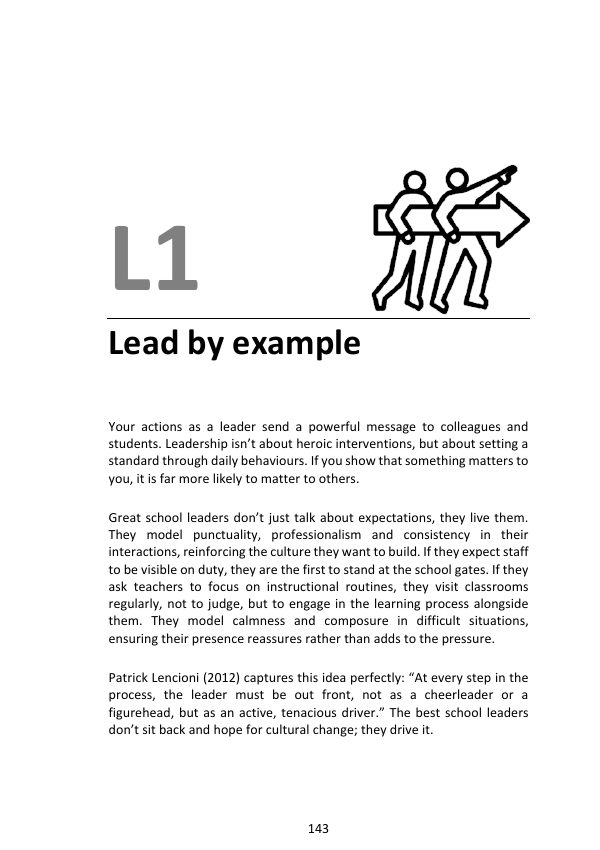
Staff and pupils adopt what they see you do far more than what you say. Live your standards daily and trust follows.
Jump to L1 resources ↓What this behaviour looks like
Out front, alongside the team
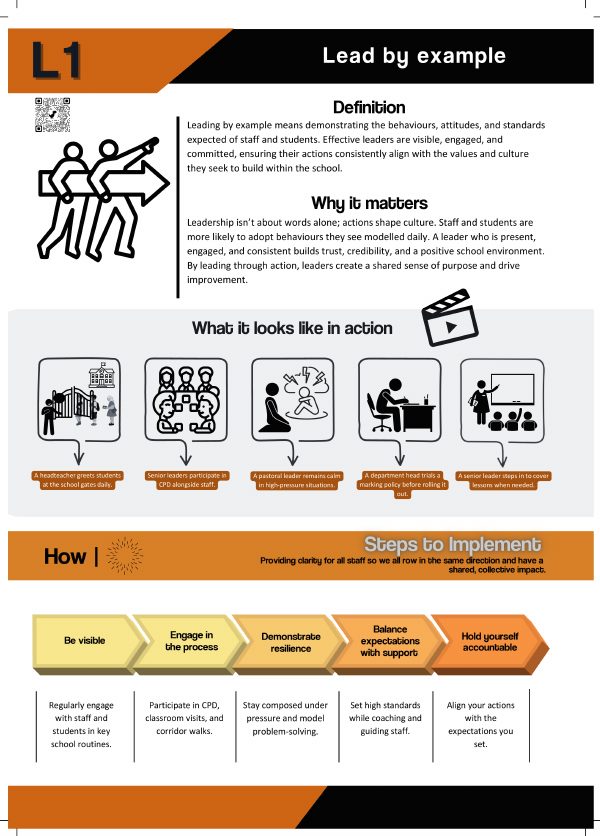
A leader is first at the gate, joins CPD alongside colleagues and trials a new policy before asking others to use it. Pupils and staff see words and actions match, including under pressure, when the leader stays calm and steps in to help.
A practical example
Covering morning arrival on a short-staffed day
Reminder from the office“Please cover every duty point promptly. I will catch up with emails in the office while you manage arrival.”
Leading from the gate“Two colleagues are absent, so I will be on the lower gate from 8.20 until the last pupil is in. If you are on duty, I will see you there. Every pupil should meet a calm, welcoming adult this morning, and that starts with me.”
Be at the duty point on time and ready to welcome pupils.
Take the lower gate yourself from 8.20 on a short-staffed day.
Colleagues and pupils see the leader keep the standard under pressure.
Pick one standard you ask of colleagues, decide where they will see you model it, and note each day whether your actions matched your words.
L1 · Resources for your setting
Put ‘Lead by Example’ into practice
Develop your own practice or lead the learning with your team. Use the chapter and workbook to explore the behaviour, then choose the resources that fit your next step.
Apply · Your leadership practice
Put it to work
Use the L1 Playbook to turn the behaviour into practical action on a real leadership challenge.
- Practical toolkit and coaching prompts
- A practice script to rehearse your approach
- A 90-day plan to guide your next steps
Members only · Explore membership →
Apply · Learning with your team
Lead a team session
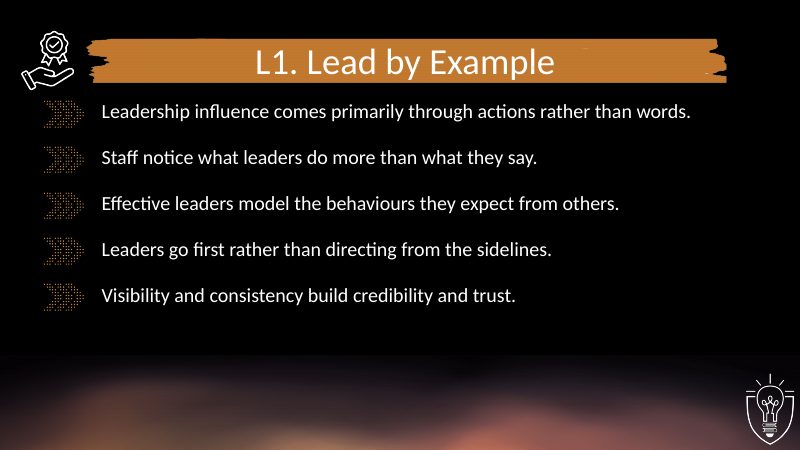
Use the L1 INSET PowerPoint to help colleagues explore the behaviour and plan how to put it into practice.
- Editable slides to adapt to your setting
- Speaker notes to support facilitation
- Discussion, rehearsal and planning
Members only · Explore membership →
Completed Playbooks
See L1 applied in eight leadership contexts
Choose your role to explore the challenge, the leader’s response and the intended result. Members can read the complete example and download an editable Word copy.
In a primary school
In a secondary school
Across schools
Selected completed example
In a primary school · Headteacher
Leading the morning gate
Gareth · Headteacher · 430-pupil urban primary school
Worked example at a glance
Leading the morning gate
The challengeStaff arrival and gate cover vary on pressured mornings, and leaders sometimes send reminders from their offices rather than joining the routine themselves.
What the leader doesThe headteacher leads the lower gate from before opening and introduces a lead-and-reserve rota, so calm, punctual mornings no longer depend on who happens to be free, then reviews every exception fairly.
What success looks likeBy day 30 every morning should have a confirmed senior lead and reserve; by day 60 at least 95% of leadership duties should be completed as planned; by day 90 at least 80% of staff should agree leaders keep the standard they ask of others.
Callum · Assistant Headteacher · 430-pupil urban primary school
Worked example at a glance
Modelling feedback after a lesson visit
The challengeFeedback often asks teachers to be more challenging without leaders demonstrating the specific practice expected, so teachers are told what to change but not shown it.
What the leader doesThe assistant headteacher models the evidence, action and rehearsal feedback process with a teacher and her phase leader, asking first what the teacher noticed and adjusting the action where she knows the class better.
What success looks likeBy day 30 every phase leader should model the feedback process accurately; by day 60 at least 85% of sampled feedback should lead to the agreed practice; by day 90 fewer pupils should hold the targeted misconception in at least 80% of sampled lessons.
Ravi · Years 1 and 2 Phase Leader · 430-pupil urban primary school
Worked example at a glance
Modelling one practical routine
The challengeThree different equipment routines operate across the phase, and the phase leader's own teaching does not always follow the agreed sequence.
What the leader doesThe phase leader teaches the agreed practical routine in a Year 2 lesson while the other Years 1 and 2 staff watch, giving the adults a role and adding a short safety reset for spills.
What success looks likeBy day 30 all four classes should use the practical routine; by day 60 at least 90% of pupils should manage equipment transitions independently within four minutes; by day 90 at least 90% of pupils should explain why each material gets the same test.
Paul · Headteacher · ages 11 to 18 secondary school, 1,420 pupils
Worked example at a glance
Holding corridor positions at changeover
The challengeSenior leaders are deployed inconsistently at lesson changeover, and staff perceive that expectations apply differently when leaders are busy.
What the leader doesThe headteacher takes the corridor position asked of every leader at the 10.55 changeover, deals with any missed position the same day and debriefs so other leaders have a model they can copy.
What success looks likeBy day 30 every priority changeover should have a lead, a reserve and a tested flow plan; by day 60 deployment should reach 95% with priority stairwells clearing in under two minutes; by day 90 corridor incidents should fall by 25%.
Jenny · Assistant Headteacher · ages 11 to 18 secondary school, 1,420 pupils
Worked example at a glance
Using the reset language under pressure
The challengeLeaders use the agreed reset language in briefings but revert to lengthy or confrontational exchanges with pupils when they are under pressure.
What the leader doesThe assistant headteacher rehearses the reset language with senior leaders, then uses it in a live corridor conversation they can watch, showing where safeguarding or a reasonable adjustment would change the wording.
What success looks likeBy day 30 every senior leader should demonstrate the reset sequence; by day 60 at least 90% of sampled resets should stay concise and lead to a recorded repair or return; by day 90 at least 80% of staff should agree leaders use it.
Marcus · Head of Year 7 · ages 11 to 18 secondary school, 1,420 pupils
Worked example at a glance
Making the family call personally
The challengeTutors are expected to call families early, yet pastoral leaders sometimes rely on templated messages during busy weeks, so tutors read about the standard rather than hear it.
What the leader doesAfter the next significant incident, the head of year makes the family call personally while a tutor listens, separating what is known from what is still being checked, then debriefs the order to copy.
What success looks likeBy day 30 every priority incident should receive personal same-day contact; by day 60 at least 90% of promised updates should arrive on time and every tutor should have rehearsed the call; by day 90 no sampled family should need to repeat information.
Henry · Head of Design and Technology · ages 11 to 18 secondary school, 1,420 pupils
Worked example at a glance
Putting unfinished work through critique
The challengePupils are asked to act on critique, but department meetings rarely show leaders exposing and improving their own work.
What the leader doesThe head of department puts an unfinished prototype of their own through the critique protocol pupils use, hands the chair to the technician and shows which suggestions are accepted, tested or rejected, and why.
What success looks likeBy day 30 every colleague should have observed and practised the critique protocol; by day 60 all teachers should model a revision of their own work with pupils; by day 90 70% of sampled Key Stage 3 projects should show a specification-linked revision.
Vikram · Trust Director of Teaching and Learning · nine-school trust
Worked example at a glance
Holding the central team to the review standard
The challengeSchools receive detailed review expectations on evidence and deadlines, but the central team's own reports sometimes arrive late or without clear evidence trails.
What the leader doesThe director applies the trust's evidence, correction and deadline standard to the central team's own reports first, escalates any slippage before the deadline and asks headteachers for feedback on accuracy and timeliness.
What success looks likeBy day 30 every central review pack should include a source index, correction log and feasible deadline; by day 60 at least 95% of reports should arrive on time; by day 90 all central reviews should meet the standard expected of schools.
The complete Playbook is for members
Turn this example into action
Read the full toolkit, coaching and practice scripts, and 90-day plan. Members can view the PDF here and download an editable Word copy.
Further reading

Recommended book
Leaders Eat Last – Simon Sinek (2014)
This book reinforces the behaviour by showing how modelling actions and values shape culture more powerfully than instruction.
References from the Everyone Succeeds book
- Covey, S.R. (2004) The 7 Habits of Highly Effective People: Powerful Lessons in Personal Change. New York: Free Press. Buy on Amazon ↗
- Goleman, D., Boyatzis, R. and McKee, A. (2002) Primal Leadership: Realizing the Power of Emotional Intelligence. Boston, MA: Harvard Business School Press. Buy on Amazon ↗
- Lencioni, P.M. (2012) The Advantage: Why Organizational Health Trumps Everything Else in Business. San Francisco, CA: Jossey-Bass. Buy on Amazon ↗
Not sure where to start? Take the free leadership diagnostic to find your three priorities.
As an Amazon Associate, Everyone Succeeds earns from qualifying purchases.