

Culture behaviour C1
Hold High Standards
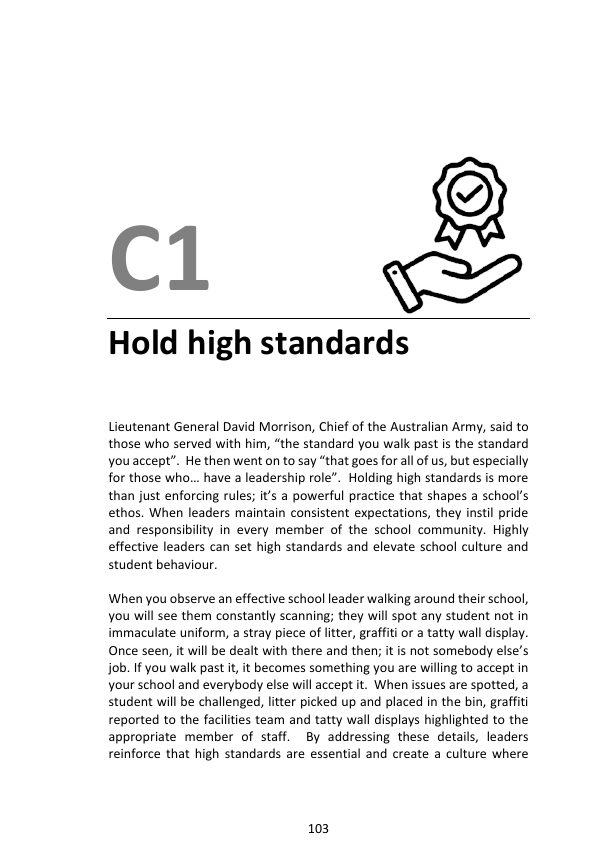
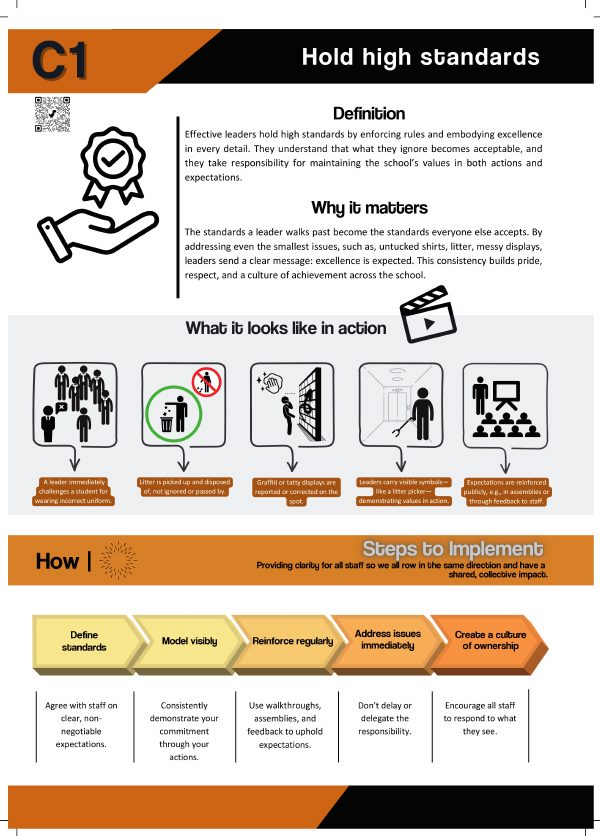
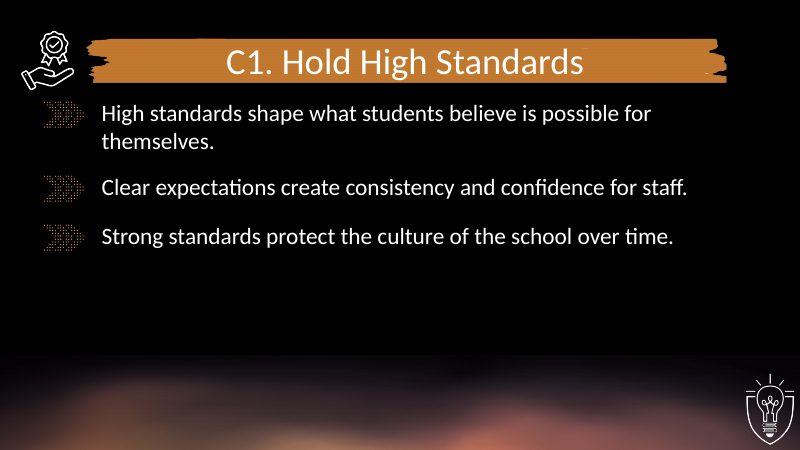
The standard you walk past is the standard you accept. Define what good looks like and act on small slips straight away.
Jump to C1 resources ↓What this behaviour looks like
No walking past
A leader agrees clear, non-negotiable standards with staff, models them visibly and deals with slips there and then, from uniform and litter to lesson starts. Pupils and colleagues see that small details matter, and every adult responds to what they see.
A practical example
Resetting lesson starts after a slow drift
Letting it drift“Lesson starts have got a bit slow lately. Can everyone try to tighten things up when they get a chance?”
Holding the standard“Our standard is that pupils begin the first task within three minutes, and recent visits show starts have slowed. We will reteach the routine on Monday and review timings on Friday. I will be on the corridor at every changeover, because a slow start we walk past soon becomes normal.”
Pupils begin the first task within three minutes.
Recent visits show that lesson starts have slowed.
Reteach the routine and review timings on Friday.
Choose one expectation that has started to slip. Write the standard in observable terms, note what the evidence shows and decide the first thing you will do about the gap.
C1 · Resources for your setting
Put ‘Hold High Standards’ into practice
Develop your own practice or lead the learning with your team. Use the chapter and workbook to explore the behaviour, then choose the resources that fit your next step.
Free preview. Everything for C1 is open to everyone, so you can see exactly what members get for all 54 behaviours. See what membership includes →

Apply · Your leadership practice
Put it to work
Use the C1 Playbook to turn the behaviour into practical action on a real leadership challenge.
- Practical toolkit and coaching prompts
- A practice script to rehearse your approach
- A 90-day plan to guide your next steps
Apply · Learning with your team
Lead a team session
Use the C1 INSET PowerPoint to help colleagues explore the behaviour and plan how to put it into practice.
- Editable slides to adapt to your setting
- Speaker notes to support facilitation
- Discussion, rehearsal and planning
ES CoachApply · Online, with ES Coach
Complete the C1 Playbook online
Work through the Playbook on your desk instead of on paper. A built-in coach supports you with every question: jot a few words and ES Coach suggests an answer for you to edit.
- ES Coach help under every question and table
- Saves as you type, and stays private to you
- Linked to your goal and your 90-day plan
Also in the online Playbook, with PDF and Word copies: worked examples following an Early Years leader, a primary phase leader, a primary SENDCo, a teaching head, a secondary SENDCo, a head of sixth form, a teaching and learning lead, a support staff team leader and a school business manager (finance lead).
Members only · Explore membership → · Sign in
Worked examples
See C1 applied in seventeen leadership contexts
Choose your role to explore the challenge, the leader’s response and the intended result. Read the complete PDF below and download an editable Word copy.
In a primary school
In a secondary school
Across schools
Selected worked example
In a primary school · Headteacher
Pride in shared spaces
Early Years leader · Three-form-entry primary of about 680 pupils in an area of high disadvantage, with 90...
Worked example at a glance
Holding every adult to one clear standard for how they spend...
The challengeHolding every adult to one clear standard for how they spend continuous provision time, at children's level and talking with them, instead of walking past adults who stand at the edge, tidy or chat to each other.
What the leader is aiming forBy the end of February, children, especially those who started with spoken English well below their age, talk more with adults in continuous provision because every adult meets one clear standard: at their level and in conversation.
How they will know it is workingWeekly snapshot figures show at least 8 in 10 adults in conversation with longer exchanges, every missed standard is followed up, and the spring language check shows at least 40 of the 46 children making progress.
Phase leader · Three-form-entry primary school of about 630 pupils in an area of high disadvantage...
Worked example at a glance
Raising the standard of writing in history, geography and science...
The challengeRaising the standard of writing in history, geography and science books in Years 5 and 6 to match what we already expect in English books.
What the leader is aiming forBy February half term, Year 5 and 6 children write in history, geography and science to the same standard we expect in English books, in full, punctuated sentences and independent extended pieces, rising further by Easter.
How they will know it is workingThe book sample rises from 11 to at least 28 of 36 meeting the standard, missing punctuation falls from 41% to 15%, and my twice-weekly learning walks show the in-the-moment prompt being used.
Primary SENDCo · Two-form-entry primary school of about 410 pupils, where I am the full-time SENDCo and...
Worked example at a glance
Holding a high standard for how interventions are delivered, after...
The challengeHolding a high standard for how interventions are delivered, after finding that many sessions were shorter than planned, did not follow the programme and were not recorded, so we could not tell whether children were being helped.
What the leader is aiming forBy mid-February, children at SEN support get the interventions their plans promise, delivered in full and recorded properly, with at least 90% of planned sessions happening, from 68% in the autumn.
How they will know it is workingFortnightly record checks and half-termly observations show the standard being held, and the session delivery rate, observation results and entry and exit data show whether children are getting better interventions.
Teaching headteacher · Primary school of 68 pupils in a river valley village, part of a small multi-academy...
Worked example at a glance
Holding the same high standard of work and behaviour in my own Years...
The challengeHolding the same high standard of work and behaviour in my own Years 4, 5 and 6 class on the two days a week when I am out of class for leadership, after noticing that the quality of books and behaviour drops on Thursdays and Fridays.
What the leader is aiming forBy mid-February, at least 20 of 26 books in my class meet our standard on Thursday and Friday pages (from 9 of 26), and behaviour incidents on those days are no higher than on my days, so my children get the same high standard every day of the week.
How they will know it is workingPlans shared by Tuesday at 4pm, the weekly handover and one behaviour system every day (lead), and the three-weekly book look, the behaviour log and pupil voice (lag).
Secondary SENDCo · An 11 to 18 girls' school of about 1,000 pupils, where needs are often identified late...
Worked example at a glance
Making sure every Key Stage 4 pupil with an agreed access arrangement...
The challengeMaking sure every Key Stage 4 pupil with an agreed access arrangement gets it in every classroom assessment and mock, not only in the summer exams, so it is genuinely her normal way of working.
What the leader is aiming forBy mid-February, at least 95% of internal assessments for Key Stage 4 pupils with access arrangements have the arrangement in place and recorded, on the way to every one, from 56% in the September science audit.
How they will know it is workingThe live list is kept up to date and one department is audited every fortnight (lead), and arrangements in place, teachers recording and pupils using rest breaks in lessons show it is working (lag).
Head of sixth form · An 11 to 18 school with a large sixth form of 420 across two buildings, a strong Oxbridge...
Worked example at a glance
Raising the standard of the subject comments teachers write for...
The challengeRaising the standard of the subject comments teachers write for university references, which arrive late and generic for students outside the early-deadline group.
What the leader is aiming forBy early January, every Year 13 university applicant outside the early-deadline group has a complete reference, with at least 95% of subject comments submitted on time and at least 90% meeting the three content points.
How they will know it is workingI will know it is working when the weekly tracker shows comments arriving on time and comments sent back are fixed within two days (lead), and when the December sample meets the standard for at least 90% of all comments and 80% of vocational students' comments while rewriting time falls (lag).
Teaching and learning lead · An 11 to 16 school of about 850 pupils recovering from a period of high staff turnover...
Worked example at a glance
Making the agreed start to lessons, a retrieval task on the board and...
The challengeMaking the agreed start to lessons, a retrieval task on the board and pupils working within three minutes of the bell, the standard in every classroom rather than in a few.
What the leader is aiming forBy mid-February, the agreed start-of-lesson routine is met in at least 27 of 30 lessons in my drop-ins, including lessons taught by our newer staff, and behaviour incidents in the first ten minutes fall below 20% of classroom incidents.
How they will know it is workingI will know it is working when heads of department send their drop-in checklists every fortnight and newer teachers are getting coaching, and when my drop-in figures and the behaviour logs both move in the right direction.
Support staff team leader · Teaching assistant lead in an 11 to 18 school of about 1,300 pupils, leading 22 teaching...
Worked example at a glance
Getting every teaching assistant to complete a short, useful support...
The challengeGetting every teaching assistant to complete a short, useful support note on the same day for each pupil with an education, health and care plan they support, so the SENDCo, teachers and families have real evidence of what helps.
What the leader is aiming forBy the end of February, at least 90% of supported lessons with pupils who have education, health and care plans have a note on the support log by 4pm the same day, and at least 80% of notes have all four parts.
How they will know it is workingI will know it is working when my Friday checks show on-time and four-part notes rising every fortnight, and the SENDCo can use lesson notes as evidence in every annual review report this spring.
School business manager (finance lead) · Secondary school, 1,100 pupils, 22 budget holders across departments, pastoral teams and...
Worked example at a glance
Getting every budget holder to submit an accurate monthly budget...
The challengeGetting every budget holder to submit an accurate monthly budget return on time, so the forecast can be trusted and money reaches pupils while it can still make a difference
What the leader is aiming forBy the February return, every budget holder sends an accurate return on time, so our forecast can be trusted and identified underspend reaches agreed priorities for pupils before Easter, while it can still make a difference.
How they will know it is workingAt least 21 of 22 returns arrive by the fifth working day and 95% of lines need no correction by February, and my monthly summary to the headteacher shows the forecast within £5,000.
Sarah · Headteacher · 420-pupil primary school
Worked example at a glance
Pride in shared spaces
The challengeCorridors and displays look tired and minor repairs stall, but raising it risks staff hearing that displays matter more than teaching.
What the leader doesThe headteacher frames the standard around the children who use the corridors, names an owner for every shared space, splits the work between staff, premises and senior leaders, and introduces a five-minute Friday check.
What success looks likeBy day 30 every repair should be acknowledged or updated promptly; by day 60 at least 90% of shared zones should meet the visual standard; by day 90 more staff, pupils and families should describe the school as cared for and welcoming.
James · Deputy Headteacher · 630-pupil primary school
Worked example at a glance
Calm transitions after playtime
The challengeLine-up times range from two to seven minutes and zones are briefly left unsupervised, while staff use different signals and are unsure who leads when a colleague is absent.
What the leader doesThe deputy headteacher places the fault in the system rather than the people, then resets one routine: named zones staffed before pupils arrive, one whistle, a two-minute line-up and explicit cover for absence.
What success looks likeBy day 30 all duty zones should be covered in at least 95% of checks; by day 60 at least 90% of classes should line up within two minutes; by day 90 transition incidents should have halved.
Maya · Years 5 and 6 Phase Leader · 420-pupil primary school
Worked example at a glance
Protecting the daily reading routine
The challengeMonitoring shows three classes losing reading time and holding irregular reading conversations, and a small phase meeting could easily turn into colleagues guessing who is being criticised.
What the leader doesThe phase leader describes the reading routine precisely enough for anyone to run it tomorrow, models it before monitoring it, invites practical barriers and agrees two brief routine checks each week.
What success looks likeBy day 30 at least 90% of sampled sessions should start within two minutes; by day 60 every class should hold four reading conversations on most days; by day 90 at least five of six focus pupils should improve their fluency.
Marcus · Headteacher · 1,150-pupil secondary school
Worked example at a glance
Calm corridors and prompt lesson starts
The challengeStandards have drifted gradually rather than failed dramatically: only 68% of lesson starts meet the three-minute standard and leaders are unevenly visible at changeover.
What the leader doesThe headteacher personally takes a corridor zone every day, publishes leaders' changeover duties and sets one clear standard: doors staffed, calm movement and pupils starting the retrieval task within three minutes of the bell.
What success looks likeBy day 30 leaders should complete at least 95% of their zone duties; by day 60 at least 85% of lessons should meet the three-minute start; by day 90 at least 95% should, with fewer changeover incidents.
Daniel · Deputy Headteacher · 1,200-pupil secondary school
Worked example at a glance
Consistent behaviour routines in every classroom
The challengeThe behaviour policy is clear but unevenly enacted: removal rates vary sixfold between similar departments and pupils describe different rules in different classrooms.
What the leader doesThe deputy headteacher has middle leaders rehearse the entry routine, correction language and consequence sequence in threes, so they can model it themselves, and makes same-day follow-up their responsibility.
What success looks likeBy day 30 at least 90% of sampled lessons should use the entry routine; by day 60 at least 85% should use correction and escalation accurately; by day 90 at least 80% of pupils should say expectations are the same everywhere.
Aisha · Head of Year 9 · 1,000-pupil secondary school
Worked example at a glance
Year 9 punctuality
The challengeLate marks have risen from 74 to 113 in four weeks, and pupils believe the follow-up depends on which adult they happen to meet.
What the leader doesThe head of year sets one standard for every pupil, gives tutors the same recording and same-day response, strengthens supervision on problem routes and offers a private way to raise genuine barriers.
What success looks likeBy day 30 register coding should be at least 95% accurate; by day 60 late marks should fall by 30%; by day 90 they should halve without disadvantaging pupils with agreed adjustments.
Helen · Head of Mathematics · 1,350-pupil secondary school
Worked example at a glance
A common Key Stage 3 homework routine
The challengeHomework submission ranges from 61% to 94% across similar classes, and colleagues hold different views, so a common routine could feel like losing control of the mathematics.
What the leader doesThe head of mathematics leaves the mathematics with colleagues but agrees a common minimum: homework set on the agreed day, due within seven days, recorded on the platform and followed up the same way.
What success looks likeBy day 30 every Key Stage 3 class should use the common routine; by day 60 each class should reach 85% submission; by day 90 submission should reach 90%, with at least 90% of sampled work showing method and correction.
Priya · Director of Education · six-school trust
Worked example at a glance
A trust-wide standard for lesson climate
The challengeSome headteachers want a single trust policy while others fear losing autonomy, and only three of the six schools define their core classroom routines observably.
What the leader doesThe director separates a common entitlement from local choices: every school defines and teaches routines for entry, attention, independent work and exit, rehearses them with staff and takes part in reciprocal peer review.
What success looks likeBy day 30 all schools should agree the four principles and their local mapping; by day 60 every school should train and rehearse its routines; by day 90 peer review should find the entitlement secure or improving everywhere.
Read the complete worked example below, including the practice script and 90-day plan.
Practise · C1
What would you say?
Resetting lesson starts after a slow drift. Here is what a busy leader might say without thinking:
“Lesson starts have got a bit slow lately. Can everyone try to tighten things up when they get a chance?”
“Our standard is that pupils begin the first task within three minutes, and recent visits show starts have slowed. From Monday, I'll be at the classroom door with you for the first week, and we'll review it together on Friday.”
Why it works. Naming the precise standard, the evidence of drift and a concrete next step makes the expectation impossible to miss, because the standard you walk past is the standard you accept.
Now say yours out loud once, the way you would on the day. Rehearsing it aloud is what makes it come out right under pressure. Rehearse a real situation with the ES Coach →
Resources for this behaviour
Templates and checklists from the resource library that put C1 into practice.
Further reading

Recommended book
Leverage Leadership 3.0 – Paul Bambrick-Santoyo (2026)
This book supports the behaviour by showing how precise expectations and follow-up drive consistency, improvement and professional trust.
References from the Everyone Succeeds book
- Bambrick-Santoyo, P. (2026) Leverage Leadership 3.0: A Practical Guide to Building Exceptional Schools. 3rd edn. Hoboken, NJ: Wiley. Buy on Amazon ↗
- Whitman, D. (2008) Sweating the Small Stuff: Inner-City Schools and the New Paternalism. Washington, DC: Thomas B. Fordham Institute. Read free ↗
Not sure where to start? Take the free self-diagnostic to choose one to three behaviours to focus on.
As an Amazon Associate, Everyone Succeeds earns from qualifying purchases.