

Culture behaviour C3
Establish Routines
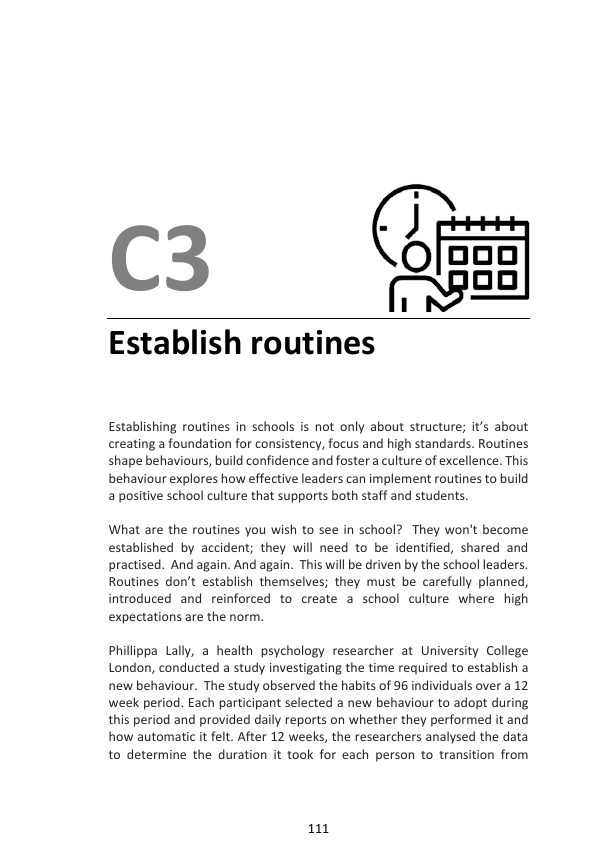
Routines do not establish themselves. Show them, name them and practise them again and again until calm, focused habits run without reminders.
Jump to C3 resources ↓What this behaviour looks like
Seen, named and practised
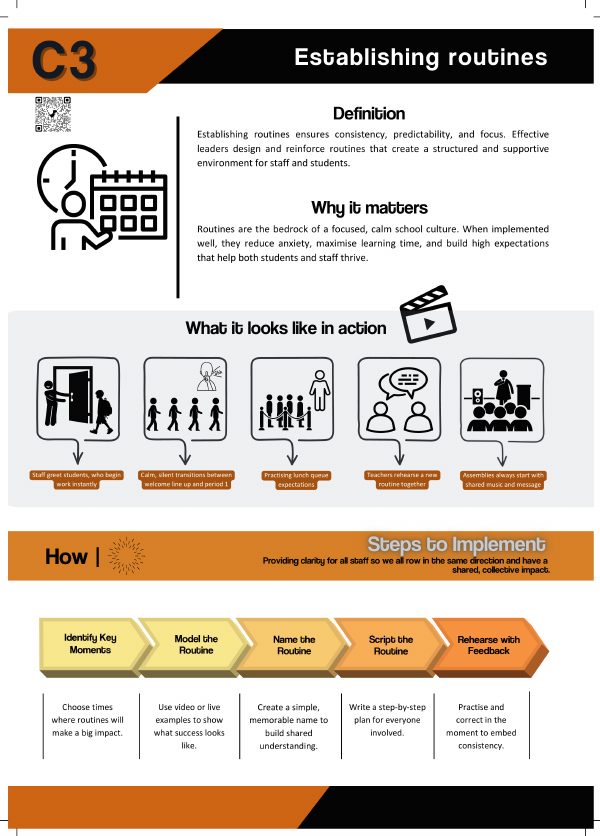
A leader picks the moments where a routine will make the biggest difference, scripts its steps and shows staff and pupils a clear model. Everyone rehearses it where it happens, with correction in the moment, until it runs without reminders.
A practical example
Introducing a new lunchtime queue
Explained once“From Monday, classes should line up quietly for lunch in the new order. The details are in the staff bulletin.”
Modelled and practised“Calm lunches give pupils more time to eat and talk. The new routine has three steps: Line, Collect, Sit. Watch the model and tell me what you notice at each step. This afternoon we will practise it in the hall with your classes, correcting as we go, until it feels automatic.”
Watch a short model of the new lunch routine.
Call the steps Line, Collect, Sit so everyone shares them.
Practise in the hall with classes, correcting in the moment.
Pick one recurring moment. Write its essential steps and a simple name, plan how you will model it, then rehearse it where it happens with feedback in the moment.
C3 · Resources for your setting
Put ‘Establish Routines’ into practice
Develop your own practice or lead the learning with your team. Use the chapter and workbook to explore the behaviour, then choose the resources that fit your next step.
Apply · Your leadership practice
Put it to work
Use the C3 Playbook to turn the behaviour into practical action on a real leadership challenge.
- Practical toolkit and coaching prompts
- A practice script to rehearse your approach
- A 90-day plan to guide your next steps
Members only · Explore membership →
Apply · Learning with your team
Lead a team session
Use the C3 INSET PowerPoint to help colleagues explore the behaviour and plan how to put it into practice.
- Editable slides to adapt to your setting
- Speaker notes to support facilitation
- Discussion, rehearsal and planning
Members only · Explore membership →
Completed Playbooks
See C3 applied in eight leadership contexts
Choose your role to explore the challenge, the leader’s response and the intended result. Members can read the complete example and download an editable Word copy.
In a primary school
In a secondary school
Across schools
Selected completed example
In a primary school · Headteacher
Safe end-of-day dismissal
David · Headteacher · 140-pupil rural primary school
Worked example at a glance
Safe end-of-day dismissal
The challengeClasses use different thresholds and different language with collectors, and there have been two near misses during staffing changes.
What the leader doesThe headteacher pilots See, Check, Release, Record with Reception and Year 6: children wait behind a marked threshold, each collector is verified, uncertainty goes to the office and staff rehearse at the real gates.
What success looks likeBy day 30 every class should use the same threshold and collector check; by day 60 collector questions should be referred correctly in 95% of checks; by day 90 dismissal should run safely with no near misses.
Sophie · Deputy Headteacher and Designated Safeguarding Lead · 480-pupil primary school
Worked example at a glance
Morning arrival and safeguarding handover
The challengeMost mornings are calm, but concern logging and absence cover depend on who is on the gate, so the routine is weakest when familiar people or radios are missing.
What the leader doesThe deputy headteacher introduces Cover, Welcome, Handover and rehearses it at the real entrance with staff absence, a distressed parent and radio failure, so every concern reaches a named safeguarding owner before registration.
What success looks likeBy day 30 every arrival zone should have a named adult and reserve; by day 60 concerns should be recorded before registration on 95% of sampled mornings; by day 90 absence checks and escalations should be on time every day.
Aaron · Years 3 and 4 Phase Leader · 360-pupil primary school
Worked example at a glance
A purposeful start to mathematics
The challengeMathematics lessons take two to eight minutes to get going, and a faster start risks becoming tidy retrieval whose answers never change the teaching.
What the leader doesThe phase leader names the routine Ready, Retrieve, Respond, trials it in one class first and rehearses it with colleagues using sample pupil answers, so the first explanation changes by minute five in response to what pupils reveal.
What success looks likeBy day 30 all classes should start retrieval within one minute on most days; by day 60 teachers should adapt the first explanation in 85% of sampled lessons; by day 90 lost start time should fall below two minutes.
Natalie · Headteacher · 1,400-pupil urban secondary school
Worked example at a glance
Calm corridor changeovers
The challengeFour congestion points slow changeover, leader visibility varies sharply and different adult language turns corrections into corridor debates.
What the leader doesThe headteacher pilots Ready, Route, Receive with two faculties at a real congestion point: adults in place before the bell, direct routes and one shared prompt, rehearsed with a mobility adjustment and an absent duty leader.
What success looks likeBy day 30 every hotspot should be staffed at each changeover; by day 60 unsafe movement and unexplained lateness should fall by a third; by day 90 movement should be calm in 90% of checks, with hotspot incidents halved.
Tom · Deputy Headteacher · 1,150-pupil secondary school
Worked example at a glance
Removal, restoration and return
The challengeCollection after a removal is prompt, but only 58% of restorative conversations are recorded before the pupil's next lesson with that teacher, and some pupils return unannounced.
What the leader doesThe deputy headteacher introduces Record, Restore, Return and rehearses the full sequence with faculty and on-call leaders, including work continuity, a restorative conversation, an agreed return and cover when the teacher is absent.
What success looks likeBy day 30 every removal should be logged, with work going with the pupil in 95% of cases; by day 60 at least 85% of restorative conversations should happen in time; by day 90 repeat removals should fall by 30%.
Jamal · Head of Year 8 · 1,000-pupil secondary school
Worked example at a glance
A fair same-day response to lateness
The challengeYear 8 tutor groups use different codes, check-ins and family-contact thresholds, so the same late arrival can lead to very different responses.
What the leader doesThe head of year introduces Record, Understand, Act: tutors record lateness accurately, hold a two-minute private check-in and act on the evidence the same day, rehearsing contrasting causes including a safeguarding disclosure.
What success looks likeBy day 30 all tutors should use the correct code and check-in; by day 60 home contact should happen at the agreed threshold in 90% of cases; by day 90 late marks should fall by 40%, with adjustments honoured.
Eleanor · Head of Science · 1,300-pupil secondary school
Worked example at a glance
Safe, purposeful science lesson starts
The challengeEquipment distribution, safety readiness and checking vary between teachers and cost learning time, yet a faster start must never come at the expense of laboratory safety.
What the leader doesThe head of science introduces Safe, Start, Respond and has teachers and technicians rehearse theory and practical starts in a laboratory, with unsafe or missing equipment isolated rather than rushed.
What success looks likeBy day 30 all science teachers should use the agreed start; by day 60 retrieval should change the opening explanation in 85% of sampled lessons; by day 90 at least 90% of timed starts should begin within one minute.
Harriet · Trust Safeguarding Director · twelve-school trust
Worked example at a glance
Safeguarding escalation across the trust
The challengeAudits show three schools delay trust notification, recording language differs and DSLs are unsure what to do when the usual contact fails while risk is still unresolved.
What the leader doesThe director names the routine Safe, State, Agree, Record, models a vague call beside a fluent one and has DSLs rehearse in threes, including the failed-contact route, so statutory action never waits for trust permission.
What success looks likeBy day 30 every school should map its steps to the trust routine; by day 60 95% of sampled concerns should meet the triage window; by day 90 reciprocal audit should find timely escalation in all twelve schools.
The complete Playbook is for members
Turn this example into action
Read the full toolkit, coaching and practice scripts, and 90-day plan. Members can view the PDF here and download an editable Word copy.
Resources for this behaviour
Templates and checklists from the resource library that put C3 into practice.
Further reading

Recommended book
Teach Like a Champion 3.0 – Doug Lemov (2021)
This text reinforces the behaviour by illustrating how disciplined, reliable action outperforms sporadic bursts of intensity.
References from the Everyone Succeeds book
- Bambrick-Santoyo, P. (2018) Leverage Leadership 2.0: A Practical Guide to Building Exceptional Schools. San Francisco, CA: Jossey-Bass. Buy on Amazon ↗
- Lally, P., van Jaarsveld, C.H.M., Potts, H.W.W. and Wardle, J. (2010) 'How are habits formed: Modelling habit formation in the real world', European Journal of Social Psychology, 40(6), pp. 998–1009. Read free ↗
- Lemov, D., Woolway, E. and Yezzi, K. (2012) Practice Perfect: 42 Rules for Getting Better at Getting Better. San Francisco, CA: Jossey-Bass. Buy on Amazon ↗
Not sure where to start? Take the free leadership diagnostic to find your three priorities.
As an Amazon Associate, Everyone Succeeds earns from qualifying purchases.