

Culture behaviour C5
Celebrate Success
Leaders often believe they give more praise than people feel they receive. Specific, sincere, timely recognition shows pupils and colleagues their effort was noticed.
Jump to C5 resources ↓What this behaviour looks like
Close the recognition gap
A leader notices what someone actually did, names it and explains the difference it made, soon after it happens. Recognition reaches pupils and colleagues, quieter contributions as well as obvious ones, and fits whether the person prefers public or private thanks.
A practical example
Thanking a colleague after a lesson visit
General praise“Great lesson today, well done!”
Specific recognition“Thank you for how you used mini-whiteboards at the start of today's lesson. You spotted the misconception about fractions straight away and changed your explanation, and pupils who had been stuck were explaining it to each other by the end.”
Using mini-whiteboards to spot the fractions misconception straight away.
Pupils who were stuck ended up explaining it to each other.
Thank the teacher personally, on the day of the visit.
Choose someone whose contribution may have gone unnoticed. Write what they did, the difference it made and how they would prefer to be thanked, then tell them within a day.
C5 · Resources for your setting
Put ‘Celebrate Success’ into practice
Develop your own practice or lead the learning with your team. Use the chapter and workbook to explore the behaviour, then choose the resources that fit your next step.
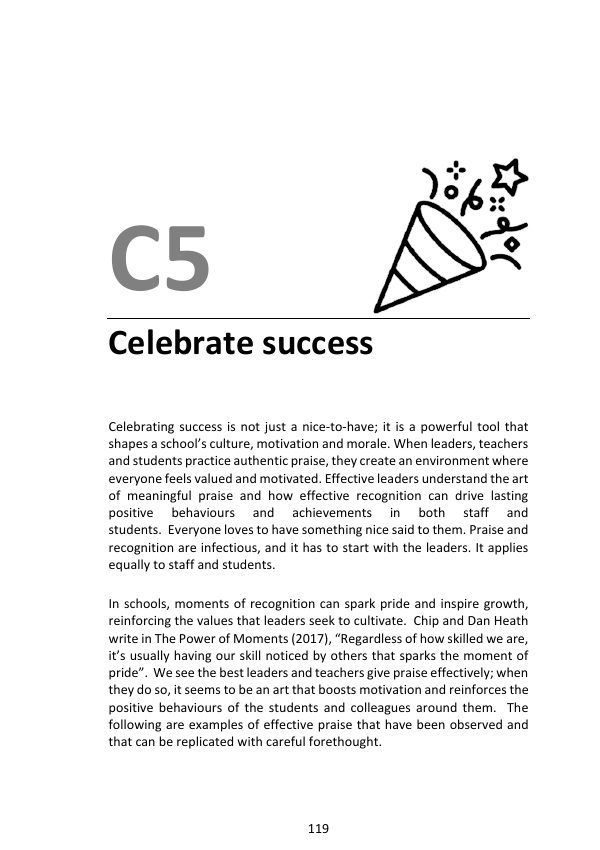
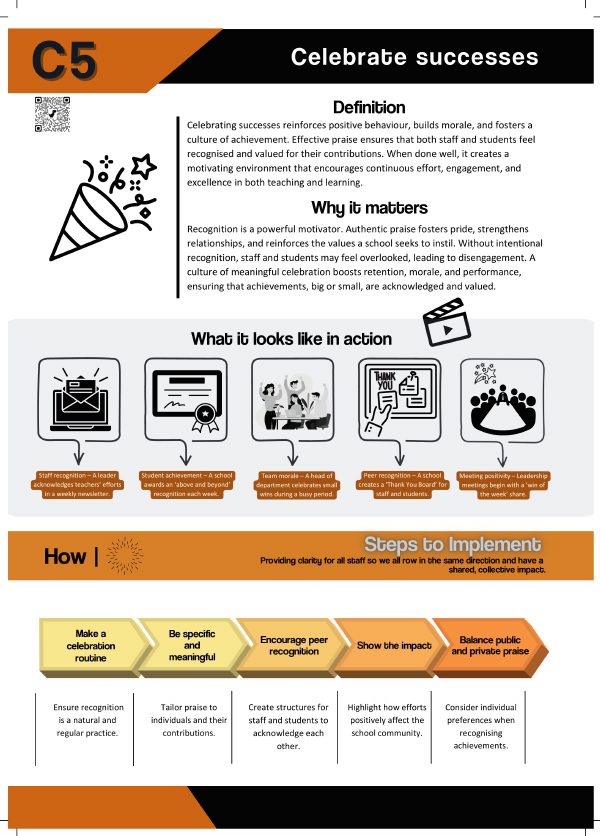

Apply · Your leadership practice
Put it to work
Use the C5 Playbook to turn the behaviour into practical action on a real leadership challenge.
- Practical toolkit and coaching prompts
- A practice script to rehearse your approach
- A 90-day plan to guide your next steps
Members only · Explore membership →
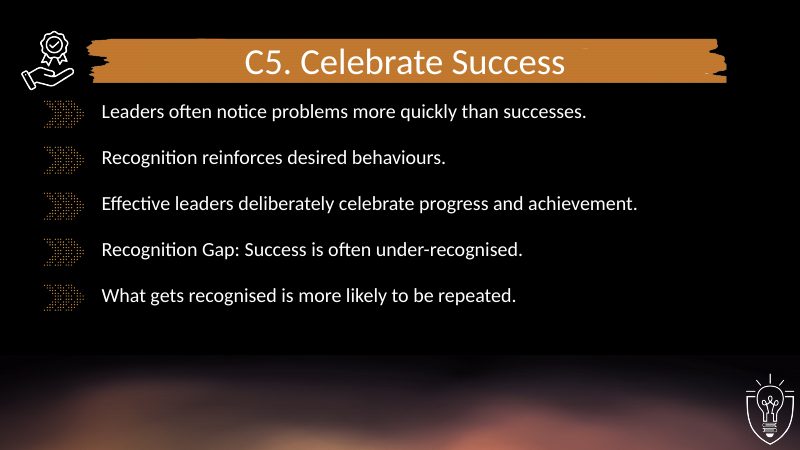
Apply · Learning with your team
Lead a team session
Use the C5 INSET PowerPoint to help colleagues explore the behaviour and plan how to put it into practice.
- Editable slides to adapt to your setting
- Speaker notes to support facilitation
- Discussion, rehearsal and planning
Members only · Explore membership →
Completed Playbooks
See C5 applied in eight leadership contexts
Choose your role to explore the challenge, the leader’s response and the intended result. Members can read the complete example and download an editable Word copy.
In a primary school
In a secondary school
Across schools
Selected completed example
In a primary school · Headteacher
Recognising everyday inclusion
Ruth · Headteacher · 350-pupil community primary school
Worked example at a glance
Recognising everyday inclusion
The challengeCelebration has favoured performances and one-off events, and recognising inclusion risks exposing a child's needs or making them feel put on show.
What the leader doesThe headteacher tells how a lunchtime supervisor and two pupils changed a game so a classmate could join in, naming the action that made it possible and sharing it only with genuine consent.
What success looks likeBy day 30 recognition should include pupils, support staff, teachers and families; by day 60 at least half of examples should describe less visible inclusion work; by day 90 pupils and staff should feel varied contributions are noticed.
Peter · Deputy Headteacher and SENCO · 420-pupil primary school
Worked example at a glance
Recognising skilled support
The challengePraise for teaching assistants focuses on patience and kindness, and rarely on the professional judgement that helps pupils work more independently.
What the leader doesThe deputy headteacher privately thanks a teaching assistant for fading prompts until a pupil could work alone, names the precise move and gives her a real choice about sharing it at a staff briefing.
What success looks likeBy day 30 every teaching assistant should receive one specific acknowledgement; by day 60 each year team should share an example of skilled support; by day 90 more pupils should begin work without adult prompting.
Zoe · Art and Design Lead and Year 5 Teacher · 330-pupil primary school
Worked example at a glance
Celebrating the creative process
The challengeDisplays favour polished outcomes and confident pupils, so many children believe only a finished piece earns attention.
What the leader doesThe art lead opens a process gallery with one pupil's sketches, a classmate's critique and six colour trials, asks the artist to explain what changed, and has pupils curate future displays against process criteria.
What success looks likeBy day 30 every class should recognise creative risk, critique and refinement; by day 60 recognition should include pupils from every class and confidence level; by day 90 more pupils should revise their work without prompting.
Claire · Headteacher · 1,020-pupil secondary school
Worked example at a glance
Crediting the work behind calmer lessons
The challengeLesson starts now lose 1.6 minutes rather than 3.8, but celebrating risks crediting one team, implying heroic overwork or ignoring the faculties where starts are still inconsistent.
What the leader doesThe headteacher uses the staff briefing to trace the contributions of teaching, support, pastoral and operational colleagues, names the barriers leaders removed and says honestly where the work is unfinished.
What success looks likeBy day 30 recognition should reach teaching, support and operational teams; by day 60 every department should contribute an evidence-based story; by day 90 staff and pupils should name the shared contributions behind the change.
Rohan · Assistant Headteacher · 1,500-pupil secondary school
Worked example at a glance
Recognition during a routine's rollout
The challengeIrregular praise has favoured already prominent colleagues, and recognition during implementation could easily feel like monitoring or a contest between faculties.
What the leader doesThe assistant headteacher thanks a colleague, and those who tested her fix for cover staff's access to seating plans, says what the small sample does and does not show, and keeps recognition separate from performance data.
What success looks likeBy day 30 specific recognition should reach every faculty with verified evidence; by day 60 peer nominations should include support staff in every faculty; by day 90 routine fidelity should be higher and recognition should feel fairer.
Talia · Student Leadership and Belonging Lead · 860-pupil secondary school
Worked example at a glance
Recognition the pupil chooses
The challengePublic recognition keeps reaching confident student leaders, while quieter service and improved attendance go unnoticed or risk being shared in ways that embarrass pupils.
What the leader doesThe belonging lead meets a peer guide privately to agree how their work is recognised and what any message home says, making clear that saying no changes nothing about their support.
What success looks likeBy day 30 every year team should recognise attendance progress, service and contribution; by day 60 recognition should include pupils who prefer privacy or were never nominated; by day 90 recognition should reflect the whole year group.
Amara · Director of Performing Arts · 1,280-pupil secondary school
Worked example at a glance
Celebrating the whole company
The challengeCelebration centres on final productions and lead performers, while designers, technicians and ensemble members rarely see their craft recognised.
What the leader doesBefore a performance, the director recognises the lighting team's rework of three scene changes in front of the company and audience, gathers evidence during rehearsals and allows private recognition for pupils who prefer it.
What success looks likeBy day 30 recognition should include performers, designers, technicians and ensemble members; by day 60 every class and production team should share a rehearsal story; by day 90 pupils should feel creative growth is valued alongside performance.
George · Trust Director of Partnerships and Professional Learning · eight-school trust
Worked example at a glance
Crediting shared practice across schools
The challengeTrust communications favour headline outcomes and large schools, so the colleagues who develop and adapt useful practice, including support staff, often go unseen.
What the leader doesThe director tells a two-school improvement story with both teams' agreement, credits the people who created and adapted the practice, seeks nominations from support and classroom teams, and offers private thanks where preferred.
What success looks likeBy day 30 all eight schools should nominate a specific improvement and its contributors; by day 60 each school should share and adapt one practice from another; by day 90 every school should appear in trust learning stories.
The complete Playbook is for members
Turn this example into action
Read the full toolkit, coaching and practice scripts, and 90-day plan. Members can view the PDF here and download an editable Word copy.
Resources for this behaviour
Templates and checklists from the resource library that put C5 into practice.
Further reading

Recommended book
The Power of Moments – Chip & Dan Heath (2017)
Explains how recognition and designed moments build culture and motivation.
References from the Everyone Succeeds book
- Bliven, A. and Jungbauer, M. (2021) 'The impact of student recognition of excellence to student outcome in a competency-based educational model', The Journal of Competency-Based Education, 6(4), pp. 195–205. View article ↗
- Heath, C. and Heath, D. (2017) The Power of Moments: Why Certain Experiences Have Extraordinary Impact. New York: Simon & Schuster. Buy on Amazon ↗
- Lepkowska, D. (2018) Tackling Teacher Retention and Turnover Challenges. Slough: NFER. Available at: https://www.nfer.ac.uk/media/ebkabwz0/tackling_teacher_retention_and_turnover_challenges_htu.pdf Read free ↗
Not sure where to start? Take the free leadership diagnostic to find your three priorities.
As an Amazon Associate, Everyone Succeeds earns from qualifying purchases.