

Culture behaviour C6
Seek Inspiration
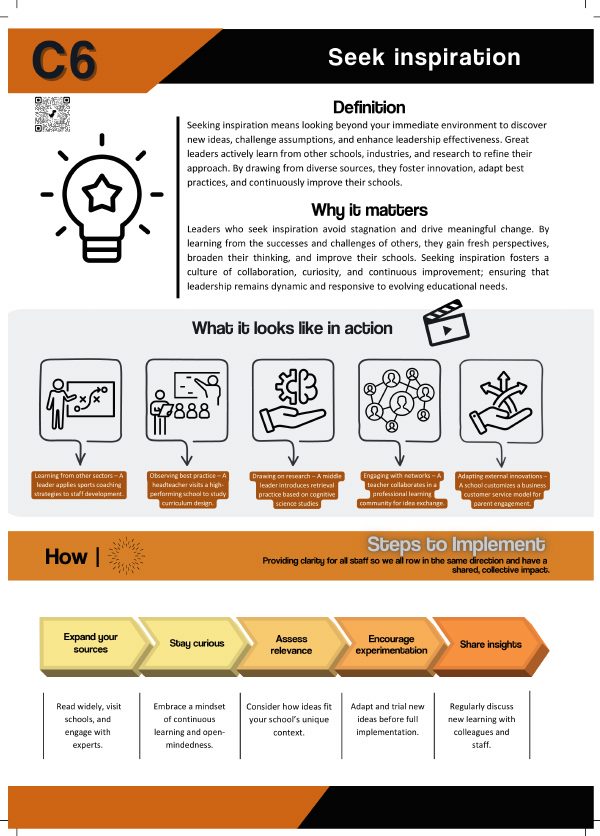
You do not have to reinvent the wheel. Look beyond your school with a clear question, learn from others and adapt rather than copy.
Jump to C6 resources ↓What this behaviour looks like
Borrow, adapt, test
A leader starts with a precise improvement question and looks to other schools, sectors or research for answers. They avoid both the 'not invented here' mindset and wholesale copying, then trial a careful adaptation and share the learning with colleagues.
A practical example
Arranging a visit to another school
Just looking“Could we come and have a look around? We have heard great things about your playtimes.”
A focused enquiry“We want playtimes to be more inclusive for pupils who find them hard. Could we watch an ordinary playtime, then ask how your adults were trained and what was hardest to staff? We would trial what we learn in one zone first and share our findings with you.”
Make playtimes more inclusive for pupils who find them hard.
A school known for good playtimes, seen on an ordinary day.
Trial what you learn in one zone before going further.
Write one improvement question, name a school or person who could help you think about it, and draft a short, respectful request that says what you would offer in return.
C6 · Resources for your setting
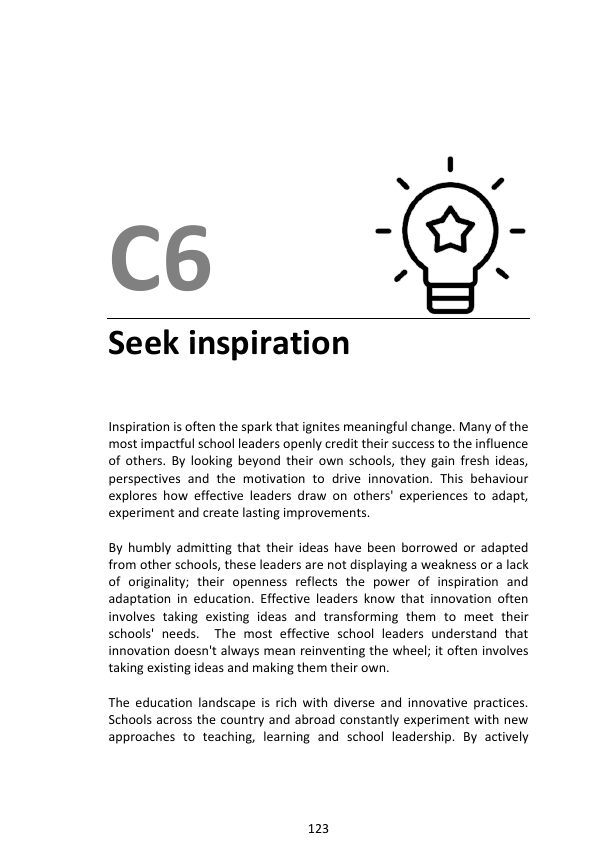
Put ‘Seek Inspiration’ into practice
Develop your own practice or lead the learning with your team. Use the chapter and workbook to explore the behaviour, then choose the resources that fit your next step.
Apply · Your leadership practice
Put it to work
Use the C6 Playbook to turn the behaviour into practical action on a real leadership challenge.
- Practical toolkit and coaching prompts
- A practice script to rehearse your approach
- A 90-day plan to guide your next steps
Members only · Explore membership →

Apply · Learning with your team
Lead a team session
Use the C6 INSET PowerPoint to help colleagues explore the behaviour and plan how to put it into practice.
- Editable slides to adapt to your setting
- Speaker notes to support facilitation
- Discussion, rehearsal and planning
Members only · Explore membership →
Completed Playbooks
See C6 applied in eight leadership contexts
Choose your role to explore the challenge, the leader’s response and the intended result. Members can read the complete example and download an editable Word copy.
In a primary school
In a secondary school
Across schools
Selected completed example
In a primary school · Headteacher
Earlier, more trusting family contact
Faisal · Headteacher · 450-pupil urban primary school
Worked example at a glance
Earlier, more trusting family contact
The challengeFirst contact about absence often comes after a pattern has hardened and can sound procedural, and the school must learn from others without importing a model just because a headline figure rose.
What the leader doesThe headteacher asks a comparable school's headteacher for thirty minutes on its first two weeks of family contact, sends questions in advance with no identifiable family information, then tests the principles with twenty families.
What success looks likeBy day 30 the conversation should be held and its principles and cautions recorded; by day 60 a revised contact approach should be piloted with twenty families; by day 90 fewer pupils should newly cross into persistent absence.
Fiona · Assistant Headteacher · 600-pupil primary school
Worked example at a glance
More inclusive playtimes
The challengeThe question is whether playtimes give pupils with sensory and social needs a real choice, and a visit could become a tour of attractive zones while the pupils most affected go unheard.
What the leader doesThe assistant headteacher asks to watch an ordinary playtime rather than a showcase, explores staffing and unintended consequences afterwards, then designs a two-zone pilot with the SENCO, midday lead and pupil representatives.
What success looks likeBy day 30 an ordinary playtime should be observed and its conditions recorded; by day 60 two zones should pilot the adapted model; by day 90 the pupils it was designed for should report more choice and belonging, with fewer distressed incidents.
Sam · English and Oracy Lead · 240-pupil junior school
Worked example at a glance
Oracy across the curriculum
The challengeYears 5 and 6 need to use subject vocabulary to explain their thinking beyond English, without adding workload or activities that favour already-confident speakers.
What the leader doesThe oracy lead asks a recommended nearby school for forty minutes around one planned sequence, focusing on two teacher moves and how quieter pupils take part, then tests those moves in English and science.
What success looks likeBy day 30 the exchange should be complete and one sequence examined; by day 60 Years 5 and 6 should pilot two teacher moves; by day 90 pupils, including the quietest, should use vocabulary more precisely and reason at greater length.
Joanne · Headteacher · 980-pupil secondary school
Worked example at a glance
A trusted coaching model
The challengeStaff development needs to be trusted rather than another accountability route, and copying a mature school's visible structures could miss the years of trust-building and protected time beneath them.
What the leader doesThe headteacher asks a comparable school for the sequence of decisions behind its coaching, including what was kept from appraisal and what was stopped to free time, then pilots protected cycles in two departments.
What success looks likeBy day 30 the exchange should have happened and the decisions behind the model written up; by day 60 two departments should pilot protected cycles; by day 90 every cycle should be followed up and staff should trust the boundary with appraisal.
Kwame · Deputy Headteacher · 1,420-pupil secondary school
Worked example at a glance
Reducing internal truancy
The challengeThe aim is to keep pupils connected to learning rather than simply locating them, and lower internal truancy figures could hide tighter surveillance or absence moving off site.
What the leader doesThe deputy headteacher arranges a sixty-minute visit to see an invented case run through a similar school's systems and its return-to-learning conversation, then tests an adapted sequence in one year group.
What success looks likeBy day 30 the visit should be complete and the enabling conditions recorded; by day 60 one year group should pilot the adapted sequence; by day 90 internal truancy there should fall by a third, without off-site absence rising.
Connor · Attendance and Reintegration Lead · 950-pupil secondary school
Worked example at a glance
Reintegration after persistent absence
The challengeYear 9 pupils need to return after persistent absence and then stay, with real belonging and learning rather than a brief rise in presence, and no pupil's history should be shared to learn from others.
What the leader doesThe reintegration lead works through an invented Year 9 case with a regional network lead, the SENCO and the Year 9 pastoral leader, capturing first-contact language and decision points, then co-produces plans with five returning pupils.
What success looks likeBy day 30 the conversation should be held and its decision points recorded; by day 60 five Year 9 pupils should begin co-produced plans; by day 90 at least four should sustain better attendance and feel more connected to learning.
Emily · Head of English · 1,080-pupil secondary school
Worked example at a glance
Analytical writing without narrowing literature
The challengeKey Stage 3 analytical writing needs strengthening, but a repeatable paragraph formula could lift structure while narrowing reading, discussion and independent interpretation.
What the leader doesThe head of English asks a strong department for forty minutes with two Year 8 teachers around one unit and two pieces of pupil work, then adapts the principle to a different Year 8 text.
What success looks likeBy day 30 one sequence and two pieces of Year 8 work should be compared with the source department; by day 60 the department should pilot an adapted sequence; by day 90 unfamiliar-text responses should be stronger, with no fall in reading breadth.
Meera · Trust Director of Education and SEND · ten-school trust
Worked example at a glance
Learning from a reciprocal SEND review
The challengeThe trust needs to assure a dependable SEND entitlement in every school without suppressing local innovation that works, and peer review could easily become high-stakes assurance that discourages honest evidence.
What the leader doesThe director arranges a 45-minute exchange with a trust that runs reciprocal SEND review, working through one anonymised review to follow-up, then pilots reciprocal review in one primary and one secondary school.
What success looks likeBy day 30 the exchange should have happened and one anonymised review been worked through; by day 60 two schools should pilot an adapted review; by day 90 each review should produce shared actions and consistent reviewer judgements.
The complete Playbook is for members
Turn this example into action
Read the full toolkit, coaching and practice scripts, and 90-day plan. Members can view the PDF here and download an editable Word copy.
Further reading

Recommended book
Leading in a Culture of Change – Michael Fullan (2001)
This book enriches your practice by showing how leaders draw insight from diverse sources and use that inspiration to drive purposeful change.
References from the Everyone Succeeds book
- Barber, M. (2021) Accomplishment: How to Achieve Ambitious and Challenging Things. London: Allen Lane. Buy on Amazon ↗
- Fullan, M. (2001) Leading in a Culture of Change. San Francisco, CA: Jossey-Bass. Buy on Amazon ↗
- Katz, R. and Allen, T.J. (1982) 'Investigating the Not Invented Here (NIH) syndrome: A look at the performance, tenure, and communication patterns of 50 R & D project groups', R&D Management, 12(1), pp. 7–20. Read free ↗
Not sure where to start? Take the free leadership diagnostic to find your three priorities.
As an Amazon Associate, Everyone Succeeds earns from qualifying purchases.