

Culture behaviour C7
Engage Parents
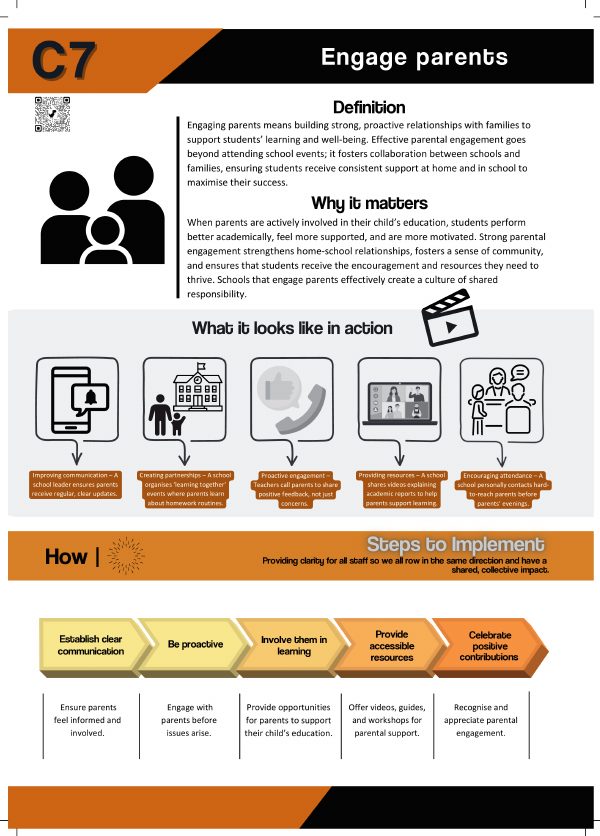
Engagement goes beyond parents' evening. Partner with families to support learning at home, listen as well as inform and call with good news too.
Jump to C7 resources ↓What this behaviour looks like
Partnership, not broadcast
A leader treats families as partners in their child's learning, not an audience for updates. Messages are clear and accessible, hard-to-reach families are contacted personally, parents are shown practical ways to help at home and good news is shared, not only problems.
A practical example
Inviting a family to parents' evening
Reminder sent“The families who have not booked have already had the app reminder. We have done our bit.”
A personal invitation“I am calling because I would really like to see you at parents' evening. Your son has been working hard on his reading and I would love to show you what he has been doing. What would you most like us to discuss? A telephone appointment or another time is fine too.”
Share the child's reading progress with the family in person.
Offer a telephone appointment or a time that suits them.
Ask what the family would most like to discuss.
Choose a family who has not responded to a general message. Tell them why you want to talk, offer a route that suits them and ask what they would most like to discuss.
C7 · Resources for your setting
Put ‘Engage Parents’ into practice
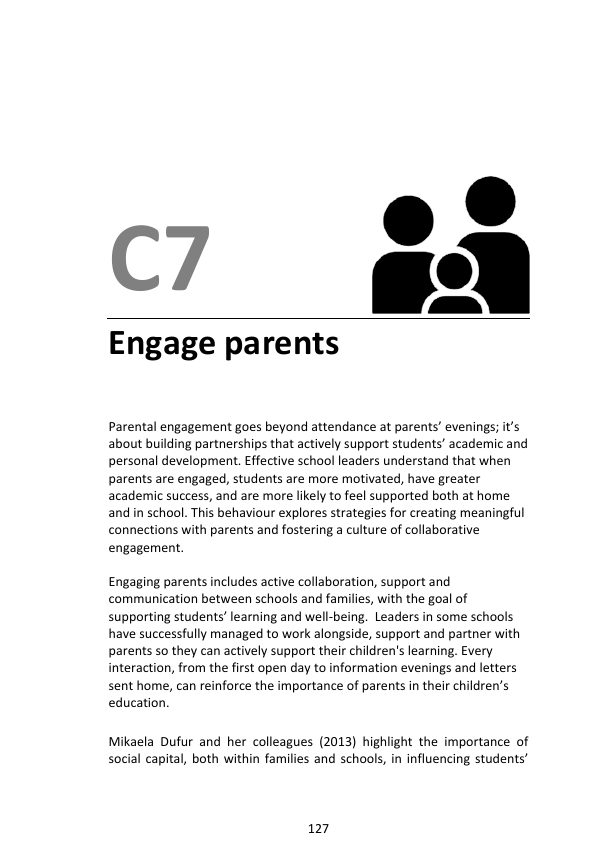
Develop your own practice or lead the learning with your team. Use the chapter and workbook to explore the behaviour, then choose the resources that fit your next step.
Apply · Your leadership practice
Put it to work
Use the C7 Playbook to turn the behaviour into practical action on a real leadership challenge.
- Practical toolkit and coaching prompts
- A practice script to rehearse your approach
- A 90-day plan to guide your next steps
Members only · Explore membership →
Apply · Learning with your team
Lead a team session
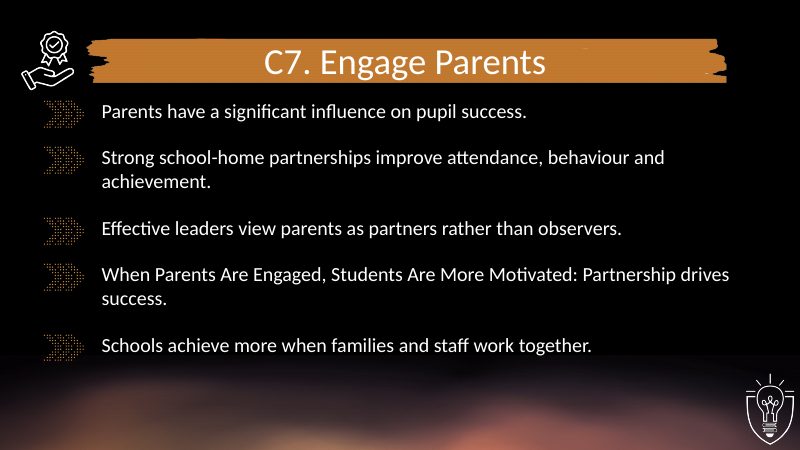
Use the C7 INSET PowerPoint to help colleagues explore the behaviour and plan how to put it into practice.
- Editable slides to adapt to your setting
- Speaker notes to support facilitation
- Discussion, rehearsal and planning
Members only · Explore membership →
Completed Playbooks
See C7 applied in eight leadership contexts
Choose your role to explore the challenge, the leader’s response and the intended result. Members can read the complete example and download an editable Word copy.
In a primary school
In a secondary school
Across schools
Selected completed example
In a primary school · Headteacher
Early attendance conversations
Elena · Headteacher · 196-pupil village primary school
Worked example at a glance
Early attendance conversations
The challengeOnly 38% of invited families come to an attendance meeting, and repeat absence has been handled mainly by letter, which families can hear as a warning rather than help.
What the leader doesThe headteacher calls families before another letter is sent, opens with the attendance facts, asks what mornings look like and agrees actions the school will complete, with replies welcome by text, telephone or paper.
What success looks likeBy day 30 at least 70% of invited families should take part in an early conversation; by day 60 almost every promised school action should be completed; by day 90 persistent absence should fall by four percentage points.
Nadine · Deputy Headteacher · 196-pupil village primary school
Worked example at a glance
Families as partners in SEND reviews
The challengeOnly 46% of families understand the SEND review process, and many receive the papers too late to contribute before professionals present a plan.
What the leader doesThe deputy headteacher sends a plain-language review map and papers seven working days ahead, invites families' priorities in any format, offers interpreters or advocates and sends the draft record back for correction.
What success looks likeBy day 30 all papers should reach families seven working days ahead; by day 60 at least 85% of families should contribute a priority beforehand; by day 90 family understanding of the process should rise above 85%.
Keira · Early Reading and Phonics Lead · 196-pupil village primary school
Worked example at a glance
Calm reading support at home
The challengeOnly 29% of families come to the phonics workshop, attendance is lowest where children need practice most, and home reading can easily turn into anxiety.
What the leader doesThe phonics lead offers demonstration, audio, translated guidance or shared-story talk, with no penalty for choosing no extra practice, and agrees a calm five-minute routine with families who have not used the workshop.
What success looks likeBy day 30 participation across all formats should reach 60%; by day 60 it should reach 75%, with target families more confident; by day 90 home-reading confidence should improve without raising children's anxiety.
Victoria · Headteacher · 880-pupil secondary school
Worked example at a glance
Rebuilding trust after a policy launch
The challengeComplaints rose from 18 to 47 in a term after a behaviour-policy launch went badly, and fewer than half of surveyed parents can explain what the policy is for.
What the leader doesThe headteacher admits plainly what went wrong, holds the safety boundaries, offers private case reviews to the most affected families and publishes, within ten working days, what has changed and why the rest stands.
What success looks likeBy day 30 every complaint theme should have an owner and a public response within ten working days; by day 60 at least 80% of families should be able to explain the policy's purpose; by day 90 complaints should fall back towards pre-launch levels.
Darius · Deputy Headteacher · 880-pupil secondary school
Worked example at a glance
Study routines families can manage
The challengeOnly 22% of families reply to study messages, and disadvantaged pupils miss twice as many independent-study deadlines as their peers.
What the leader doesThe deputy headteacher asks families about the real barriers to study at home, gives each theme one named owner across academic and pastoral teams, and changes the deadlines, access and communication the school controls.
What success looks likeBy day 30 family response through the new routes should reach 60%; by day 60 deadline collisions should fall and use of supervised study rise; by day 90 the missed-deadline gap should narrow by a third.
Chantal · Family Engagement and Transition Lead · 880-pupil secondary school
Worked example at a glance
Transition knowledge that gets used
The challengeForty-one families have not shared transition information, and anxiety-related contacts peak once pupils have already started Year 7.
What the leader doesThe transition lead asks every family for one strength, one worry and one practical detail through a route that suits them, personally contacts those missing and makes sure the information reaches the staff who need it.
What success looks likeBy day 30 at least 90% of families should contribute transition information; by day 60 every priority pupil should have a named contact and a tested action; by day 90 avoidable first-half-term concerns should fall by 30%.
Lucia · Head of Modern Foreign Languages · 880-pupil secondary school
Worked example at a glance
Informed choices about languages
The challengeOnly 34% of families attend the options evening, and the questions that do arrive repeat the same misconceptions about who languages are for.
What the leader doesThe head of languages shares a pupil-led explanation of language learning, takes anonymous questions through several routes, offers private advice where concerns are complex and tests one change families suggest.
What success looks likeBy day 30 at least 75% of families should attend or watch the recording; by day 60 one family-informed change should be tested; by day 90 option choices should reflect informed preference, with access gaps narrowing.
Alison · Trust Director of Community and Family Partnership · seven-school trust
Worked example at a glance
Family voice that shapes decisions
The challengeSeven schools run six unrelated surveys, response rates range from 12% to 64%, and nobody can tell whose voice is missing or what families actually changed.
What the leader doesThe director agrees shared principles rather than one method: consult while decisions are still open, reach the least-heard families through trusted routes and publish what changed within ten working days.
What success looks likeBy day 30 every school should publish one open question with accessible routes; by day 60 every school should close the loop on two priorities; by day 90 families should report clearer influence, with no school below 35% reach.
The complete Playbook is for members
Turn this example into action
Read the full toolkit, coaching and practice scripts, and 90-day plan. Members can view the PDF here and download an editable Word copy.
Resources for this behaviour
Templates and checklists from the resource library that put C7 into practice.
Further reading
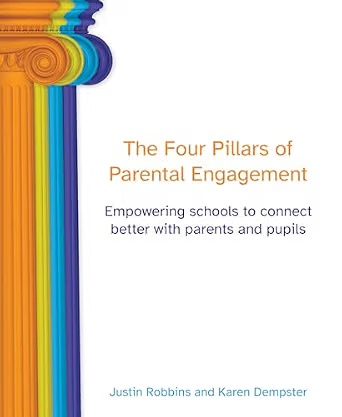
Recommended book
The Four Pillars of Parental Engagement. Robbins, J. and Dempster, K., (2021)
This book strengthens the behaviour by demonstrating how meaningful partnership with parents supports student outcomes and strengthens trust.
References from the Everyone Succeeds book
- Dufur, M.J., Parcel, T.L. and Troutman, K.P. (2013) 'Does capital at home matter more than capital at school? Social capital effects on academic achievement', Research in Social Stratification and Mobility, 31, pp. 1–21. View article ↗
- Education Endowment Foundation (2021) Parental engagement. Teaching and Learning Toolkit. Available at: https://educationendowmentfoundation.org.uk/education-evidence/teaching-learning-toolkit/parental-engagement Read free ↗
- Hattie, J. (2008) Visible Learning: A Synthesis of Over 800 Meta-Analyses Relating to Achievement. London: Routledge. Buy on Amazon ↗
- Robbins, J. and Dempster, K. (2021) The Four Pillars of Parental Engagement: Empowering Schools to Connect Better with Parents and Pupils. Carmarthen: Crown House Publishing. Buy on Amazon ↗
Not sure where to start? Take the free leadership diagnostic to find your three priorities.
As an Amazon Associate, Everyone Succeeds earns from qualifying purchases.