

Strategy behaviour S4
Uphold Values
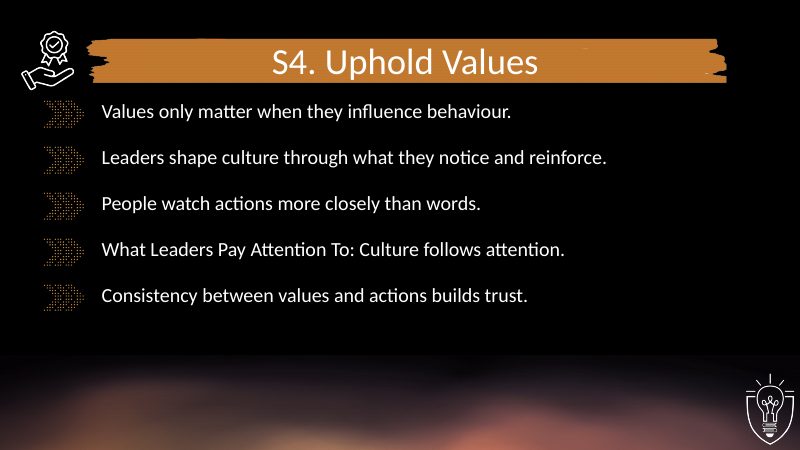
Values on a wall change nothing. Make them the test for every decision, the behaviour you model and what you celebrate or challenge.
Jump to S4 resources ↓What this behaviour looks like
Lived, not just stated
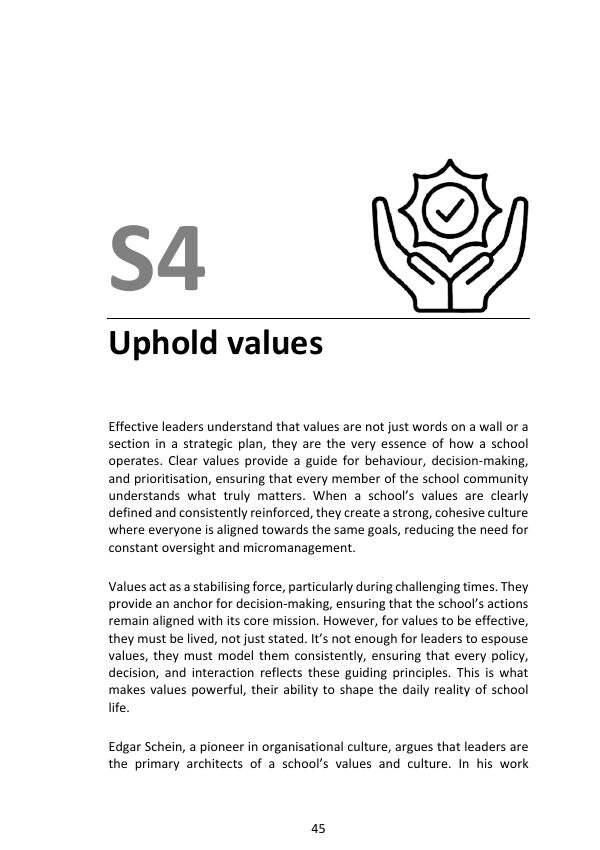
A leader defines what each core value looks like in daily practice and uses it to make and explain decisions. Staff, pupils and families see values modelled and celebrated, and behaviour that contradicts them is addressed swiftly and fairly.
A practical example
Opening the weekly staff briefing
Values on the wall“Remember, our values are respect, curiosity and kindness. Now, on to this week's notices.”
Values in action“This week a colleague showed respect by moving a difficult conversation away from a busy corridor and listening before correcting. That is our value in practice. Before we agree the new lunchtime rota, let's check it treats every child with the same respect.”
Respect means private conversations and listening before correcting.
Test the new lunchtime rota against equal respect for every child.
Recognise a colleague's respectful corridor conversation at briefing.
Choose one value. Write one behaviour that shows it, test a decision you face this week against it, and thank one colleague specifically for living it.
S4 · Resources for your setting
Put ‘Uphold Values’ into practice
Develop your own practice or lead the learning with your team. Use the chapter and workbook to explore the behaviour, then choose the resources that fit your next step.
Apply · Your leadership practice
Put it to work
Use the S4 Playbook to turn the behaviour into practical action on a real leadership challenge.
- Practical toolkit and coaching prompts
- A practice script to rehearse your approach
- A 90-day plan to guide your next steps
Members only · Explore membership →
Apply · Learning with your team
Lead a team session
Use the S4 INSET PowerPoint to help colleagues explore the behaviour and plan how to put it into practice.
- Editable slides to adapt to your setting
- Speaker notes to support facilitation
- Discussion, rehearsal and planning
Members only · Explore membership →
ES CoachApply · Online, with ES Coach
Complete the S4 Playbook online
Work through the Playbook on your desk instead of on paper. A built-in coach supports you with every question: jot a few words and ES Coach suggests an answer for you to edit.
- ES Coach help under every question and table
- Saves as you type, and stays private to you
- Linked to your goal and your 90-day plan
Also in the online Playbook, with PDF and Word copies: a worked example for school business managers and central trust teams, following a trust people director.
Members only · Explore membership → · Sign in
Worked examples
See S4 applied in eight leadership contexts
Choose your role to explore the challenge, the leader’s response and the intended result. Members can read the complete example and download an editable Word copy.
In a primary school
In a secondary school
Across schools
Selected worked example
In a primary school · Headteacher
A lunchtime space for belonging
Salma · Headteacher · 545-pupil growing primary school
Worked example at a glance
A lunchtime space for belonging
The challengeThe school celebrates belonging, yet 17 pupils, including nine with SEND, say lunchtime gives them no workable place, and a separate quiet area could create a new label.
What the leader doesThe headteacher has the 17 pupils co-design a mixed courtyard trial open to all, rehearses a dignified invitation with midday staff and privately corrects language that framed the space as only for children who cannot cope.
What success looks likeBy day 30 the 17 pupils should co-design the trial and every midday adult rehearse the invitation; by day 60 isolation incidents should fall by 40%; by day 90 at least 85% of pupils should name a workable lunchtime choice.
Sana · Deputy Headteacher for appraisal and professional growth · 545-pupil growing primary school
Worked example at a glance
Appraisal that supports growth
The challengeLeaders assigned 68% of objectives, 74% focused only on pupil outcomes and support staff had less access to development, so appraisal signals accountability more than growth.
What the leader doesThe deputy headteacher asks managers to co-design one practice goal each colleague can influence, attach time, coaching and evidence to it, and keep any capability concern on its separate, transparent route.
What success looks likeBy day 30 every draft objective should name the practice, evidence, support and review; by day 60 at least 90% of promised coaching should have begun; by day 90 staff confidence in meaningful development should rise across every role.
Mei · Curriculum Lead and Year 5 teacher · 545-pupil growing primary school
Worked example at a glance
Protecting time for curiosity
The challengeSince curriculum coverage was tightened, pupil questions have fallen from 3.1 to 1.2 per lesson, with the steepest fall among pupils using additional communication support.
What the leader doesThe curriculum lead trials enquiry within two units, removes one recording demand, recognises a colleague who let a pupil's gesture reshape the explanation and challenges planning that cut a question exposing a misconception.
What success looks likeBy day 30 two trial units should meet the enquiry test; by day 60 question quality and participation should double without weaker recall; by day 90 a sustainable enquiry model should be embedded across foundation subjects.
Hannah · Headteacher · ages 11 to 18 secondary school, 1,390 pupils
Worked example at a glance
A late route that protects dignity
The challengeGovernors are asked to approve a public late line and sanction board that may signal firmness but risks humiliation, disclosure of personal circumstances and unequal impact.
What the leader doesThe headteacher sets three options against deterrence, due process, equality and safeguarding, proposes supervised rapid entry with private same-day follow-up, and corrects a senior colleague who read pupils' names aloud.
What success looks likeBy day 30 every duty and tutor adult should rehearse the dignified late route; by day 60 punctuality should improve with no public exposure incidents; by day 90 families and pupils should report a clear, fair route across groups.
Priyanka · Deputy Headteacher for staffing and curriculum · ages 11 to 18 secondary school, 1,390 pupils
Worked example at a glance
Sharing difficult classes fairly
The challengeChallenging classes and lost non-contact time fall mostly on early-career teachers and three departments, and the timetable only looks balanced when cumulative load is ignored.
What the leader doesThe deputy headteacher allocates six classes and 42 cover periods using a cumulative-load check, allowing exceptions only with a stated pupil need, consultation, compensating support and an end date.
What success looks likeBy day 30 every draft allocation should include a cumulative-load check; by day 60 all lost non-contact time should be restored and support begun; by day 90 pupil continuity should improve with no group carrying unjustified load.
Amal · Attendance Improvement Lead · ages 11 to 18 secondary school, 1,390 pupils
Worked example at a glance
Reciprocal attendance contact
The challengeAmong contacted families, 37% say the first absence letter neither asked about barriers nor named school support, so softer wording alone would not fix a one-sided process.
What the leader doesThe attendance lead replaces the compliance letter with an invitation to plan together, keeps statutory information clear, records one school and one family action and tracks school promises as closely as family ones.
What success looks likeBy day 30 the team should rehearse the new route and close overdue school actions; by day 60 at least 90% of school actions should be completed; by day 90 attendance and family confidence should improve without widening inequity.
Kate · Head of Drama · ages 11 to 18 secondary school, 1,390 pupils
Worked example at a glance
Assessing creative courage
The challengeYear 10 assessment rewards polished final performance while experiment, revision and production roles earn little credit, and a careless new criterion could reward novelty or unsafe disclosure.
What the leader doesThe head of Drama defines observable evidence of one experiment, a feedback response and a justified revision, double-marks samples across roles and uses one pupil's before-and-after lighting revision as a shared example.
What success looks likeBy day 30 the team should agree the four-part criterion in moderation; by day 60 every pupil in two trial groups should complete one experiment and revision cycle; by day 90 creative risk and final quality should improve, with 85% marker agreement.
Nadia · Trust Director of Improvement · twelve-school trust
Worked example at a glance
Local agency in reading recovery
The challengeEight routine decisions need central approval although only three carry real trust-wide risk, and headteachers must now choose between one central reading timetable and local models.
What the leader doesThe director treats local agency as a decision rule: four common standards protect pupil entitlement, schools choose their own model, and any new central approval must state its risk, evidence and expiry date.
What success looks likeBy day 30 every central approval should have an evidenced risk, owner and review date; by day 60 all schools should run a local model meeting the four standards; by day 90 progress should be secure and approvals fall from eight to three.
The complete Playbook is for members
Turn this example into action
Read the full toolkit, coaching and practice scripts, and 90-day plan. Members can view the PDF here and download an editable Word copy.
Resources for this behaviour
Templates and checklists from the resource library that put S4 into practice.
Further reading

Recommended book
The Advantage – Patrick Lencioni (2012)
This text supports the behaviour by demonstrating how values shape healthy organisational culture, helping you use them as a filter for decisions and expectations.
References from the Everyone Succeeds book
- Lencioni, P.M. (2012) The Advantage: Why Organizational Health Trumps Everything Else in Business. San Francisco, CA: Jossey-Bass. Buy on Amazon ↗
- Coyle, D. (2018) The Culture Code: The Secrets of Highly Successful Groups. New York: Bantam. Buy on Amazon ↗
- Hargreaves, A. and Fullan, M. (2012) Professional Capital: Transforming Teaching in Every School. New York: Teachers College Press. Buy on Amazon ↗
- Robinson, V.M.J. (2011) Student-Centered Leadership. San Francisco: Jossey-Bass. Buy on Amazon ↗
- Schein, E.H. with Schein, P. (2016) Organizational Culture and Leadership. 5th edn. Hoboken, NJ: Wiley. Buy on Amazon ↗
Not sure where to start? Take the free self-diagnostic to choose one to three behaviours to focus on.
As an Amazon Associate, Everyone Succeeds earns from qualifying purchases.