

Strategy behaviour S5
Establish Collective Goals
Unite everyone, from the headteacher to the lunchtime supervisor, around one or two measurable goals, so every role sees how it helps pupils.
Jump to S5 resources ↓What this behaviour looks like
One Wildly Important Goal
A leader narrows many ambitions to one or two measurable goals, shaped with colleagues and explained clearly. Teachers, assistants, office and lunchtime staff can each name their part, and when progress stalls, people help rather than protect their own patch.
A practical example
Setting an early reading priority
A vague ambition“This year we want to improve reading across the school.”
A collective goal“By July, we aim to increase the proportion of Year 1 pupils reading the agreed passage accurately and fluently from 65% to 85%. Teachers lead daily practice, assistants provide targeted support and the office coordinates family sessions. We will review progress monthly.”
Raise Year 1 fluent reading from 65% to 85% by July.
Teachers lead practice, assistants support, the office runs family sessions.
Review Year 1 reading progress together every month.
Write one goal as from X to Y by when, name what each group will contribute, and set a date for your first shared review.
S5 · Resources for your setting
Put ‘Establish Collective Goals’ into practice
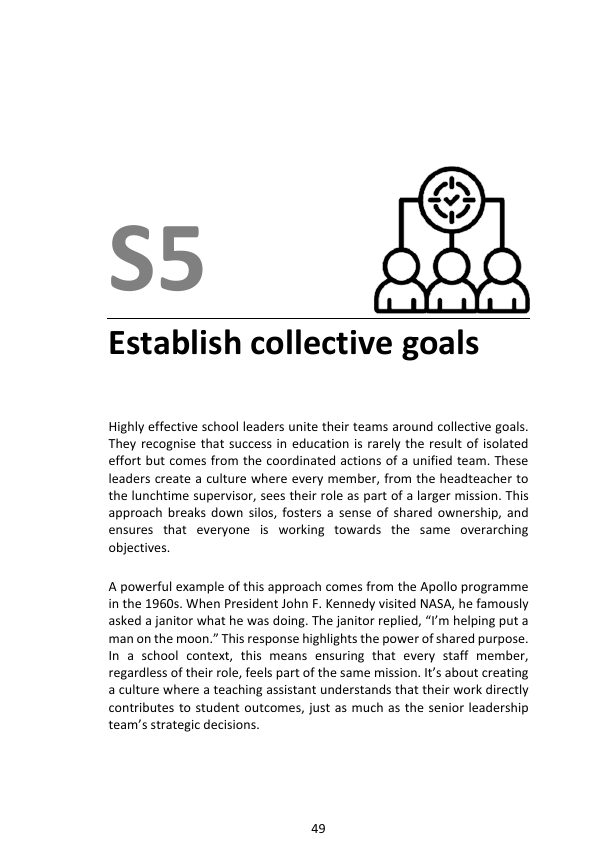
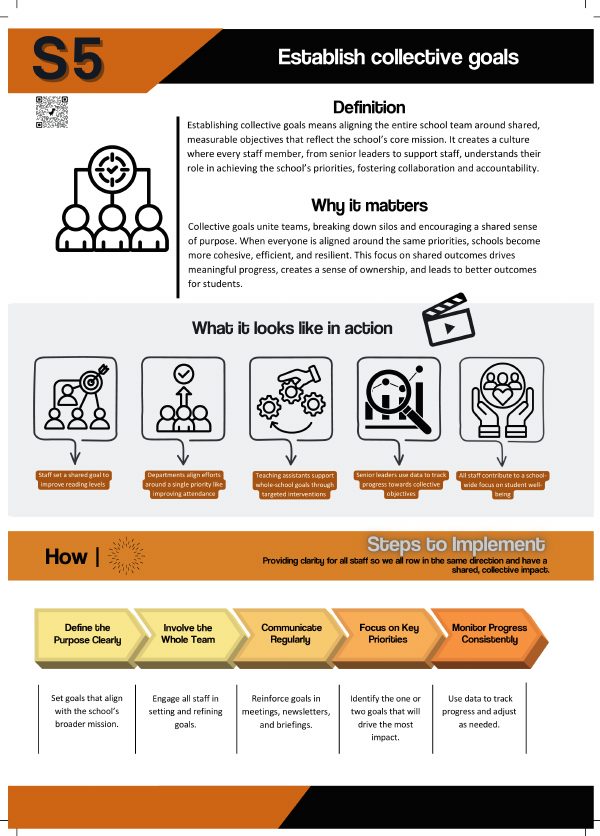
Develop your own practice or lead the learning with your team. Use the chapter and workbook to explore the behaviour, then choose the resources that fit your next step.
Apply · Your leadership practice
Put it to work
Use the S5 Playbook to turn the behaviour into practical action on a real leadership challenge.
- Practical toolkit and coaching prompts
- A practice script to rehearse your approach
- A 90-day plan to guide your next steps
Members only · Explore membership →
Apply · Learning with your team
Lead a team session
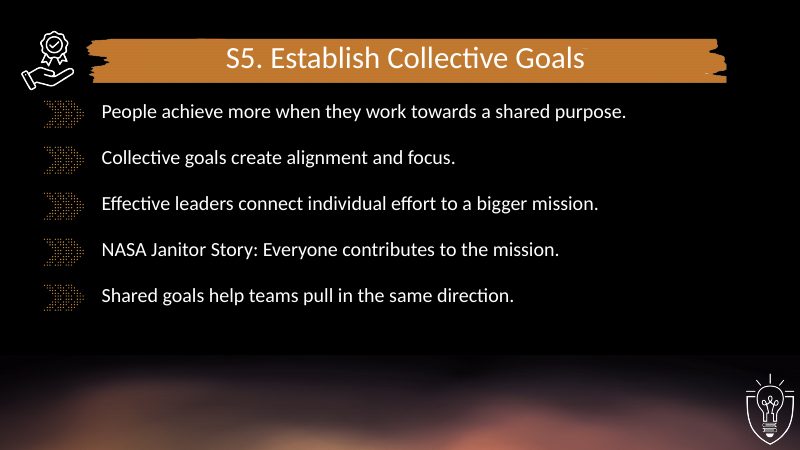
Use the S5 INSET PowerPoint to help colleagues explore the behaviour and plan how to put it into practice.
- Editable slides to adapt to your setting
- Speaker notes to support facilitation
- Discussion, rehearsal and planning
Members only · Explore membership →
Completed Playbooks
See S5 applied in eight leadership contexts
Choose your role to explore the challenge, the leader’s response and the intended result. Members can read the complete example and download an editable Word copy.
In a primary school
In a secondary school
Across schools
Selected completed example
In a primary school · Headteacher
Phonics for mid-year arrivals
Tim · Headteacher · 300-pupil primary school with high pupil mobility
Worked example at a glance
Phonics for mid-year arrivals
The challengeLast year only 12 of 31 mid-year arrivals in Reception to Year 2 were taught from their phonic starting point within five days, and just nine reached their class code point within a term.
What the leader doesThe headteacher fixes the five-day standard and the equity check, lets teams design the rest and asks office, phonics and class staff each to own one step, with a Friday review of every arrival.
What success looks likeBy day 30 three assessors should be trained and every arrival have a recorded code point; by day 60 at least 75% should be taught at their code point within five days; by day 90 this should reach 90%.
Miles · Assistant Headteacher for strategy and evaluation · 300-pupil primary school with high pupil mobility
Worked example at a glance
A school-wide writing goal
The challengeOnly 52% of pupils sustain and revise writing independently, the disadvantage gap is too wide and phase leaders disagree about whether a common frame helps or hinders independence.
What the leader doesThe assistant headteacher fixes the 75% outcome and equity threshold, asks phase teams to test proposals against pupil work, then records the decision, the rejected alternatives and the resources needed.
What success looks likeBy day 30 every phase should agree the principle, baseline and first adaptation; by day 60 independent success should exceed 65% in every phase; by day 90 it should reach 75%, with the disadvantage gap below eight points.
Ewan · Science Lead and Year 4 teacher · 300-pupil primary school with high pupil mobility
Worked example at a glance
Evidence-based science conclusions
The challengeOnly 39% of Years 3 and 4 pupils write evidence-based conclusions independently. Many record what happened and rely on adult prompts to explain why.
What the leader doesThe Science lead fixes a goal of 70%, with every class above 60%, lets colleagues refine prompts using pupil examples and runs a ten-minute weekly check of reasoning rather than presentation.
What success looks likeBy day 30 every class should teach the agreed reasoning sequence and complete baseline moderation; by day 60 at least 60% of sampled pupils in every class should succeed independently; by day 90 at least 70% should succeed overall.
Lee · Headteacher · ages 11 to 16 secondary school, 1,020 pupils
Worked example at a glance
Calm, purposeful lesson starts
The challengeOnly 68% of sampled lessons start calmly and purposefully within four minutes, costing learning time and creating unequal experiences for pupils who find transitions hard.
What the leader doesThe headteacher fixes a common minimum for entry, readiness and the first task, leaves subject-specific openings to faculties and asks pastoral, SEND and site teams to remove corridor and timetable barriers.
What success looks likeBy day 30 every faculty should agree and rehearse its version of the start; by day 60 every faculty should reach at least 80%; by day 90 the school should reach 90%, with every faculty at 85% and no belonging gap.
Dan · Assistant Headteacher for behaviour and inclusion · ages 11 to 16 secondary school, 1,020 pupils
Worked example at a glance
Reintegration that prevents repeats
The challengeReintegration records often capture pupil compliance while adult academic and SEND actions stay incomplete, so the conditions behind repeat suspensions remain.
What the leader doesThe assistant headteacher tests a reintegration standard against anonymised cases with staff, pupils and families, then reviews each return at 48 hours, two weeks and six weeks, escalating any missed adult action.
What success looks likeBy day 30 the standard should be calibrated and every repeat case have a complete plan; by day 60 at least 90% of reintegrations should meet the standard; by day 90 repeat suspensions should be on track to fall by 30%.
Scott · Year 11 Progress Lead · ages 11 to 16 secondary school, 1,020 pupils
Worked example at a glance
A shared Year 11 attendance goal
The challengeYear 11 attendance is 88.9% with a 6.8-point disadvantaged gap, and unmanageable catch-up demands could undermine the pupils who do return.
What the leader doesThe progress lead gives each priority pupil one contact and a shared plan, asks subject staff to name only essential missed learning and reviews a ten-pupil cohort weekly for completed school actions.
What success looks likeBy day 30 every priority pupil should have one contact and a shared plan; by day 60 school actions should be on time in nine of ten cases; by day 90 Year 11 should be on track for 93%, with the gap below four points.
Hugo · Head of English · ages 11 to 16 secondary school, 1,020 pupils
Worked example at a glance
Independent analytical paragraphs
The challengeOnly 48% of Key Stage 3 pupils write well-evidenced analytical paragraphs independently, and colleagues disagree whether one mandatory frame builds consistency or dependence.
What the leader doesThe head of English fixes the 72% goal and improvement in every class, leaves texts and models open, and uses fortnightly blind moderation of unpolished work to decide when scaffolds should fade.
What success looks likeBy day 30 the standard should be calibrated, with a baseline for every class; by day 60 every class should improve by at least ten points; by day 90 independent success should reach 72%, with every group up fifteen points.
Ian · Trust Director of Education · nine-school mixed-phase trust
Worked example at a glance
One reading goal for nine schools
The challengeOnly five of nine schools meet the reading-entitlement standard and 54% of priority readers make expected progress, while context and capacity differ widely between schools.
What the leader doesThe director fixes the outcome and four entitlement standards, lets each headteacher choose a local model and reviews a monthly school-level scorecard so the trust average cannot hide a weaker school or group.
What success looks likeBy day 30 all nine schools should have a named owner, chosen model and baseline; by day 60 the four below standard should show secure dosage; by day 90 all should be on track, with priority-reader progress rising towards 75%.
The complete Playbook is for members
Turn this example into action
Read the full toolkit, coaching and practice scripts, and 90-day plan. Members can view the PDF here and download an editable Word copy.
Further reading
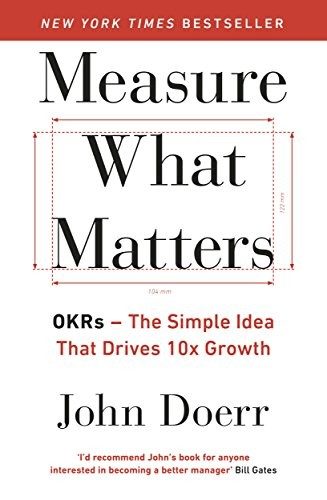
Recommended book
Measure What Matters – John Doerr (2018)
This book helps you put the behaviour into action by showing how clear goals and measurable key results create focus, alignment and disciplined improvement.
References from the Everyone Succeeds book
- Lencioni, P.M. (2012) The Advantage: Why Organizational Health Trumps Everything Else in Business. San Francisco, CA: Jossey-Bass. Buy on Amazon ↗
- Doerr, J. (2018) Measure What Matters: How Google, Bono, and the Gates Foundation Rock the World with OKRs. New York: Portfolio/Penguin. Buy on Amazon ↗
- McChesney, C., Covey, S. and Huling, J. (2012) The 4 Disciplines of Execution: Achieving Your Wildly Important Goals. New York: Free Press. Buy on Amazon ↗
Not sure where to start? Take the free leadership diagnostic to find your three priorities.
As an Amazon Associate, Everyone Succeeds earns from qualifying purchases.