

Teams behaviour T10
Embracing Accountability
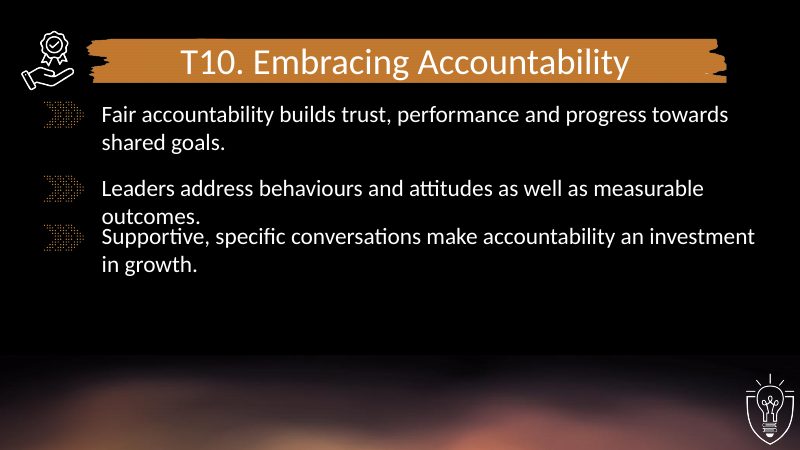
Data is easier to discuss than behaviour. Hold clear, fair, private conversations about actions and conduct, so accountability means support and growth, not blame.
Jump to T10 resources ↓What this behaviour looks like
Care enough to say it
A leader holds colleagues to account for behaviour and conduct, not just results, and does not dodge the uncomfortable conversation. They state the expectation privately and calmly, listen to the other person's account, agree the improvement and support, and apply the same standard to everyone.
A practical example
A dismissive comment in a staff meeting
Avoiding it“It was probably just a bad day. I'll let the comment in the staff meeting go and hope it doesn't happen again.”
Addressing it“I care, so I am raising this. We agreed to challenge ideas with reasons and respect. On Tuesday you called the policy pointless, and several colleagues stopped contributing. What was happening for you? Let's agree how you will raise the concern constructively next time.”
We agreed to challenge ideas with reasons and respect.
Describe Tuesday's comment and its effect, then hear their account.
Agree how the concern will be raised constructively next time.
Write down the expectation, the evidence and one open question to hear their account. Then decide the improvement you need, the support you will offer and when you will review it.
T10 · Resources for your setting
Put ‘Embracing Accountability’ into practice
Develop your own practice or lead the learning with your team. Use the chapter and workbook to explore the behaviour, then choose the resources that fit your next step.


Apply · Your leadership practice
Put it to work
Use the T10 Playbook to turn the behaviour into practical action on a real leadership challenge.
- Practical toolkit and coaching prompts
- A practice script to rehearse your approach
- A 90-day plan to guide your next steps
Members only · Explore membership →
Apply · Learning with your team
Lead a team session
Use the T10 INSET PowerPoint to help colleagues explore the behaviour and plan how to put it into practice.
- Editable slides to adapt to your setting
- Speaker notes to support facilitation
- Discussion, rehearsal and planning
Members only · Explore membership →
Completed Playbooks
See T10 applied in eight leadership contexts
Choose your role to explore the challenge, the leader’s response and the intended result. Members can read the complete example and download an editable Word copy.
In a primary school
In a secondary school
Across schools
Selected completed example
In a primary school · Headteacher
Addressing repeatedly late planning
Matthew · Headteacher · 426-pupil primary school
Worked example at a glance
Addressing repeatedly late planning
The challengeA teacher's last three medium-term plans arrived three to six days late. Two resource requests and one SEND adaptation were completed after teaching began, affecting colleagues who depend on the plans.
What the leader doesThe headteacher describes the impact calmly, explores the teacher's planning process, removes verified duplication and agrees the teacher's proposed milestone and support for two cycles before returning to normal review.
What success looks likeBy day 30 the next plan should be on time and usable, with any risk raised early; by day 60 two planning cycles should meet the date without hidden workload; by day 90 normal planning review should be restored.
Wendy · Deputy Headteacher for behaviour · 356-pupil junior school
Worked example at a glance
A shortened transition routine
The challengeA phase leader has shortened the agreed transition routine on six observed occasions in a fortnight, dropping the silent count and second adult. Corridor incidents rose from two to seven over the same period.
What the leader doesThe deputy head separates what was observed from assumptions about cause, hears the phase leader's account, resolves the teaching-assistant timing at 1.10 and reviews three transitions and the incident log over ten school days.
What success looks likeBy day 30 the full routine should be used consistently, with any agreed adjustment understood; by day 60 corridor incidents should fall and staff should find the routine workable; by day 90 the phase should sustain safe transitions routinely.
Elif · Computing Lead and Year 4 teacher · 604-pupil primary school
Worked example at a glance
Raising an accessibility gap with a peer
The challengeA colleague has twice uploaded digital resources with image-only text and 'click here' links, despite the agreed accessibility check. Three pupils needed adult help with tasks meant to be independent.
What the leader doesThe computing lead raises it privately as a subject lead, not a line manager, asks how the files were made, demonstrates accessible text and links in the actual platform and reviews the next two uploads together.
What success looks likeBy day 30 both files should be corrected and the next two uploads should meet the access standard; by day 60 shared resources should be independently accessible; by day 90 adult support should be used for learning rather than navigation.
Gerard · Headteacher · 1,140-pupil secondary school
Worked example at a glance
A proposal announced as a decision
The challengeA senior leader told staff an unconfirmed staffing and timetable model 'will operate from January' while consultation was still open. Twenty-seven staff queries and a corrective briefing followed.
What the leader doesThe headteacher raises it privately using the exact wording and sequence, owns any ambiguity from the headteacher's side, agrees a joint correction to staff and reviews the next two high-impact messages before normal delegation resumes.
What success looks likeBy day 30 the correction should be complete, with one route for staff questions; by day 60 two high-impact communications should be accurate and checked; by day 90 normal delegation should resume and staff should be clearer about decision status.
Faisal · Assistant Headteacher for quality assurance · 1,250-pupil secondary school
Worked example at a glance
A curriculum review missing its evidence
The challengeA faculty curriculum review omitted the agreed pupil-work sample and did not show how evidence informed the next curriculum action, so it cannot support the intended assurance decision.
What the leader doesThe assistant head explains why the review cannot yet support the decision, asks how the requirement was read, models one evidence chain, caps the sample and agrees a bounded completion by Friday.
What success looks likeBy day 30 the review should contain a defensible sample and an owned curriculum decision; by day 60 the curriculum response should be in place and early evidence reviewed; by day 90 assurance should use concise, subject-valid evidence.
Holly · Head of Sixth Form · 1,360-pupil secondary school
Worked example at a glance
A missed welfare follow-up
The challengeA same-day student welfare follow-up agreed in the pastoral meeting was neither completed nor escalated. By the next morning nothing was recorded, and the missed action may carry safeguarding significance.
What the leader doesThe head of sixth form confirms the student's current safety first, then hears the colleague's full account, clarifies the handover and provides supervision, and reviews the next five relevant handovers through the existing pastoral huddle.
What success looks likeBy day 30 the current response should be safely complete and urgent actions recorded or escalated on time; by day 60 the colleague should escalate early and confidently; by day 90 normal supervision should resume with reliable recording.
Lorna · Head of Art and Design · 1,300-pupil secondary school
Worked example at a glance
Unsecured cutting tools in the studio
The challengeTwice this fortnight, cutting tools were left on an open bench after pupils left the art studio. The technician found and secured them during the final building check.
What the leader doesThe head of department states the safety standard plainly, owns the rota ambiguity after the technician's hours changed, rehearses the close-down with the teacher and checks every session's tool record for a week.
What success looks likeBy day 30 every practical session should have a named owner and a complete tool-security record; by day 60 staffing changes should use a reliable safety handover; by day 90 departmental checks should show no unsecured tool incidents.
Siobhan · Trust Director of Safeguarding · seven-school trust
Worked example at a glance
Overdue safeguarding audit actions
The challengeA school safeguarding lead has twice returned trust audit actions late. Two actions were still incomplete eight working days after the latest deadline, with no request for support or risk escalation.
What the leader doesThe director first confirms any current safeguarding risk, keeps to the factual chronology, asks what happened before assuming deprioritisation, and agrees evidence by 4.00 pm the next day, weekly checks for four weeks and reciprocal trust support.
What success looks likeBy day 30 both actions should be safely closed, with new risks escalated the same day; by day 60 evidence should arrive on time without a parallel process; by day 90 assurance should be reliable and extra monitoring should end.
The complete Playbook is for members
Turn this example into action
Read the full toolkit, coaching and practice scripts, and 90-day plan. Members can view the PDF here and download an editable Word copy.
Resources for this behaviour
Templates and checklists from the resource library that put T10 into practice.
Further reading

Recommended book
The Five Dysfunctions of a Team – Patrick Lencioni (2002)
This text supports the behaviour by illustrating how shared accountability strengthens commitment, quality and team cohesion.
References from the Everyone Succeeds book
- Lencioni, P.M. (2012) The Advantage: Why Organizational Health Trumps Everything Else in Business. San Francisco, CA: Jossey-Bass. Buy on Amazon ↗
Not sure where to start? Take the free leadership diagnostic to find your three priorities.
As an Amazon Associate, Everyone Succeeds earns from qualifying purchases.