

Strategy behaviour S8
Find the Lead Measures
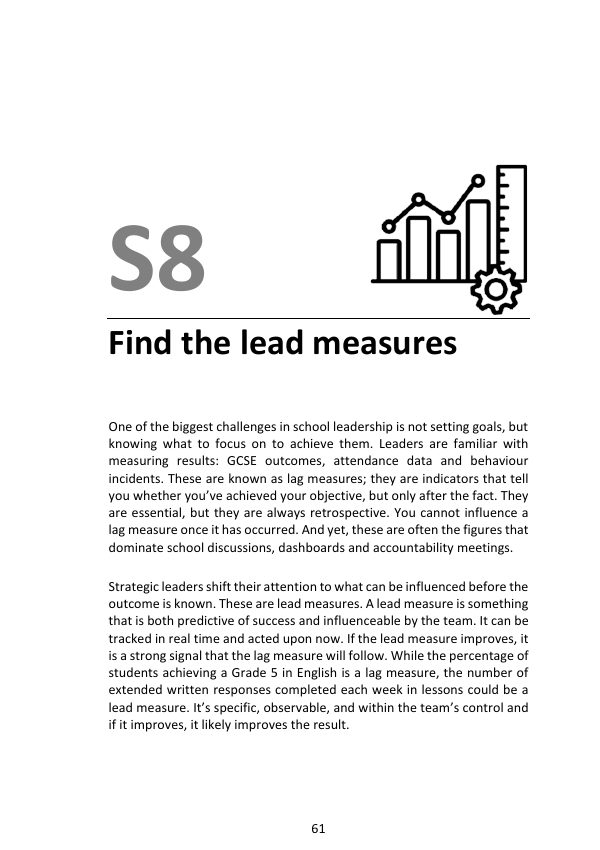
You cannot change a result once it arrives. Track the earlier actions your team can influence now, and check they are moving the outcome.
Jump to S8 resources ↓What this behaviour looks like
Lead before lag
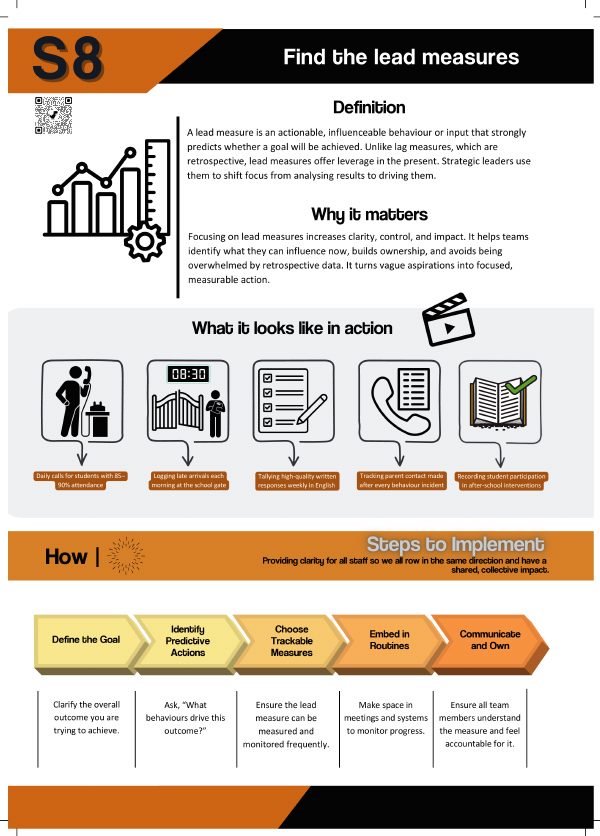
A leader distinguishes the outcome they want from earlier actions that could influence it. They track a few useful measures that colleagues can act on now, check the quality of the action and test whether it is helping pupils' outcomes improve.
A practical example
Improving attendance for priority pupils
Watching the result“Our target is 95% attendance. Each week we'll look at the attendance figure and tell staff whether we are on track.”
Tracking the lead“Our target is 95% attendance. Each day, the attendance team will contact families of absent priority pupils by 10 am and agree support. Each week, we will check timely contact, completed support and whether attendance improves.”
Reach 95% attendance: the outcome we want to change.
Contact absent priority pupils' families by 10 am and agree support.
Check contact, support and attendance weekly to test the link.
Write the outcome you want, then one earlier action your team controls that should influence it. Decide how you will check the action is done well and whether the outcome moves.
S8 · Resources for your setting
Put ‘Find the Lead Measures’ into practice
Develop your own practice or lead the learning with your team. Use the chapter and workbook to explore the behaviour, then choose the resources that fit your next step.
Apply · Your leadership practice
Put it to work
Use the S8 Playbook to turn the behaviour into practical action on a real leadership challenge.
- Practical toolkit and coaching prompts
- A practice script to rehearse your approach
- A 90-day plan to guide your next steps
Members only · Explore membership →
Apply · Learning with your team
Lead a team session
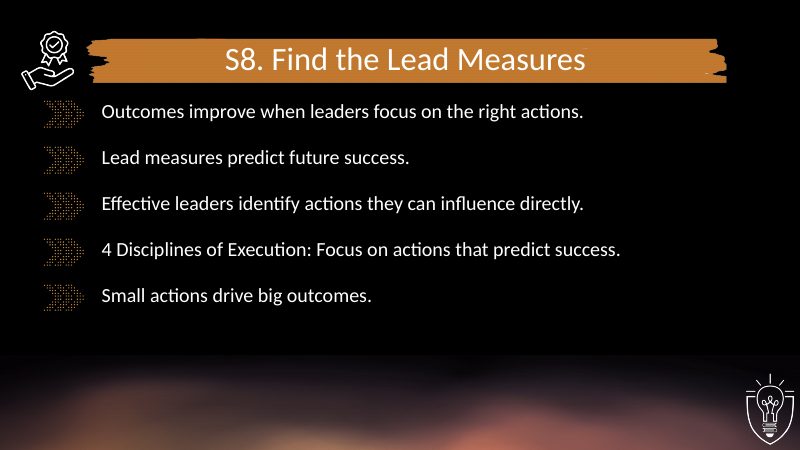
Use the S8 INSET PowerPoint to help colleagues explore the behaviour and plan how to put it into practice.
- Editable slides to adapt to your setting
- Speaker notes to support facilitation
- Discussion, rehearsal and planning
Members only · Explore membership →
Completed Playbooks
See S8 applied in eight leadership contexts
Choose your role to explore the challenge, the leader’s response and the intended result. Members can read the complete example and download an editable Word copy.
In a primary school
In a secondary school
Across schools
Selected completed example
In a primary school · Headteacher
Earlier signs of inference
Oliver · Headteacher · 410-pupil two-form-entry primary school
Worked example at a glance
Earlier signs of inference
The challengeOnly 57% of Years 5 and 6 pupils, and 39% of disadvantaged pupils, answer inference questions securely, and the summer assessment will report too late to change teaching.
What the leader doesThe headteacher tracks three think-aloud inference models per class each week, a fortnightly sample of pupils justifying inferences orally and reteaching within five school days, using existing plans rather than new assessments.
What success looks likeBy day 30 all classes should use calibrated models and rotating baselines; by day 60 pupils' oral justification should improve in every class; by day 90 inference should track towards 72%, with the gap below twelve points.
Cerys · Deputy Headteacher for inclusion · 520-pupil primary academy with specialist resource provision
Worked example at a glance
Adjustments that reach pupils
The challengeAttendance for pupils on SEN Support is 87.9%, and 19 priority pupils have no plan their family has reviewed. There is plenty of paperwork but little evidence of delivery.
What the leader doesThe deputy headteacher tracks whether each named adjustment happens on the days required, whether families have reviewed the plan and school actions are complete, and how each pupil's morning entry is changing.
What success looks likeBy day 30 all nineteen pupils should have accurate plans and named adjustments; by day 60 school actions should be timely and morning entry should improve; by day 90 SEN Support attendance should track towards 91%.
Jaspreet · History Lead and Year 5 teacher · 218-pupil one-form-entry primary school
Worked example at a glance
Tracking historical causation
The challengeOnly 34% of sampled Key Stage 2 pupils can explain historical causation using evidence on their own, and the end-of-term enquiry arrives after every unit has been taught.
What the leader doesThe History lead checks that each sequence includes an annotated model comparing two causes, samples pupils' reasoning every three weeks and makes sure shared misconceptions are retaught before the independent enquiry.
What success looks likeBy day 30 every class should have a calibrated model and fair rotating baseline; by day 60 every class should complete evidence-led reteaching and begin to improve; by day 90 every class should track towards at least 60% secure explanation.
Douglas · Headteacher · ages 11 to 16 secondary school, 1,070 pupils
Worked example at a glance
Keeping leavers in education
The challengeEighteen of last year's Year 11 were not in education, employment or training by November, although 91% had secured a place by results day.
What the leader doesThe headteacher tracks next actions completed by the agreed date, destinations confirmed with provider, young person and family, and backup routes opened within two working days when a place falls through.
What success looks likeBy day 30 every flagged young person should have a workable route, next action and backup; by day 60 verification should show lower risk across groups; by day 90 no more than five leavers (eighteen last year) should risk lacking a November place.
Leon · Assistant Headteacher for Key Stage 4 achievement · ages 11 to 18 secondary school, 1,570 pupils
Worked example at a glance
Independent practice that sticks
The challengeOnly 54% of Year 11 pupils complete the independent-practice cycle to standard each fortnight, faculties define it differently, and the figure has been treated as the result.
What the leader doesThe assistant headteacher sets a common standard that respects subject differences, then tracks checked practice sets weekly, reteaching within five days fortnightly and a three-weekly delayed retention sample.
What success looks likeBy day 30 every subject should calibrate a high-quality practice set and access route; by day 60 identified pupils should get a timely response and retention should begin to improve; by day 90 completion should track towards 78%, with group gaps below ten points.
Kayleigh · Head of Year 8 · ages 11 to 16 secondary school, 980 pupils
Worked example at a glance
Fewer repeat lesson removals
The challengeThirty-six Year 8 pupils have had three or more lesson removals this half-term, follow-up depends on the subject, and the half-termly figure arrives once the pattern is set.
What the leader doesThe head of year tracks same-day restorative and learning conversations after a second removal, agreed classroom adjustments across subjects and each pupil's seven-day pattern, including truancy, so problems are not simply displaced.
What success looks likeBy day 30 all focus pupils should have timely follow-up and a usable agreed adjustment; by day 60 repeat removals should begin to fall without more avoidance; by day 90 the 40% reduction reached at ten weeks should have held, with no rise in truancy.
Yuki · Head of Design and Technology · ages 11 to 18 secondary school, 1,290 pupils
Worked example at a glance
Genuine design iteration
The challengeOnly 43% of Year 11 portfolios show testing or user feedback justifying a design change, and the final internal review will confirm this too late to act.
What the leader doesThe head of department tracks weekly iteration records, separating completed cycles from time-limited held decisions, standardises a six-portfolio sample fortnightly and makes sure workshop and testing requests are met within seven days.
What success looks likeBy day 30 every teacher should calibrate genuine cycles and legitimate held decisions against a fair baseline; by day 60 access requests should be met within seven days in every teaching group; by day 90 portfolios should track towards 75% secure iteration.
Grace · Trust Director of Attendance and Inclusion · seven-school trust
Worked example at a glance
Acting before the July census
The challengePersistent absence is 18.6% across seven schools, ranging from 11.2% to 26.4%, and the July census is the only figure anyone acts on, arriving once the year is over.
What the leader doesThe director asks schools to track what they control: barrier-removal actions delivered on time and family-confirmed plans with school actions complete. The director owns a third measure, escalated obstacles cleared within ten working days.
What success looks likeBy day 30 all schools should use consistent definitions and complete overdue actions; by day 60 family-reviewed plans should be secure, with no escalated obstacle older than ten working days; by day 90 the trust should track towards 14%, with no school above 20%.
The complete Playbook is for members
Turn this example into action
Read the full toolkit, coaching and practice scripts, and 90-day plan. Members can view the PDF here and download an editable Word copy.
Further reading
Recommended book
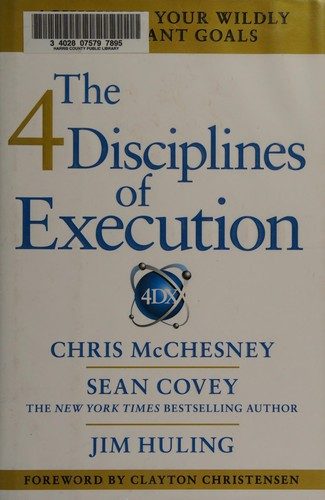
The 4 Disciplines of Execution – Chris McChesney et al. (2012)
This text strengthens your behaviour by clarifying how predictive actions drive outcomes, helping you identify where your effort will make the most significant difference.
References from the Everyone Succeeds book
- Bryar, C. and Carr, B. (2021) Working Backwards: Insights, Stories, and Secrets from Inside Amazon. London: Macmillan Business. Buy on Amazon ↗
- McChesney, C., Covey, S. and Huling, J. (2012) The 4 Disciplines of Execution: Achieving Your Wildly Important Goals. New York: Free Press. Buy on Amazon ↗
Not sure where to start? Take the free leadership diagnostic to find your three priorities.
As an Amazon Associate, Everyone Succeeds earns from qualifying purchases.