

Leadership behaviour L12
Control the Controllables
Shift the question from 'why is this happening?' to 'what can we do?' and put your team's energy where it helps pupils.
Jump to L12 resources ↓What this behaviour looks like
What can we do now?
A leader acknowledges pressures such as funding, policy or exam changes without dwelling on them, and turns attention to teaching, attendance, behaviour and culture. They help colleagues and pupils sort what they control, influence or must accept, and choose one practical next action.
A practical example
When a repair date keeps moving
Dwelling on it“The roof repair has been delayed again. The contractor never tells us anything, so there is no point chasing. We will just have to manage day by day until they turn up.”
Controlling what's ours“We cannot set the contractor's date, but I can escalate the delay and request a firm update. Today we can secure suitable rooms, protect lessons and tell families the plan, so pupils' learning carries on while we wait.”
Rooms are ours, the delay can be escalated, the date cannot.
Today, secure suitable rooms, protect lessons and tell families.
Pupils' learning carries on while the repair date stays uncertain.
Sort each concern into control, influence or acceptance. Choose one action you can take today, one person you could influence and a date to review.
L12 · Resources for your setting
Put ‘Control the Controllables’ into practice
Develop your own practice or lead the learning with your team. Use the chapter and workbook to explore the behaviour, then choose the resources that fit your next step.


Apply · Your leadership practice
Put it to work
Use the L12 Playbook to turn the behaviour into practical action on a real leadership challenge.
- Practical toolkit and coaching prompts
- A practice script to rehearse your approach
- A 90-day plan to guide your next steps
Members only · Explore membership →
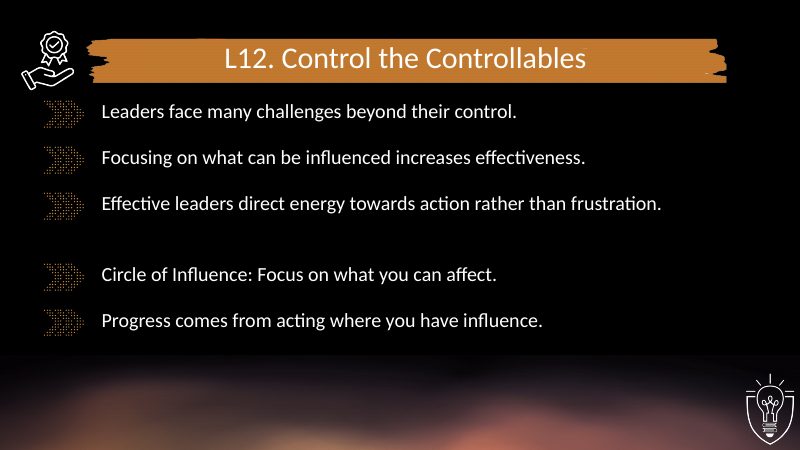
Apply · Learning with your team
Lead a team session
Use the L12 INSET PowerPoint to help colleagues explore the behaviour and plan how to put it into practice.
- Editable slides to adapt to your setting
- Speaker notes to support facilitation
- Discussion, rehearsal and planning
Members only · Explore membership →
Completed Playbooks
See L12 applied in eight leadership contexts
Choose your role to explore the challenge, the leader’s response and the intended result. Members can read the complete example and download an editable Word copy.
In a primary school
In a secondary school
Across schools
Selected completed example
In a primary school · Headteacher
Responding to a delayed roof repair
Grace · Headteacher · 470-pupil two-site primary school
Worked example at a glance
Responding to a delayed roof repair
The challengeThe roof repair date has moved twice, and staff need to separate the external delay from the safety, rooming, curriculum and communication decisions that are still theirs.
What the leader doesAt the morning briefing the headteacher sets out what the school controls, uses one escalation and communication route and agrees when a two-week plan should replace daily improvisation.
What success looks likeBy day 30 safe rooming and one communication route should be secure; by day 60 no curriculum area should lose planned learning; by day 90 the repair disruption should close without residual gaps.
Kirsty · Deputy Headteacher · 470-pupil two-site primary school
Worked example at a glance
Covering an unfilled vacancy fairly
The challengeA teaching vacancy remains open amid a real national shortage, and spreading duties without removing work would turn an external constraint into harm the school causes itself.
What the leader doesThe deputy headteacher maps the post's duties, hours and competence, decides what stops, protects appointment standards and costs any interim arrangement out loud before anyone calls it temporary.
What success looks likeBy day 30 the vacancy should be broken down into safe, costed work; by day 60 interim deployment should protect workload and teaching; by day 90 a sustainable appointment or redesigned model should be secured.
Freya · Computing Lead and Year 6 teacher · 470-pupil two-site primary school
Worked example at a glance
Teaching through unreliable connectivity
The challengeUnreliable connectivity is costing computing lessons about nine minutes while staff try to diagnose the connection instead of switching to an alternative.
What the leader doesThe computing lead gives every teacher a tested green, amber or red route that keeps the lesson's concept, one cue to switch, and a record that makes escalation to the provider useful.
What success looks likeBy day 30 every planned online lesson should have a tested fallback; by day 60 teaching should restart within two minutes of an outage; by day 90 connectivity problems should no longer reduce computing ambition.
Sharon · Headteacher · ages 11 to 18 urban secondary school, 1,470 pupils
Worked example at a glance
Leading through a budget reduction
The challengeAn externally imposed funding reduction cannot be reversed this cycle, and speculation is running ahead of any agreement on how savings will be weighed.
What the leader doesThe headteacher publishes decision criteria before any options are developed, asks leaders for complete, comparable proposals and makes trade-offs between valuable provision openly rather than hiding loss.
What success looks likeBy day 30 decision criteria and protected provision should be published; by day 60 a balanced proposal should close the reduction; by day 90 implementation should protect pupils' core entitlement.
Jodie · Deputy Headteacher · ages 11 to 18 urban secondary school, 1,470 pupils
Worked example at a glance
Managing late buses
The challengeA disrupted bus route is causing verified late arrivals, inconsistent coding, repeated family calls and avoidable interruption to first lessons.
What the leader doesThe deputy headteacher introduces one temporary protocol for safe arrival, coding, learning and communication, and uses pupil-level evidence to press the bus operator and local authority.
What success looks likeBy day 30 one safe arrival and learning protocol should be live; by day 60 affected pupils should lose no repeated curriculum sequence; by day 90 the response should keep adapting until reliable transport returns.
Ruth · Transition Lead · ages 11 to 18 urban secondary school, 1,470 pupils
Worked example at a glance
Supporting a pupil in temporary housing
The challengeA pupil in temporary housing faces disrupted travel, equipment and learning. The school cannot solve the housing, but it can end repeated retelling and inconsistent adjustments.
What the leader doesThe transition lead gives the pupil one trusted adult and a minimum-information plan that secures practical support and full curriculum access, and escalates to partner agencies promptly.
What success looks likeBy day 30 affected pupils should have one contact and a practical plan; by day 60 priority learning should stay connected during disruption; by day 90 support should adapt promptly as housing circumstances change.
Saira · Head of Music · ages 11 to 18 urban secondary school, 1,470 pupils
Worked example at a glance
Responding to music withdrawal requests
The challengeDuring examination season, several pupils and families have asked whether music participation should continue, and the pressure they feel is real.
What the leader doesThe head of music asks colleagues to explore the actual barrier with families, use honest evidence and offer bounded, meaningful participation routes without becoming defensive or applying pressure.
What success looks likeBy day 30 participation patterns and sources of pressure should be clear; by day 60 flexible routes should be tested without lowering musical purpose; by day 90 participation should stabilise through examination season.
Helen · Trust Director of Strategy · growing eight-school trust
Worked example at a glance
Keeping improvement going amid policy speculation
The challengeUnverified possibilities about national accountability measures are taking over agendas, and schools are waiting to know which improvement work should go ahead.
What the leader doesThe director resets project priorities, asks principals to classify concerns accurately and complete no-regrets actions, and agrees the evidence triggers that would reopen a paused discussion.
What success looks likeBy day 30 every major project should have a control decision and dependency; by day 60 verified policy input should replace daily speculation; by day 90 trust priorities should remain stable through the policy decision.
The complete Playbook is for members
Turn this example into action
Read the full toolkit, coaching and practice scripts, and 90-day plan. Members can view the PDF here and download an editable Word copy.
Further reading

Recommended book
The 7 Habits of Highly Effective People – Stephen Covey (1989)
This text supports the behaviour by helping you focus energy on what you can influence, improving clarity, calm and effectiveness.
References from the Everyone Succeeds book
- Dweck, C.S. (2006) Mindset: The New Psychology of Success. New York: Random House. Buy on Amazon ↗
- Grupe, D.W. and Nitschke, J.B. (2013) 'Uncertainty and anticipation in anxiety: an integrated neurobiological and psychological perspective', Nature Reviews Neuroscience, 14(7), pp. 488–501. Read free ↗
Not sure where to start? Take the free leadership diagnostic to find your three priorities.
As an Amazon Associate, Everyone Succeeds earns from qualifying purchases.