

Leadership behaviour L11
Learn to Bend
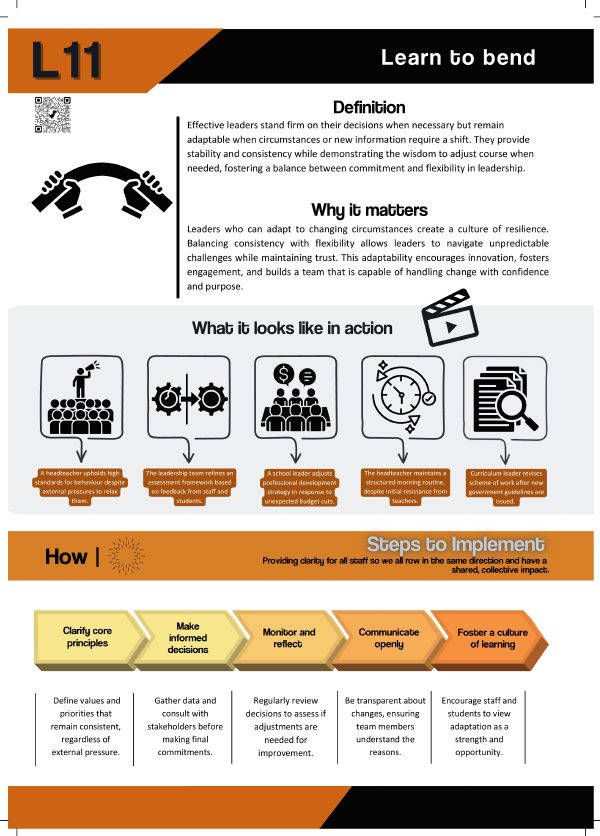
Resilience is not rigidity. Stand firm on principles, but when evidence shows a plan is not working, change course calmly and explain why.
Jump to L11 resources ↓What this behaviour looks like
Avoid summit fever
A leader makes clear which principles are non-negotiable and which routes can change, gathers views from colleagues, pupils and families, and checks whether plans still serve them. When the evidence shifts, they adapt openly and explain why, so change reads as judgement, not drift.
A practical example
Rethinking a meeting families are not attending
Sticking to the plan“Families are invited to the daytime attendance meeting as usual. If they don't come, we will send a follow-up letter.”
Bending the route“Early help stays our goal, but only 41% of families attend the daytime meeting. From Monday, we will offer daytime, evening or telephone appointments. We will check take-up fortnightly and ask families which barriers remain.”
Early help stays the goal; only the route changes.
Only 41% of families attend the daytime meeting.
Offer daytime, evening or telephone appointments; check take-up fortnightly.
Write what must hold, one credible alternative and the date or data point that would trigger a switch, then share it with your team.
L11 · Resources for your setting
Put ‘Learn to Bend’ into practice
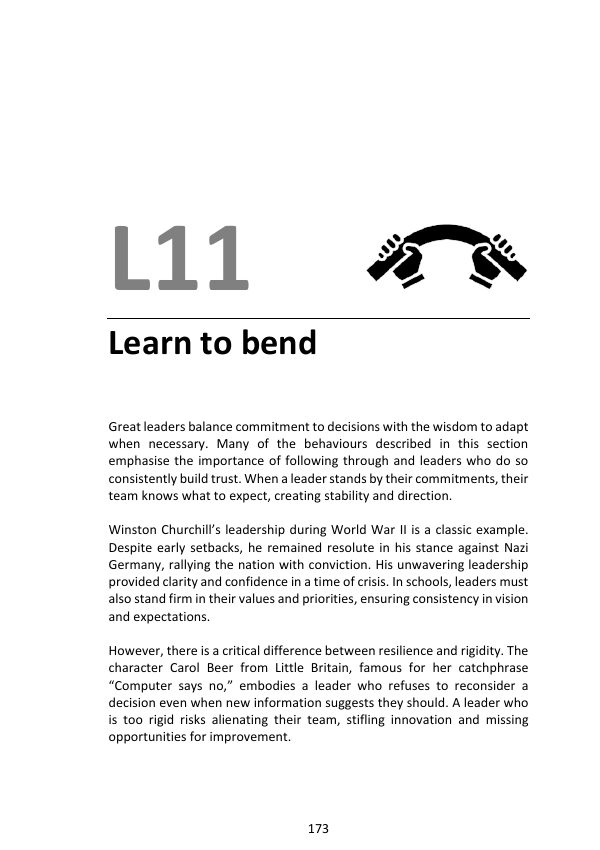
Develop your own practice or lead the learning with your team. Use the chapter and workbook to explore the behaviour, then choose the resources that fit your next step.
Apply · Your leadership practice
Put it to work
Use the L11 Playbook to turn the behaviour into practical action on a real leadership challenge.
- Practical toolkit and coaching prompts
- A practice script to rehearse your approach
- A 90-day plan to guide your next steps
Members only · Explore membership →
Apply · Learning with your team
Lead a team session
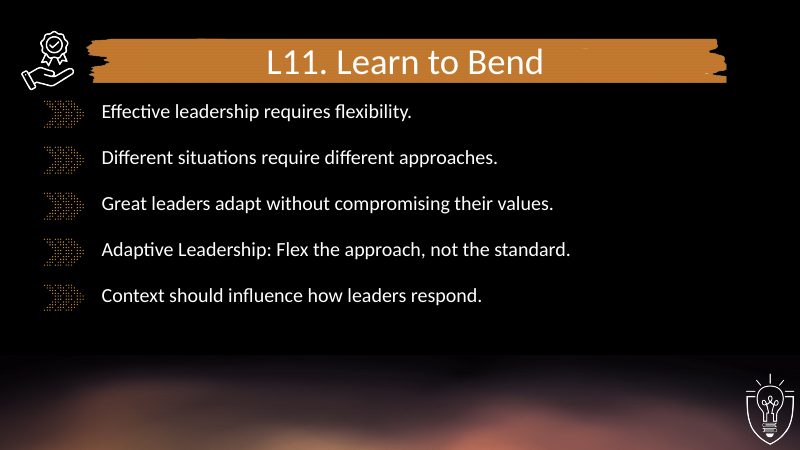
Use the L11 INSET PowerPoint to help colleagues explore the behaviour and plan how to put it into practice.
- Editable slides to adapt to your setting
- Speaker notes to support facilitation
- Discussion, rehearsal and planning
Members only · Explore membership →
Completed Playbooks
See L11 applied in eight leadership contexts
Choose your role to explore the challenge, the leader’s response and the intended result. Members can read the complete example and download an editable Word copy.
In a primary school
In a secondary school
Across schools
Selected completed example
In a primary school · Headteacher
Changing how families are invited
Dominic · Headteacher · 420-pupil city primary school
Worked example at a glance
Changing how families are invited
The challengeOnly 41% of families come to the single daytime attendance meeting, and the school has treated that as a family problem rather than a format problem.
What the leader doesThe headteacher keeps early help and safeguarding response fixed, offers families several routes into the attendance conversation and prepares a respectful opening for parents who have previously felt blamed.
What success looks likeBy day 30 staff should be able to explain all routes and thresholds; by day 60 meaningful family participation should reach at least 75%; by day 90 attendance should improve without any delay to protection.
Joel · Assistant Headteacher · 420-pupil city primary school
Worked example at a glance
Re-planning coaching cycles
The challengeEighteen weekly coaching cycles were planned but only nine could be staffed safely, a planning error the assistant headteacher owns.
What the leader doesThe assistant headteacher changes the cadence to staged cohorts so all eighteen teachers are coached, protects rehearsal, confidentiality and follow-up, and offers something now to teachers in later cohorts.
What success looks likeBy day 30 cohorts, an urgent route and protected follow-ups should be published; by day 60 six teachers should complete full cycles; by day 90 twelve should have completed, with the third cohort booked.
Zain · Mathematics Lead and Year 4 teacher · 420-pupil city primary school
Worked example at a glance
Rethinking maths intervention timing
The challengeWithdrawal sessions are improving fluency, but the same pupils keep missing the same foundation-subject lessons to attend them.
What the leader doesThe mathematics lead keeps the fluency goal fixed, pilots an adapted timetable for three weeks with clear thresholds and puts a number on the curriculum time that withdrawal was costing.
What success looks likeBy day 30 the adapted timetable should protect practice and curriculum access; by day 60 fluency and transfer should match or exceed the old route; by day 90 a sustainable intervention model should be agreed.
Craig · Headteacher · ages 11 to 16 secondary school, 810 pupils
Worked example at a glance
Targeting behaviour support
The challengeWhole-school training has raised awareness, but repeat disruption is still concentrated in the same six classrooms.
What the leader doesThe headteacher moves from whole-school training to targeted coaching and system support in six classrooms, agreeing evidence rights and safeguards so teachers experience support rather than surveillance.
What success looks likeBy day 30 evidence rights and coaching safeguards should be agreed; by day 60 six teachers should complete high-quality coaching cycles; by day 90 repeat disruption should fall by at least 30%.
Gavin · Assistant Headteacher · ages 11 to 16 secondary school, 810 pupils
Worked example at a glance
Phasing a behaviour launch
The challengeA single launch day for 120 staff was never enough time to model and rehearse the new behaviour routines.
What the leader doesThe assistant headteacher replaces the launch day with a phased launch, sets a proficiency threshold before full implementation and explains the change to staff and families without it sounding like retreat.
What success looks likeBy day 30 the cohort sequence and a common pupil message should be ready; by day 60 all cohorts should meet the 90% proficiency threshold; by day 90 full implementation should be consistent.
Liam · Alternative Provision Lead · ages 11 to 16 secondary school, 810 pupils
Worked example at a glance
Redesigning an attendance incentive
The challengeYear 8 attendance is slightly up, but pupils with medical needs say, rightly, that the incentive scheme is unfair to them.
What the leader doesThe provision lead redesigns the incentive around three criteria that reward controllable progress, keeps a genuinely private route for medical absence and trials it for four weeks.
What success looks likeBy day 30 tutors should apply and explain the three criteria; by day 60 at least 80% of pupils should understand the principle; by day 90 attendance should improve without unsafe incentives.
Owen · Head of History · ages 11 to 16 secondary school, 810 pupils
Worked example at a glance
Shortening a history assessment
The challengeThe extended history task gives reliable data but takes two weeks of curriculum time, and the head of department has defended it longer than the evidence justifies.
What the leader doesThe head of history keeps valid evidence of disciplinary reasoning fixed, pilots shorter tasks and separates what pupils need to practise from what the assessment needs to measure.
What success looks likeBy day 30 constructs, thresholds and pilot tasks should be agreed; by day 60 moderation agreement should reach at least 85%; by day 90 a balanced annual assessment model should be decided.
Trevor · Trust Chief Executive · ten-school trust
Worked example at a glance
Adapting reviews for small schools
The challengeThe two-day review works in large schools but takes more out of a small primary than it puts back, yet one model has been kept for all ten schools because it felt safer.
What the leader doesThe chief executive keeps one review standard but pilots a lighter route in three small primaries, with agreed evidence equivalence and stop conditions, and lets the standards committee decide the future model.
What success looks likeBy day 30 three pilot routes and evidence equivalence should be agreed; by day 60 three Plan B reviews should be complete without weaker assurance; by day 90 the standards committee should decide the future model.
The complete Playbook is for members
Turn this example into action
Read the full toolkit, coaching and practice scripts, and 90-day plan. Members can view the PDF here and download an editable Word copy.
Further reading

Recommended book
Adaptive Leadership – Ronald Heifetz (2009)
This book deepens the behaviour by explaining when to hold firm, when to adapt and how to navigate complexity with flexibility.
References from the Everyone Succeeds book
- Chughtai, M.S., Syed, F., Naseer, S. and Chinchilla, N. (2024) 'Role of adaptive leadership in learning organizations to boost organizational innovations with change self-efficacy', Current Psychology, 43(33), pp. 27262–27281. Read free ↗
Not sure where to start? Take the free leadership diagnostic to find your three priorities.
As an Amazon Associate, Everyone Succeeds earns from qualifying purchases.