

Strategy behaviour S15
Plan with a Premortem
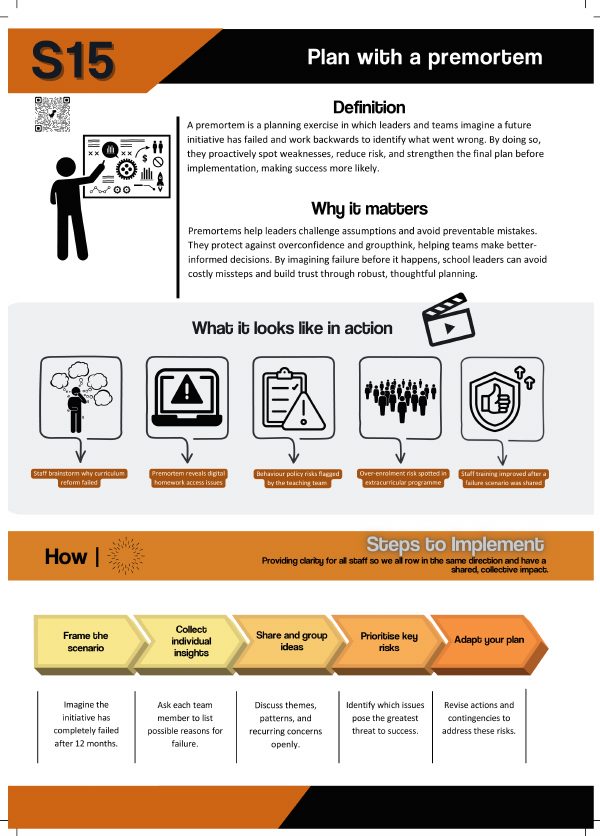
Imagine your plan has already failed, then ask why. Honest answers now mean small corrections early, not a scramble when it is too late.
Jump to S15 resources ↓What this behaviour looks like
Why might it fail?
Before a launch, a leader asks colleagues to imagine the plan has failed and to write down why, honestly and independently. The biggest risks, including those affecting pupils and families, get owners, preventive actions and warning signs, and the plan changes before it starts.
A practical example
Launching a digital homework system
Optimism by default“The new homework platform launches in September. I'm sure it'll be fine.”
Running a premortem“Imagine it is next July and the homework platform has failed. Write your reasons independently, then we will compare them. For the two biggest risks, we will agree an owner, a preventive action and a warning sign before launch.”
Picture the homework platform failing by next July.
Give the two biggest risks an owner and preventive action.
Agree a warning sign for each risk before launch.
Take ten minutes with your team. Say the plan has failed, list the reasons individually, pick the top two risks and give each an owner, a preventive action and a warning sign.
S15 · Resources for your setting
Put ‘Plan with a Premortem’ into practice
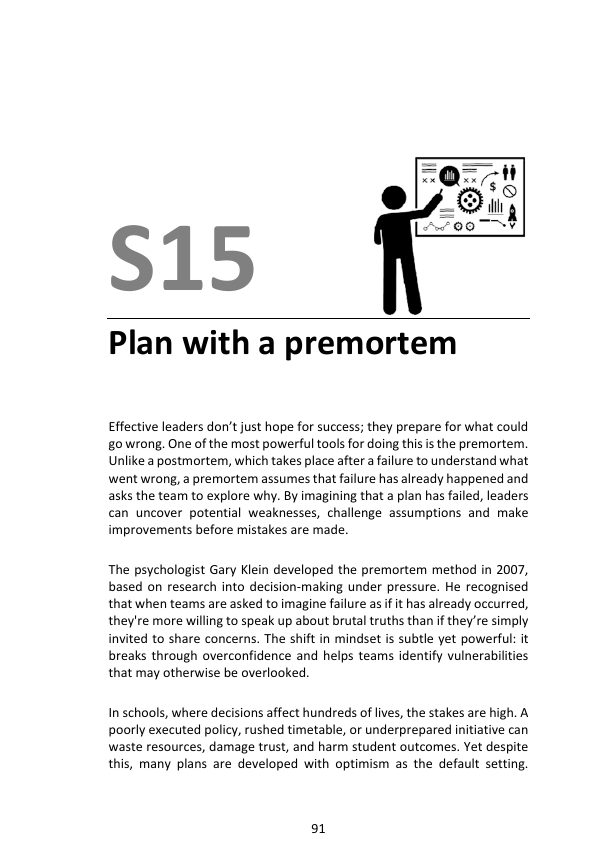
Develop your own practice or lead the learning with your team. Use the chapter and workbook to explore the behaviour, then choose the resources that fit your next step.
Apply · Your leadership practice
Put it to work
Use the S15 Playbook to turn the behaviour into practical action on a real leadership challenge.
- Practical toolkit and coaching prompts
- A practice script to rehearse your approach
- A 90-day plan to guide your next steps
Members only · Explore membership →
Apply · Learning with your team
Lead a team session
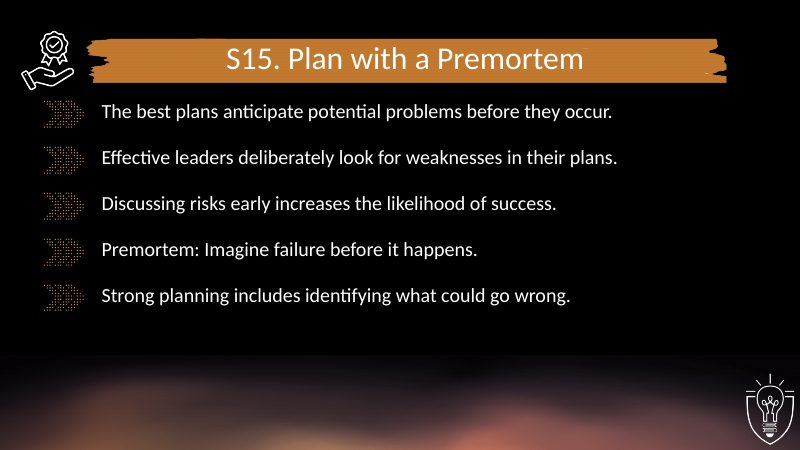
Use the S15 INSET PowerPoint to help colleagues explore the behaviour and plan how to put it into practice.
- Editable slides to adapt to your setting
- Speaker notes to support facilitation
- Discussion, rehearsal and planning
Members only · Explore membership →
ES CoachApply · Online, with ES Coach
Complete the S15 Playbook online
Work through the Playbook on your desk instead of on paper. A built-in coach supports you with every question: jot a few words and ES Coach suggests an answer for you to edit.
- ES Coach help under every question and table
- Saves as you type, and stays private to you
- Linked to your goal and your 90-day plan
Also in the online Playbook, with PDF and Word copies: worked examples following an Early Years leader, a primary phase leader, a primary SENDCo, a teaching head, a secondary SENDCo, a head of sixth form, a teaching and learning lead, a support staff team leader and a trust estates and capital lead.
Members only · Explore membership → · Sign in
Worked examples
See S15 applied in seventeen leadership contexts
Choose your role to explore the challenge, the leader’s response and the intended result. Members can read the complete example and download an editable Word copy.
In a primary school
In a secondary school
Across schools
Selected worked example
In a primary school · Headteacher
Moving to mixed-age classes
Early Years leader · Small rural primary of about 90 pupils with one mixed Reception and Year 1 class of 22...
Worked example at a glance
Running a premortem on our new, earlier transition programme for...
The challengeRunning a premortem on our new, earlier transition programme for children starting Reception in September before we commit time and money to it.
What the leader is aiming forBy the end of February, children starting Reception in September have begun to know us through their settings and Little Explorers, because the premortem helped us fix the risks before spending time and money.
How they will know it is workingMy tracker of replies from the six settings, Little Explorers registers reviewed after each session, and the diary checked each half term showing all visits booked with cover agreed for the TA.
Phase leader · Small rural primary school of about 95 pupils in four classes, where I lead KS2 across...
Worked example at a glance
Running a premortem with our tiny KS2 team before we launch a...
The challengeRunning a premortem with our tiny KS2 team before we launch a two-year rolling cycle for writing in our mixed-age classes from January.
What the leader is aiming forBy February half term, every KS2 child in our mixed-age classes is taught writing units from the new two-year cycle without repeats, and the younger children in each class write extended pieces independently, not mainly copied.
How they will know it is workingUnit plans with outcomes for both year groups checked the Friday before each unit, three-weekly joint book looks showing at least 8 of 10 younger children writing independently, and the teacher's confidence rising from 2 to 4.
Primary SENDCo · One-form-entry primary school of about 230 pupils, where I am SENDCo two days a week and...
Worked example at a glance
Using a premortem to strengthen our plan for access arrangements for...
The challengeUsing a premortem to strengthen our plan for access arrangements for the KS2 tests in May, after last year's arrangements were organised late and two children did not get the support they normally use in class.
What the leader is aiming forBy test week in May, every Year 6 child who needs an access arrangement gets it, as their normal way of working, with every application on time and every family informed, unlike last year when two children missed their usual support.
How they will know it is workingFortnightly tick sheet checks, evidence checks and monthly plan reviews show the risks being reduced, and the January learning walk, approved applications, a complete test week plan and informed families show whether the plan has worked.
Teaching headteacher · Primary school of 104 pupils in a rural market village, in a multi-academy trust of...
Worked example at a glance
Running a premortem before replacing our long paper SEN support plans...
The challengeRunning a premortem before replacing our long paper SEN support plans with one-page plans that class teachers write and review with families and children each term, so that the plans actually change what happens in lessons.
What the leader is aiming forBy late March, at least 30 of the 51 targets for our 19 children on SEN support are met (from 22 last year), because every child has a one-page plan that their class teacher reviews with the family and that the adults working with them know and use.
How they will know it is workingReview meetings booked, teaching assistants able to say each child's targets and mid-term family updates (lead), and targets met at the spring review and the family survey (lag).
Secondary SENDCo · An 11 to 18 school of about 1,250 pupils in a multi-academy trust, where I am new to the...
Worked example at a glance
Running a premortem, with my team and the trust's SEND lead, on my...
The challengeRunning a premortem, with my team and the trust's SEND lead, on my plan to launch termly SEN support reviews with families for all 162 pupils on SEN support from January, before it goes to staff and parents.
What the leader is aiming forBy early March, at least 90% of the 48 pupils on SEN support in Years 7 and 8 have had a termly review with a one-page plan, with at least 70% of families taking part.
How they will know it is workingI will know it is working when every Year 7 and 8 tutor is trained and has booked reviews by January and plans pass my quality check (lead), and when reviews happen on time, families attend and teachers can name a pupil's strategy (lag).
Head of sixth form · Rural 11 to 18 school with a sixth form of 150, where many students travel 40 minutes or...
Worked example at a glance
Running a premortem before we commit to sharing A level further...
The challengeRunning a premortem before we commit to sharing A level further maths, French and music with a neighbouring school nine miles away from September, so that small subjects survive without the plan failing on minibuses, timetables and students' trust.
What the leader is aiming forBy the end of February, a written agreement with the neighbouring school is approved by both heads and at least five Year 11 pupils across the two schools have chosen each of further maths, French and music for September.
How they will know it is workingThree-weekly risk reviews, honest options information and named owners for each priority risk are in place (lead), and the signed agreement, safeguarding and reporting arrangements and Year 11 subject choices show the plan is strong enough to launch (lag).
Teaching and learning lead · A three-form-entry primary school of about 630 pupils in an area of high disadvantage...
Worked example at a glance
Running a premortem on our plan to launch a daily 15-minute...
The challengeRunning a premortem on our plan to launch a daily 15-minute whole-class reading fluency routine in all 15 classes from Year 2 to Year 6 in January.
What the leader is aiming forBy the spring fluency check in March, the proportion of pupils in Years 3 to 6 reading below the speed expected for their age falls from 41% to 30% or below, with the routine seen in at least 13 of 15 classes.
How they will know it is workingLead evidence is the afternoon drop-in record shared every Friday and every teacher rehearsing the routine before launch; lag evidence is the March fluency check and the early career teachers' confidence ratings.
Support staff team leader · Office manager in a small primary school of about 120 pupils, leading one part-time...
Worked example at a glance
Running a premortem with my administrator and the headteacher before...
The challengeRunning a premortem with my administrator and the headteacher before we stop taking cash and cheques for school dinners, clubs and trips and move every family to online payments from January.
What the leader is aiming forBy mid-February, at least 90 of our 95 families pay online, no more than five families have a negative dinner balance at the end of any week, and payments take us no more than one hour a week.
How they will know it is workingI will know it is working when the Friday checks of active accounts and balances happen every week (lead), and active accounts, payments made online, dinner debt and my time log all move the right way (lag).
Trust estates and capital lead · Multi-academy trust of fourteen schools (twelve primary, two secondary), 5,800 pupils...
Worked example at a glance
Planning a roof and heating replacement at a primary school that will...
The challengePlanning a roof and heating replacement at a primary school that will have contractors on site for nine weeks during term, so that the building is fixed without putting pupils' safety or learning at risk
What the leader is aiming forBy mid-June, the Key Stage 2 roof is replaced during nine weeks of term without putting pupils' safety or learning at risk, so 420 pupils have warm, dry classrooms with no lessons lost to leaks.
How they will know it is workingThe revised plan has an agreed change for each priority risk by late February, my Tuesday and Thursday checks find no vehicle breaches or pupil safety incidents, and no class spends over five weeks out of its classroom.
Leonie · Headteacher · 186-pupil village primary school
Worked example at a glance
Moving to mixed-age classes
The challengeA falling roll and a vacancy mean four classes must become three mixed-age groups, changing friendships, curriculum planning and support for pupils with SEND.
What the leader doesThe headteacher runs a premortem with staff, then delays class lists until a pupil map and one curriculum cycle are complete, publishes allocation principles and protects planning days.
What success looks likeBy day 30 priority risks and controls should be agreed; by day 60 the proposed model should pass timetable and transition testing; by day 90 a safe, sustainable class structure should be approved.
Nadia · Assistant Headteacher for early reading · 648-pupil three-form-entry primary school
Worked example at a glance
One reading assessment platform
The challengeTeachers spend six hours a term entering overlapping reading results, but the new platform's automated groups do not reliably reflect speech, language or English-acquisition needs.
What the leader doesThe assistant headteacher asks reading, SEND, EAL and data leads to imagine the platform failing, then makes teacher validation meetings non-negotiable, records override reasons and removes duplicate entry.
What success looks likeBy day 30 every priority validity and workload risk should have a named control; by day 60 the pilot should produce valid moderated decisions; by day 90 a defensible decision to adopt, adapt or reject should be made.
Marek · Mathematics Lead and Year 3 teacher · 412-pupil two-form-entry infant and junior school
Worked example at a glance
Number fluency without withdrawal
The challengeNumber retrieval is slow for many pupils, but past interventions became extra worksheets and took pupils with SEND out of foundation subjects.
What the leader doesThe mathematics lead imagines the routine failing, then adds a visible ten-minute stop rule, a strategy-explanation prompt and an agreement that no pupil routinely misses foundation subjects for extra practice.
What success looks likeBy day 30 controls for the five priority risks should be in place; by day 60 the routine should improve fluency and transfer; by day 90 a sustainable approach should be agreed.
Omar · Headteacher · ages 11 to 16 secondary school, 1,340 pupils
Worked example at a glance
A longer day for enrichment
The challengeEnrichment participation is 46% and lowest for disadvantaged pupils, but a compulsory extended day leaves transport, staff contracts, prayer, caring duties and specialist capacity unresolved.
What the leader doesThe headteacher replaces a whole-school launch with a six-week, two-cohort pilot, secures transport and contracts first, publishes access and quality thresholds and agrees when the pilot would stop.
What success looks likeBy day 30 safety, access and capacity risks should each have a funded control; by day 60 a six-week pilot should deliver equivalent routes; by day 90 the decision to scale, change or stop should rest on evidence.
Quentin · Assistant Headteacher for attendance · ages 11 to 18 secondary school, 1,530 pupils
Worked example at a glance
Same-day home visits, safely
The challengeUnexplained absence remains unresolved beyond noon for 27 pupils a week, but same-day visits raise staffing, lone-working, consent, data and fairness risks.
What the leader doesThe assistant headteacher adds a risk matrix with DSL approval, lone-working controls and a weekly equity review, then starts a two-week supervised pilot, stopping any visit without a complete safety plan.
What success looks likeBy day 30 risk, data and lone-working controls should pass testing; by day 60 a supervised pilot should reduce unresolved absence safely; by day 90 a proportionate future pathway should be decided.
Poppy · Pastoral Lead for Key Stage 3 · ages 11 to 18 secondary school, 1,260 pupils
Worked example at a glance
Safe peer mentoring
The challengePupils report loneliness and low-level conflict and 34 have volunteered to mentor, but the plan has no safeguarding boundaries, supervision or route for disclosures.
What the leader doesThe pastoral lead cuts the first cohort to twelve matches, rehearses a listen, limit and link script with every mentor and timetables weekly supervision, with a named adult ready to take over.
What success looks likeBy day 30 safeguarding controls and role boundaries should be tested; by day 60 a small pilot should run safely; by day 90 the team should decide whether the programme continues, changes or stops.
Rosa · Head of History · ages 11 to 18 secondary school, 1,110 pupils
Worked example at a glance
Re-sequencing Key Stage 3 History
The challengePupils recall facts securely but argue causes weakly. The new enquiry sequence is promising, but subject knowledge varies, Year 9 resources are incomplete and preparation clashes with exam marking.
What the leader doesThe head of History phases the launch, with Years 7 and 8 first and Year 9 only once resources and rehearsal pass review, and leads subject-knowledge briefings and coached rehearsal for each enquiry.
What success looks likeBy day 30 the five curriculum risks should be owned and controlled; by day 60 Years 7 and 8 should launch securely; by day 90 Year 9 should meet the threshold or remain staged.
Kavita · Trust Director of Digital Strategy · seven-school trust
Worked example at a glance
A safe move to one MIS
The challengeSeven schools must move to one management information system by September, but data quality, training and local processes vary sharply between them.
What the leader doesThe director asks the implementation group to imagine the migration has failed, ranks risks such as unreliable data and shadow systems, and adds two rehearsal migrations, school sign-off and a rollback decision.
What success looks likeBy day 30 five priority risks should have owned controls; by day 60 every school should demonstrate safe readiness or an adapted route; by day 90 migration should proceed with no unresolved high-harm risk.
The complete Playbook is for members
Turn this example into action
Read the full toolkit, coaching and practice scripts, and 90-day plan. Members can view the PDF here and download an editable Word copy.
Resources for this behaviour
Templates and checklists from the resource library that put S15 into practice.
Further reading

Recommended book
Sources of Power– Gary Klein (1998)
This text strengthens the behaviour by demonstrating how anticipating failure in advance leads to better planning, sharper insight and reduced risk.
References from the Everyone Succeeds book
- Heath, C. and Heath, D. (2013) Decisive: How to Make Better Choices in Life and Work. New York: Crown Business. Buy on Amazon ↗
- Klein, G. (2007) 'Performing a project premortem', Harvard Business Review, 85(9), pp. 18–19. View article ↗
- Marquet, L.D. (2013) Turn the Ship Around! A True Story of Building Leaders by Breaking the Rules. New York: Portfolio/Penguin. Buy on Amazon ↗
Not sure where to start? Take the free self-diagnostic to choose one to three behaviours to focus on.
As an Amazon Associate, Everyone Succeeds earns from qualifying purchases.