

Strategy behaviour S13
Aspire to Greatness
Aim for the moon, not a couple of percentage points. Set a bold goal for your pupils and make it believable with clear milestones.
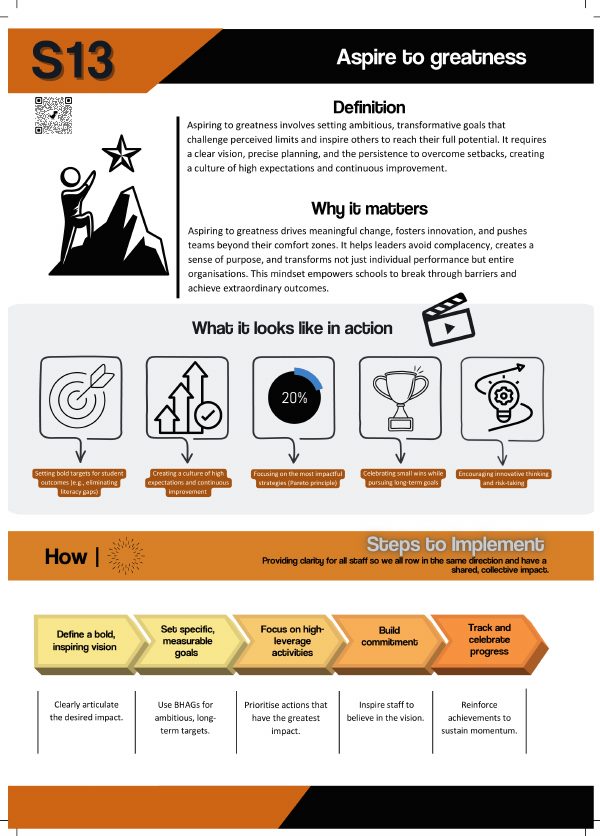
Jump to S13 resources ↓What this behaviour looks like
A Big Hairy Audacious Goal
A leader sets a bold goal that stretches well beyond steady improvement, then makes it believable with precise milestones and a few high-impact actions. Staff, pupils and families are invited to believe in it, and progress is celebrated honestly, even when a target is missed.
A practical example
Setting a long-term reading goal
A safe target“We aim to improve our reading results by a couple of percentage points next year.”
A bold goal“Within five years, we will close the reading gap between disadvantaged pupils and their peers. By the end of this term, every pupil below the agreed reading standard will have a reviewed support plan. Each half term, we will check whether the gap is closing.”
Close the disadvantaged reading gap within five years.
Every pupil below standard has a reviewed plan this term.
Check each half term whether the gap is closing.
Write one bold goal for your pupils in a single sentence. Add the first milestone, and how often you will check whether you are moving towards it.
S13 · Resources for your setting
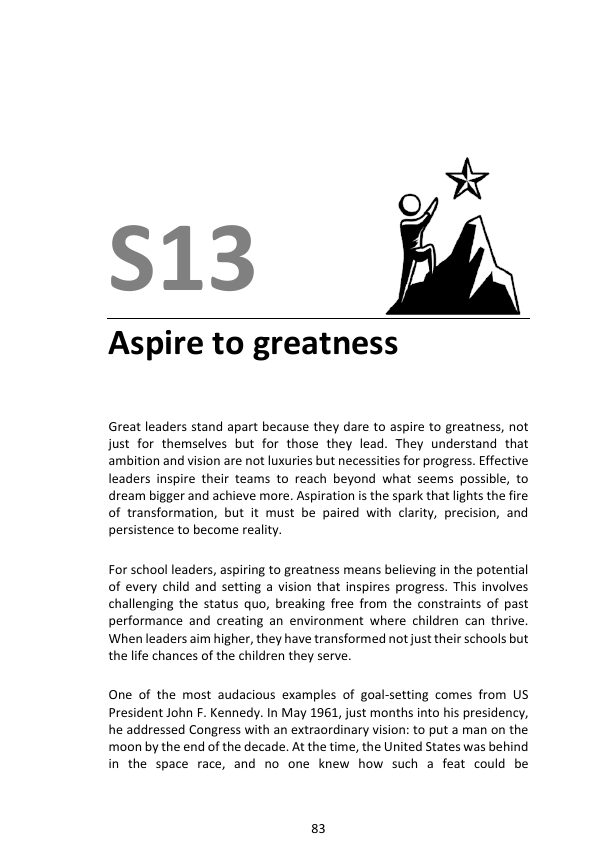
Put ‘Aspire to Greatness’ into practice
Develop your own practice or lead the learning with your team. Use the chapter and workbook to explore the behaviour, then choose the resources that fit your next step.
Apply · Your leadership practice
Put it to work
Use the S13 Playbook to turn the behaviour into practical action on a real leadership challenge.
- Practical toolkit and coaching prompts
- A practice script to rehearse your approach
- A 90-day plan to guide your next steps
Members only · Explore membership →
Apply · Learning with your team
Lead a team session
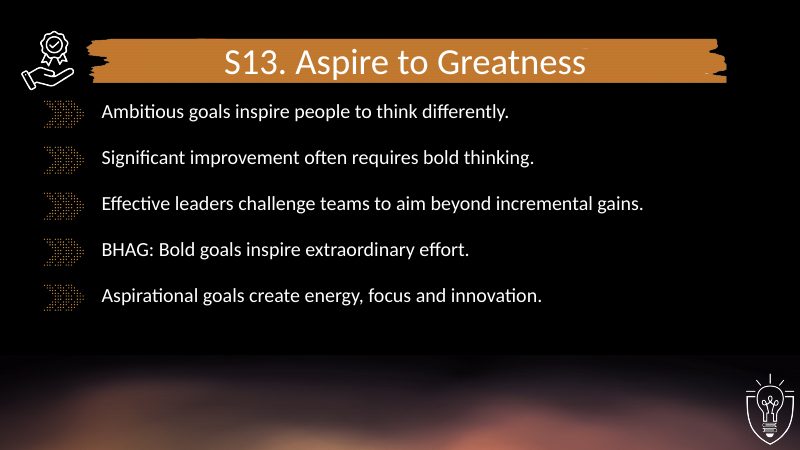
Use the S13 INSET PowerPoint to help colleagues explore the behaviour and plan how to put it into practice.
- Editable slides to adapt to your setting
- Speaker notes to support facilitation
- Discussion, rehearsal and planning
Members only · Explore membership →
Completed Playbooks
See S13 applied in eight leadership contexts
Choose your role to explore the challenge, the leader’s response and the intended result. Members can read the complete example and download an editable Word copy.
In a primary school
In a secondary school
Across schools
Selected completed example
In a primary school · Headteacher
Fluent reading for every child
Gareth · Headteacher · 408-pupil two-form-entry coastal primary school
Worked example at a glance
Fluent reading for every child
The challengeSeventy-one per cent of Year 2 pupils meet the fluency benchmark but only 46% of disadvantaged pupils do, and the team is asked to believe in a target nobody has yet hit.
What the leader doesThe headteacher protects daily fluency practice in every Reception to Year 2 class, runs fortnightly checks that trigger support within five school days and stops one duplicate written task so adults can listen to pupils read.
What success looks likeBy day 30 all classes should protect daily practice and complete the first diagnostic clinic; by day 60 fluency should improve and the disadvantage gap begin to narrow; by day 90 no class should be on a trajectory below 80%.
Elliot · Deputy Headteacher for inclusion · two-school primary federation, 312 pupils
Worked example at a glance
Enrichment open to every pupil
The challengePupils with SEND take part in 63% of trips, clubs and leadership opportunities, compared with 86% of their peers.
What the leader doesThe deputy headteacher requires every opportunity owner to complete an accessibility check before publication, with the inclusion team resolving barriers within five school days so families need not keep asking for exceptions.
What success looks likeBy day 30 three live opportunities should be redesigned and the common check adopted; by day 60 participation should rise across opportunity types, with stronger belonging; by day 90 anticipatory access planning should be embedded in both schools.
Nadiya · Art and Design Lead and Year 4 teacher · 645-pupil three-form-entry primary school
Worked example at a glance
Every pupil a capable maker
The challengePupils are enthusiastic about art, but progression in drawing, making and reflection is inconsistent, and only 18% of disadvantaged pupils attend an arts club.
What the leader doesThe Art lead asks each phase to teach and moderate one sequenced creative process a term, replaces one display-driven task with sustained work and tracks participation and access by pupil group.
What success looks likeBy day 30 every phase should launch one sustained creative process; by day 60 portfolios should show stronger revision and pupil explanation; by day 90 enrichment participation should broaden and the portfolio spine be secure.
Catherine · Headteacher · ages 11 to 18 secondary school, 1,560 pupils
Worked example at a glance
A secure destination for every leaver
The challengeSustained destinations are 91%, but pupils with lower prior attainment are three times more likely to enter an insecure route.
What the leader doesThe headteacher gives every pupil from Year 9 a named adult and a termly destination conversation, with tutors recording one pupil-owned next step and escalating barriers within five school days.
What success looks likeBy day 30 priority pupils should receive high-quality destination conversations and actions; by day 60 every tutor should use the standard securely and barriers resolve faster; by day 90 destination risk should fall, backed by credible partnership capacity.
Mei · Assistant Headteacher for digital learning and AI · ages 11 to 18 secondary school, 1,690 pupils
Worked example at a glance
Critical use of AI in every subject
The challengeStaff confidence in teaching critical AI literacy ranges from 21% to 78% by faculty, and most pupil use of these tools is invisible to teachers.
What the leader doesThe assistant headteacher runs design labs where faculties rehearse one subject-specific use each half term, with pupils explaining tool choice and verification, and safeguarding, privacy and workload checked first.
What success looks likeBy day 30 two contrasting faculties should teach validated, tightly defined pilots; by day 60 every faculty should complete a design lab and confidence gaps narrow; by day 90 a reliable whole-school entitlement and portfolio plan should exist.
Reece · Head of Year 8 · ages 11 to 16 secondary school, 1,080 pupils
Worked example at a glance
Belonging in Year 8
The challengeMore than a quarter of Year 8 pupils say adults notice them mainly when something has gone wrong, and repeat suspensions are concentrated among 19 pupils.
What the leader doesThe head of year gives each priority pupil two purposeful trusted-adult contacts a week, one noticing a strength and one advancing support, and reviews absence and incident patterns twice weekly.
What success looks likeBy day 30 all 19 priority pupils should have a strengths map, a chosen route and first contacts; by day 60 belonging should improve and repeat incidents reduce; by day 90 the relational rhythm should be reliable across Year 8.
Tomás · Head of Geography · ages 11 to 16 secondary school, 930 pupils
Worked example at a glance
Fieldwork for every pupil
The challengeOnly one Key Stage 3 unit uses field data, and disadvantaged participation in optional fieldwork is 34% lower than for other pupils.
What the leader doesThe head of Geography builds a local field-evidence sequence into each year's taught curriculum, removes one low-value worksheet sequence to protect field time and reviews participation by pupil group.
What success looks likeBy day 30 Year 7 should teach a rigorous local enquiry; by day 60 every Key Stage 3 year should have an enquiry and partners; by day 90 the progression model should be secure and the local observatory have an agreed design and first partner.
Leonie · Trust Director of Curriculum and Standards · nine-school trust
Worked example at a glance
A trust-wide oracy entitlement
The challengeOnly four of nine schools teach oracy through an agreed progression, and quieter pupils say they contribute least.
What the leader doesThe director asks every school to teach and revisit one high-impact speaking routine each week, appoint a phase-spanning pair to lead it and act within ten school days where a group is not benefiting.
What success looks likeBy day 30 all nine schools should have the routine planned and first teaching booked within ten school days; by day 60 every school should teach it securely and target support; by day 90 progress should be visible without hidden variation between schools.
The complete Playbook is for members
Turn this example into action
Read the full toolkit, coaching and practice scripts, and 90-day plan. Members can view the PDF here and download an editable Word copy.
Further reading
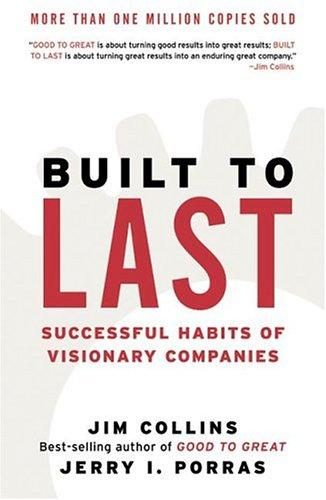
Recommended book
Built to Last – Jim Collins & Jerry Porras (1994)
This book deepens the behaviour by showing how consistent, reinforcing actions generate long-term momentum and cultural change.
References from the Everyone Succeeds book
- Collins, J.C. and Porras, J.I. (2005) Built to Last: Successful Habits of Visionary Companies. London: Random House Business Books. Buy on Amazon ↗
- Locke, E.A., Shaw, K.N., Saari, L.M. and Latham, G.P. (1981) 'Goal setting and task performance: 1969–1980', Psychological Bulletin, 90(1), pp. 125–152. Read free ↗
- Sullivan, D. and Hardy, B. (2023) 10x Is Easier Than 2x: How World-Class Entrepreneurs Achieve More by Doing Less. Carlsbad, CA: Hay House Business. Buy on Amazon ↗
Not sure where to start? Take the free leadership diagnostic to find your three priorities.
As an Amazon Associate, Everyone Succeeds earns from qualifying purchases.