

Strategy behaviour S15
Plan with a Premortem
Imagine your plan has already failed, then ask why. Honest answers now mean small corrections early, not a scramble when it is too late.
Jump to S15 resources ↓What this behaviour looks like
Why might it fail?
Before a launch, a leader asks colleagues to imagine the plan has failed and to write down why, honestly and independently. The biggest risks, including those affecting pupils and families, get owners, preventive actions and warning signs, and the plan changes before it starts.
A practical example
Launching a digital homework system
Optimism by default“The new homework platform launches in September. I'm sure it'll be fine.”
Running a premortem“Imagine it is next July and the homework platform has failed. Write your reasons independently, then we will compare them. For the two biggest risks, we will agree an owner, a preventive action and a warning sign before launch.”
Picture the homework platform failing by next July.
Give the two biggest risks an owner and preventive action.
Agree a warning sign for each risk before launch.
Take ten minutes with your team. Say the plan has failed, list the reasons individually, pick the top two risks and give each an owner, a preventive action and a warning sign.
S15 · Resources for your setting
Put ‘Plan with a Premortem’ into practice
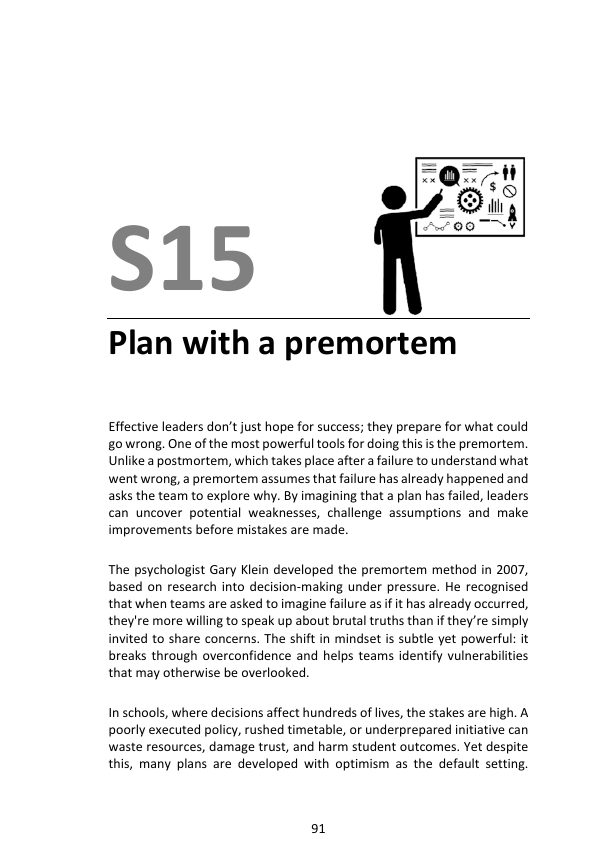
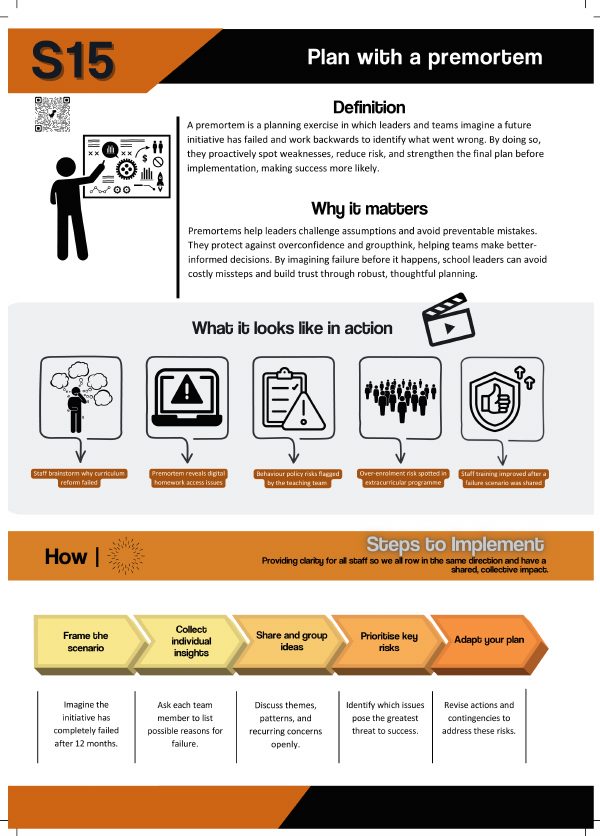
Develop your own practice or lead the learning with your team. Use the chapter and workbook to explore the behaviour, then choose the resources that fit your next step.
Apply · Your leadership practice
Put it to work
Use the S15 Playbook to turn the behaviour into practical action on a real leadership challenge.
- Practical toolkit and coaching prompts
- A practice script to rehearse your approach
- A 90-day plan to guide your next steps
Members only · Explore membership →
Apply · Learning with your team
Lead a team session
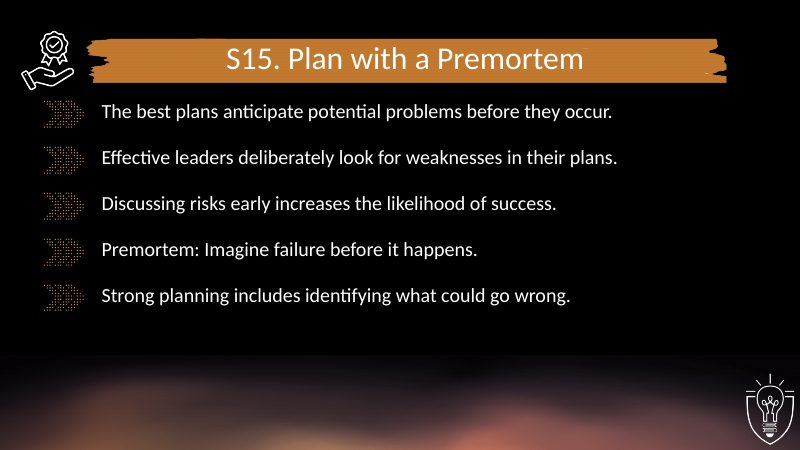
Use the S15 INSET PowerPoint to help colleagues explore the behaviour and plan how to put it into practice.
- Editable slides to adapt to your setting
- Speaker notes to support facilitation
- Discussion, rehearsal and planning
Members only · Explore membership →
Worked examples
See S15 applied in eight leadership contexts
Choose your role to explore the challenge, the leader’s response and the intended result. Members can read the complete example and download an editable Word copy.
In a primary school
In a secondary school
Across schools
Selected worked example
In a primary school · Headteacher
Moving to mixed-age classes
Leonie · Headteacher · 186-pupil village primary school
Worked example at a glance
Moving to mixed-age classes
The challengeA falling roll and a vacancy mean four classes must become three mixed-age groups, changing friendships, curriculum planning and support for pupils with SEND.
What the leader doesThe headteacher runs a premortem with staff, then delays class lists until a pupil map and one curriculum cycle are complete, publishes allocation principles and protects planning days.
What success looks likeBy day 30 priority risks and controls should be agreed; by day 60 the proposed model should pass timetable and transition testing; by day 90 a safe, sustainable class structure should be approved.
Nadia · Assistant Headteacher for early reading · 648-pupil three-form-entry primary school
Worked example at a glance
One reading assessment platform
The challengeTeachers spend six hours a term entering overlapping reading results, but the new platform's automated groups do not reliably reflect speech, language or English-acquisition needs.
What the leader doesThe assistant headteacher asks reading, SEND, EAL and data leads to imagine the platform failing, then makes teacher validation meetings non-negotiable, records override reasons and removes duplicate entry.
What success looks likeBy day 30 every priority validity and workload risk should have a named control; by day 60 the pilot should produce valid moderated decisions; by day 90 a defensible decision to adopt, adapt or reject should be made.
Marek · Mathematics Lead and Year 3 teacher · 412-pupil two-form-entry infant and junior school
Worked example at a glance
Number fluency without withdrawal
The challengeNumber retrieval is slow for many pupils, but past interventions became extra worksheets and took pupils with SEND out of foundation subjects.
What the leader doesThe mathematics lead imagines the routine failing, then adds a visible ten-minute stop rule, a strategy-explanation prompt and an agreement that no pupil routinely misses foundation subjects for extra practice.
What success looks likeBy day 30 controls for the five priority risks should be in place; by day 60 the routine should improve fluency and transfer; by day 90 a sustainable approach should be agreed.
Omar · Headteacher · ages 11 to 16 secondary school, 1,340 pupils
Worked example at a glance
A longer day for enrichment
The challengeEnrichment participation is 46% and lowest for disadvantaged pupils, but a compulsory extended day leaves transport, staff contracts, prayer, caring duties and specialist capacity unresolved.
What the leader doesThe headteacher replaces a whole-school launch with a six-week, two-cohort pilot, secures transport and contracts first, publishes access and quality thresholds and agrees when the pilot would stop.
What success looks likeBy day 30 safety, access and capacity risks should each have a funded control; by day 60 a six-week pilot should deliver equivalent routes; by day 90 the decision to scale, change or stop should rest on evidence.
Quentin · Assistant Headteacher for attendance · ages 11 to 18 secondary school, 1,530 pupils
Worked example at a glance
Same-day home visits, safely
The challengeUnexplained absence remains unresolved beyond noon for 27 pupils a week, but same-day visits raise staffing, lone-working, consent, data and fairness risks.
What the leader doesThe assistant headteacher adds a risk matrix with DSL approval, lone-working controls and a weekly equity review, then starts a two-week supervised pilot, stopping any visit without a complete safety plan.
What success looks likeBy day 30 risk, data and lone-working controls should pass testing; by day 60 a supervised pilot should reduce unresolved absence safely; by day 90 a proportionate future pathway should be decided.
Poppy · Pastoral Lead for Key Stage 3 · ages 11 to 18 secondary school, 1,260 pupils
Worked example at a glance
Safe peer mentoring
The challengePupils report loneliness and low-level conflict and 34 have volunteered to mentor, but the plan has no safeguarding boundaries, supervision or route for disclosures.
What the leader doesThe pastoral lead cuts the first cohort to twelve matches, rehearses a listen, limit and link script with every mentor and timetables weekly supervision, with a named adult ready to take over.
What success looks likeBy day 30 safeguarding controls and role boundaries should be tested; by day 60 a small pilot should run safely; by day 90 the team should decide whether the programme continues, changes or stops.
Rosa · Head of History · ages 11 to 18 secondary school, 1,110 pupils
Worked example at a glance
Re-sequencing Key Stage 3 History
The challengePupils recall facts securely but argue causes weakly. The new enquiry sequence is promising, but subject knowledge varies, Year 9 resources are incomplete and preparation clashes with exam marking.
What the leader doesThe head of History phases the launch, with Years 7 and 8 first and Year 9 only once resources and rehearsal pass review, and leads subject-knowledge briefings and coached rehearsal for each enquiry.
What success looks likeBy day 30 the five curriculum risks should be owned and controlled; by day 60 Years 7 and 8 should launch securely; by day 90 Year 9 should meet the threshold or remain staged.
Kavita · Trust Director of Digital Strategy · seven-school trust
Worked example at a glance
A safe move to one MIS
The challengeSeven schools must move to one management information system by September, but data quality, training and local processes vary sharply between them.
What the leader doesThe director asks the implementation group to imagine the migration has failed, ranks risks such as unreliable data and shadow systems, and adds two rehearsal migrations, school sign-off and a rollback decision.
What success looks likeBy day 30 five priority risks should have owned controls; by day 60 every school should demonstrate safe readiness or an adapted route; by day 90 migration should proceed with no unresolved high-harm risk.
The complete Playbook is for members
Turn this example into action
Read the full toolkit, coaching and practice scripts, and 90-day plan. Members can view the PDF here and download an editable Word copy.
Resources for this behaviour
Templates and checklists from the resource library that put S15 into practice.
Further reading

Recommended book
Sources of Power– Gary Klein (1998)
This text strengthens the behaviour by demonstrating how anticipating failure in advance leads to better planning, sharper insight and reduced risk.
References from the Everyone Succeeds book
- Heath, C. and Heath, D. (2013) Decisive: How to Make Better Choices in Life and Work. New York: Crown Business. Buy on Amazon ↗
- Klein, G. (2007) 'Performing a project premortem', Harvard Business Review, 85(9), pp. 18–19. View article ↗
- Marquet, L.D. (2013) Turn the Ship Around! A True Story of Building Leaders by Breaking the Rules. New York: Portfolio/Penguin. Buy on Amazon ↗
Not sure where to start? Take the free self-diagnostic to choose one to three behaviours to focus on.
As an Amazon Associate, Everyone Succeeds earns from qualifying purchases.