

Yourself behaviour Y6
Prioritise What Matters
Fill your week with emails and quick wins and the big rocks never fit. Book the work only you can lead first.
Jump to Y6 resources ↓What this behaviour looks like
Big rocks first
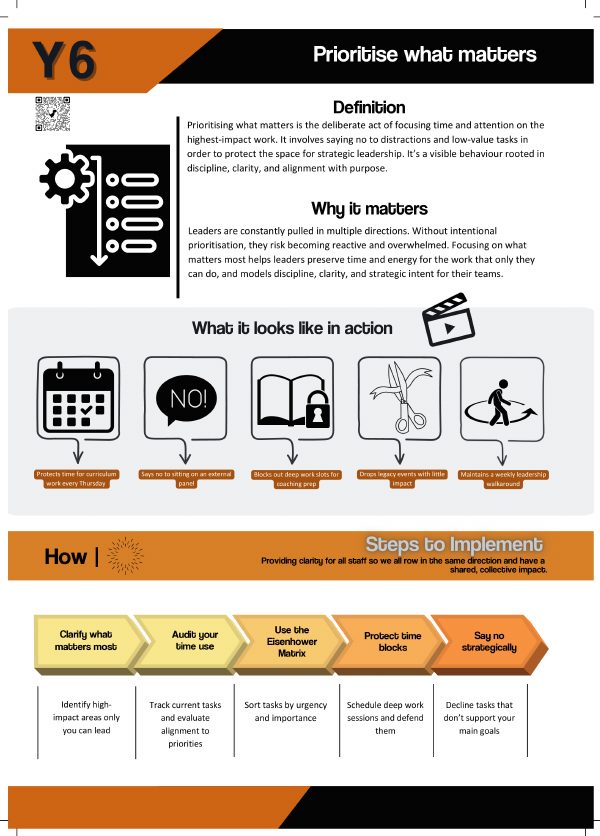
A leader books the work only they can lead, such as curriculum planning, coaching colleagues or a weekly walkaround, before the week fills up. They separate urgent from important, say no to low-value requests and drop legacy events that no longer serve pupils.
A practical example
Protecting time for a curriculum review
Fitting it in“I will get to the English and maths sequencing review when things calm down. For now I will answer these premises questions and approve the orders.”
Booked in first“A 90-minute block is in my diary every week for the sequencing review, with a clear output, and purchasing goes to the business manager within the agreed limit. Routine requests wait or go to the agreed colleague. Genuine emergencies can interrupt; if they do, I rebook the block.”
The English and maths sequencing review gets my best time.
Book a weekly 90-minute block with a clear output.
Route routine requests elsewhere and rebook if emergencies interrupt.
Name one big rock, book a protected block for it and decide one thing you will delegate, move or stop to make room.
Y6 · Resources for your setting
Put ‘Prioritise What Matters’ into practice
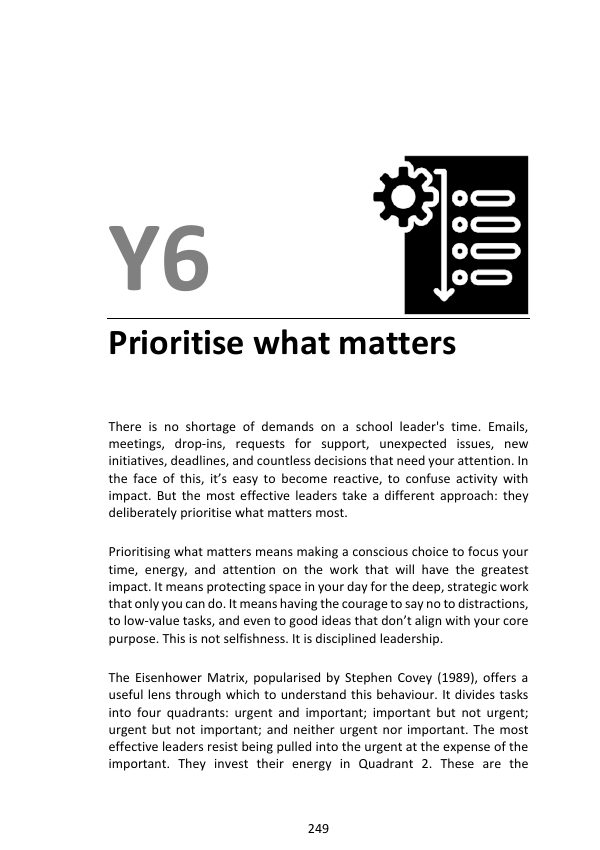
Develop your own practice or lead the learning with your team. Use the chapter and workbook to explore the behaviour, then choose the resources that fit your next step.
Apply · Your leadership practice
Put it to work
Use the Y6 Playbook to turn the behaviour into practical action on a real leadership challenge.
- Practical toolkit and coaching prompts
- A practice script to rehearse your approach
- A 90-day plan to guide your next steps
Members only · Explore membership →
Apply · Learning with your team
Lead a team session
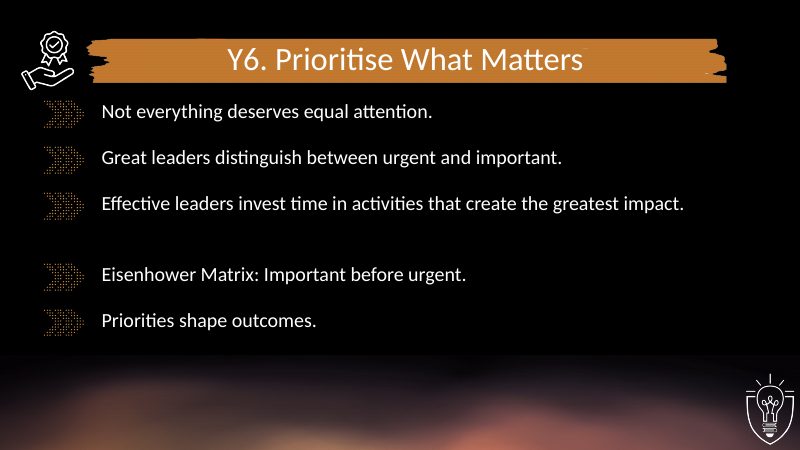
Use the Y6 INSET PowerPoint to help colleagues explore the behaviour and plan how to put it into practice.
- Editable slides to adapt to your setting
- Speaker notes to support facilitation
- Discussion, rehearsal and planning
Members only · Explore membership →
ES CoachApply · Online, with ES Coach
Complete the Y6 Playbook online
Work through the Playbook on your desk instead of on paper. A built-in coach supports you with every question: jot a few words and ES Coach suggests an answer for you to edit.
- ES Coach help under every question and table
- Saves as you type, and stays private to you
- Linked to your goal and your 90-day plan
Also in the online Playbook, with PDF and Word copies: worked examples following an Early Years leader, a primary phase leader, a primary SENDCo, a teaching head, a secondary SENDCo, a head of sixth form, a teaching and learning lead, a support staff team leader and a trust chief operating officer.
Members only · Explore membership → · Sign in
Worked examples
See Y6 applied in seventeen leadership contexts
Choose your role to explore the challenge, the leader’s response and the intended result. Members can read the complete example and download an editable Word copy.
In a primary school
In a secondary school
Across schools
Selected worked example
In a primary school · Headteacher
Making room for the curriculum review
Early Years leader · Small rural primary of about 90 pupils with a mixed Reception and Year 1 class of 22...
Worked example at a glance
Protecting time for the two things only I can lead this year, getting...
The challengeProtecting time for the two things only I can lead this year, getting four Reception children back on track in phonics and building early links with the nurseries and childminders our next intake comes from, while maths leadership and small tasks fill every gap in my week.
What the leader is aiming forBy mid-February, at least three of our four Reception children who were behind are reading the expected sounds and words, and our six feeder settings are linked to us, because I protected time for both.
How they will know it is workingKeep-up tallied on the wall chart on 9 of every 10 days, my transition log of contacts, leadership Thursdays used for transition work, and my record of leaving times and free Saturdays.
Phase leader · Small rural primary school of about 95 pupils in four classes, where I lead KS2 across...
Worked example at a glance
Protecting time for the two pieces of leadership work only I can do...
The challengeProtecting time for the two pieces of leadership work only I can do this term, the two-year writing cycle for our mixed-age classes and Year 6 writing assessment, by deciding what to delegate, move or decline.
What the leader is aiming forBy early March, KS2 children in our mixed-age classes have a two-year writing sequence with no repeated or missed units, and by early February all 12 Year 6 children have their independent writing accurately assessed.
How they will know it is workingMy Wednesday writing time happening in at least 14 of 16 weeks, at least 10 of my 12 Year 6 judgements agreed by the colleague from the nearby school, and leaving by 5pm three days most weeks.
Primary SENDCo · A three-form-entry primary of about 650 pupils, with a 52-place Nursery, in an area of...
Worked example at a glance
My week is swallowed by behaviour incidents, phone calls, covering...
The challengeMy week is swallowed by behaviour incidents, phone calls, covering absent teaching assistants and paperwork, so the two things I know would make the biggest difference, coaching teachers on adaptive teaching and early identification of speech and language needs in Nursery and Reception, keep getting pushed to "next week".
What the leader is aiming forBy the end of the spring term, agreed adaptations are in place for at least 85% of pupils on SEN support and every Nursery and Reception child has been screened for speech and language needs, because I book that work first.
How they will know it is workingCoaching slots checked every Friday, learning walks, the Early Years screening tracker, and a half-termly time log showing less time on incidents and none on cover.
Teaching headteacher · A primary of 150 pupils in a large coastal village, with five mixed-age classes and a...
Worked example at a glance
My three leadership days disappear into the building, cover...
The challengeMy three leadership days disappear into the building, cover, lunchtime problems, emails and the wraparound club, while our most important priority, reading in Years 3 and 4, where only 55% of pupils are reading at the expected standard, gets almost none of my time.
What the leader is aiming forBy mid-February, at least 68% of Year 3 and 4 pupils are reading at the expected standard (from 55%), on track for 75% by July, because I protect three hours a week for reading and hand on site, cover and wraparound decisions.
How they will know it is workingAt least 80% of scheduled reading visits completed, a half-termly time log showing site and cover time down from 12 hours to four, and the termly reading assessment.
Secondary SENDCo · An 11 to 18 school of about 1,250 pupils in a multi-academy trust, where I am new to the...
Worked example at a glance
Protecting time for the work only the SENDCo can lead, such as the...
The challengeProtecting time for the work only the SENDCo can lead, such as the quality of annual reviews and the Year 6 transition plan, when my week is being swallowed by behaviour incidents and parent emails that I used to handle as a head of year and am still being asked to pick up.
What the leader is aiming forBy mid-March, all 9 annual reviews due before Easter are held on time with at least 80% of outcomes specific and measurable, the Year 6 transition plan is agreed with every feeder primary, and I spend no more than 2 hours a week on behaviour that does not involve pupils with SEND.
How they will know it is workingI will know it is working when I keep at least 90% of my protected review blocks and the weekly head of year slot happens every Wednesday (lead), and when reviews are on time and of good quality, the transition plan is agreed and my time log shows the shift (lag).
Head of sixth form · Rural 11 to 18 school with a sixth form of 150, where many students travel 40 minutes or...
Worked example at a glance
Protecting time for Year 13 references and Year 11 recruitment...
The challengeProtecting time for Year 13 references and Year 11 recruitment conversations when my weeks are swallowed by bus queries, cover and small common room problems, and being honest with the deputy head about a new request I cannot take on this term.
What the leader is aiming forBy early January all 61 Year 13 references are complete, and by the February application date all 34 undecided Year 11 pupils have had a recruitment conversation, while I am home by 5.30pm at least three evenings in most weeks.
How they will know it is workingProtected reference sessions and recruitment lunchtimes happen as booked and I check my diary each Friday (lead), and references completed, conversations held, applications received, evenings home and fewer queries reaching me show it is working (lag).
Teaching and learning lead · A three-form-entry primary school of about 630 pupils in an area of high disadvantage...
Worked example at a glance
Protecting my weekly coaching visits to our eight early career...
The challengeProtecting my weekly coaching visits to our eight early career teachers, which keep being pushed out by cover, data requests and being called to incidents.
What the leader is aiming forBy mid-February, I make at least 7 of my 8 planned early career teacher coaching visits in at least 9 of 12 school weeks, up from 3 in the week I looked at.
How they will know it is workingLead evidence is my Friday count of visits made and the new cover and call-out orders being kept; lag evidence is the early career teachers meeting their coaching goals and saying the coaching helps them.
Support staff team leader · Office manager in a small primary school of about 120 pupils, leading one part-time...
Worked example at a glance
Protecting two afternoons a week for the attendance follow-up only I...
The challengeProtecting two afternoons a week for the attendance follow-up only I can lead, after a term in which the office window, the phone, first aid and the newsletter filled every day and three children's absences were not followed up for weeks.
What the leader is aiming forBy the February half term next year, every child below 90% attendance has a phone call within a week, the number below 90% falls from 11 to 7 or fewer, and all five care plans are up to date.
How they will know it is workingI will know it is working when my two protected afternoons happen at least 8 times in 10 and my administrator covers the front without calling me out (lead), and attendance figures, call records and care plan reviews show the change (lag).
Trust chief operating officer · Multi-academy trust of eight schools (five primary, two secondary and one alternative...
Worked example at a glance
Protecting time for the few things only I can do in the spring term...
The challengeProtecting time for the few things only I can do in the spring term, including next year's budget and the alternative provision school's move to new premises, when most of my week goes on approvals, calls and other people's urgent problems
What the leader is aiming forBy mid-March, I have protected time for the few things only I can do, so every school has a budget and three-year plan protecting pupils' support and the alternative provision school's 64 pupils move safely after Easter.
How they will know it is workingMy Friday check shows 80% of protected budget mornings kept and approvals halved, all eight budgets are agreed by mid-March for the board in late March, and the move is on track for Easter.
Pranav · Headteacher · 426-pupil primary school
Worked example at a glance
Making room for the curriculum review
The challengeA safeguarding referral and a two-day boiler failure have taken the curriculum block two weeks running, and the headteacher still absorbs routine premises and purchasing questions that others could hold.
What the leader doesThe headteacher moves the sequencing block to Monday, hands the boiler follow-up and routine approvals to the business manager while taking work off her list, and rebooks any lost block the same week.
What success looks likeBy day 30 the curriculum block should run in three weeks out of four; by day 60 each block should produce a written sequencing decision with a named owner; by day 90 delegated work should stay delegated and the review should have a finish date.
Stefan · Deputy Headteacher for staffing and professional development · 718-pupil primary school
Worked example at a glance
Protecting coaching for new phase leaders
The challengePersonally coordinating every cover change means coaching for new phase leaders keeps being displaced, so leadership capacity in the school is not growing.
What the leader doesThe deputy delegates daily cover to the office lead within agreed rules and a 7.45 exception checkpoint, publishes one live cover board and protects two coaching sessions each week.
What success looks likeBy day 30 the office lead should publish cover daily, escalating only agreed exceptions; by day 60 each new phase leader should have had at least eleven of twelve coaching sessions; by day 90 cover should stay safe and phase leaders should make deployment judgements.
Rhea · English Lead and Year 5 teacher · 344-pupil junior school
Worked example at a glance
Protecting the subject hour
The challengeNon-urgent resource questions arrive at the classroom door all week, breaking up the protected subject hour and pulling the English lead away from improving writing in Years 5 and 6.
What the leader doesThe English lead gathers resource questions for a Thursday check-in, points colleagues to an indexed resource map, closes communication during the protected hour and uses it to review pupils' writing.
What success looks likeBy day 30 resource questions should come to Thursday's check-in and be answered the same day; by day 60 two writing adjustments should be taught in Years 5 and 6; by day 90 recurring questions should stop because the guidance answers them.
Talia · Headteacher · ages 11 to 16 secondary school, 1,250 pupils
Worked example at a glance
Clearing the diary for attendance strategy
The challengeThirty-two inherited meetings a fortnight leave the headteacher working on persistent absence only in fragmented gaps, while every issue seems to need a headteacher meeting.
What the leader doesThe headteacher removes twelve meetings, shortens eight and delegates six, publishes where each decision now goes and protects Monday and Thursday blocks to design the attendance strategy.
What success looks likeBy day 30 removed meetings should stay gone with every decision on a clear route; by day 60 protected blocks should produce a written persistent-absence strategy with named owners; by day 90 persistently absent pupils should be missing measurably less school.
Vera · Assistant Headteacher for assessment · ages 11 to 18 secondary school, 1,610 pupils
Worked example at a glance
Protecting time for assessment validity
The challengeProducing every requested data cut on the day it is asked for fragments the assistant head's time, leaving little for making the assessment system valid and proportionate.
What the leader doesThe assistant head asks each request to name the decision it serves, runs a weekly clinic where subject leaders interpret data themselves, declines analysis with no credible use and protects Tuesday mornings for validity work.
What success looks likeBy day 30 every analysis request should arrive with a decision, owner and date; by day 60 the Tuesday block should run in seven weeks of eight and two assessments should be changed or removed; by day 90 subject leaders should answer routine questions themselves.
Usman · Head of Year 10 · ages 11 to 18 secondary school, 1,430 pupils
Worked example at a glance
Making time for pupils at greatest risk
The challengeReformatting tutor updates and handling low-level requests all day leave the head of year little time for the 24 Year 10 pupils most at risk of disengaging.
What the leader doesThe head of year stops cosmetic edits, uses one concise update template, delegates routine follow-up to tutors with clear thresholds and protects three morning contact blocks each week.
What success looks likeBy day 30 tutor updates should arrive complete without rewriting; by day 60 all three planned contacts should happen in at least five weeks out of six; by day 90 tutors should spot concerns earlier and attendance or belonging should improve for half the group.
Will · Head of Business · ages 11 to 16 secondary school, 890 pupils
Worked example at a glance
Saying no to protect curriculum time
The challengeOptional competitions, speakers and projects keep displacing department development time, and a new enterprise competition invitation lands in the busiest assessment half term.
What the leader doesThe head of department declines the competition this cycle while keeping the relationship, asks for next year's dates in writing and protects the Monday department block for reviewing pupils' writing.
What success looks likeBy day 30 the refusal should be sent with no hidden competition work; by day 60 the Monday block should run in six weeks of eight and produce two adjustments colleagues have taught; by day 90 applied writing should improve without anyone absorbing hidden hours.
Ophelia · Trust Director of School Improvement · eleven-school trust
Worked example at a glance
Protecting time for priority schools
The challengeSeven routine curriculum meetings a fortnight and repeated data requests crowd out the diagnostic work and coaching that the three schools in greatest need depend on.
What the leader doesThe director hands routine forums to school-improvement partners with clear escalation thresholds, replaces most meetings with written exception updates and protects two diagnostic blocks each week for priority schools.
What success looks likeBy day 30 partners should chair every routine forum, with only agreed escalations reaching the director; by day 60 diagnostic blocks should run in most weeks and each priority school should have a written diagnosis; by day 90 priority schools should move against their trajectories.
The complete Playbook is for members
Turn this example into action
Read the full toolkit, coaching and practice scripts, and 90-day plan. Members can view the PDF here and download an editable Word copy.
Further reading

Recommended book
The 7 Habits of Highly Effective People – Stephen Covey (1989)
This text strengthens the behaviour by showing how to focus on high-value work, reduce distraction and invest in long-term impact.
References from the Everyone Succeeds book
- Collins, J. (2001) Good to Great: Why Some Companies Make the Leap… and Others Don't. London: Random House Business Books. Buy on Amazon ↗
- Covey, S.R. (1989) The 7 Habits of Highly Effective People: Powerful Lessons in Personal Change. New York: Free Press. Buy on Amazon ↗
- McKeown, G. (2014) Essentialism: The Disciplined Pursuit of Less. London: Virgin Books. Buy on Amazon ↗
- Newport, C. (2016) Deep Work: Rules for Focused Success in a Distracted World. London: Piatkus. Buy on Amazon ↗
Not sure where to start? Take the free self-diagnostic to choose one to three behaviours to focus on.
As an Amazon Associate, Everyone Succeeds earns from qualifying purchases.