

Teams behaviour T4
Create a Team
Golf teams add up individual scores; basketball teams play together. Build a team that relies on one another, shares responsibility and owns results.
Jump to T4 resources ↓What this behaviour looks like
Basketball, not golf
A leader names the goal a team can only reach together, builds trust and makes it safe for every voice, teachers and support staff alike, to contribute and challenge. The team decides together, holds one another to account and celebrates progress for all pupils.
A practical example
A phase meeting about writing
A working group“Each teacher gives a quick update on their class. Any questions? Fine, same time next week.”
A real team“We have each brought three pieces of independent writing. Let's look at them together before anyone explains, and hear from our teaching assistants first. Then we will agree one change we all make, because writing across the phase is our shared result.”
Improve independent writing across the phase, together.
Read the writing first; teaching assistants speak first.
Every class makes the same agreed change; the result is shared.
Replace one round of updates with a shared problem: state the aim, give everyone time to think before anyone speaks, and agree one improvement the team will own.
T4 · Resources for your setting
Put ‘Create a Team’ into practice
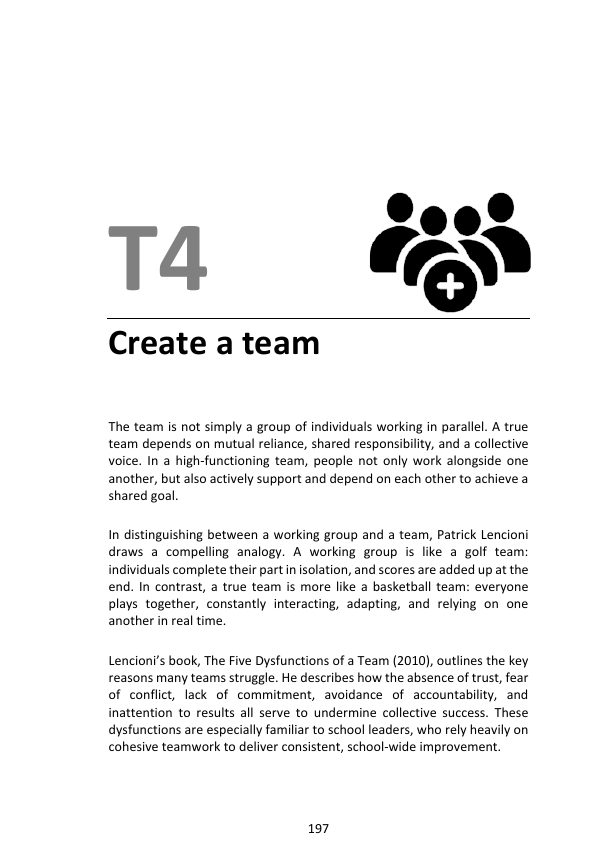
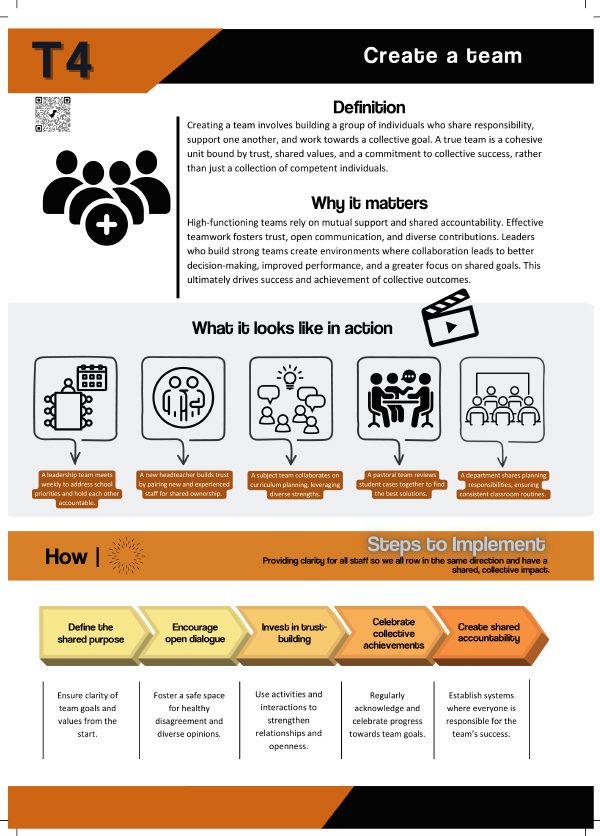
Develop your own practice or lead the learning with your team. Use the chapter and workbook to explore the behaviour, then choose the resources that fit your next step.
Apply · Your leadership practice
Put it to work
Use the T4 Playbook to turn the behaviour into practical action on a real leadership challenge.
- Practical toolkit and coaching prompts
- A practice script to rehearse your approach
- A 90-day plan to guide your next steps
Members only · Explore membership →
Apply · Learning with your team
Lead a team session
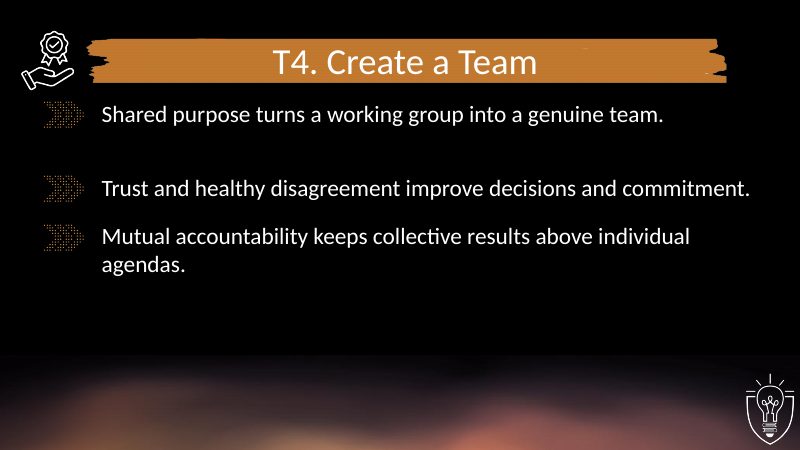
Use the T4 INSET PowerPoint to help colleagues explore the behaviour and plan how to put it into practice.
- Editable slides to adapt to your setting
- Speaker notes to support facilitation
- Discussion, rehearsal and planning
Members only · Explore membership →
Completed Playbooks
See T4 applied in eight leadership contexts
Choose your role to explore the challenge, the leader’s response and the intended result. Members can read the complete example and download an editable Word copy.
In a primary school
In a secondary school
Across schools
Selected completed example
In a primary school · Headteacher
Agreeing one vocabulary entitlement
Patrick · Headteacher · 438-pupil primary school
Worked example at a glance
Agreeing one vocabulary entitlement
The challengeSeven year-group teams have interpreted the school's vocabulary decision differently. Staff are working hard, but the lack of precision creates repeat planning and an inconsistent experience for pupils.
What the leader doesThe headteacher circulates the proposed entitlement beforehand, has everyone examine the same pupil work before subject experts speak, invites the strongest case against it and agrees what teachers will stop doing.
What success looks likeBy day 30 every year group should state the entitlement and apply it to one sequence; by day 60 pupil work should show it in every year group; by day 90 independent vocabulary use should improve in at least five year groups.
Malcolm · Assistant Headteacher for inclusion · 364-pupil junior school
Worked example at a glance
One plan for a pupil with overlapping needs
The challengeA Year 5 pupil's learning, attendance and wellbeing needs sit across nine actions on three systems. The parent has had three calls in eight days and is unsure which plan is current.
What the leader doesThe assistant head maps the case with the inclusion team, invites a 'what are we missing?' round before adding provision, and agrees one outcome, one sequence and one named contact for the family.
What success looks likeBy day 30 every complex case should have one shared outcome, contact owner and review date; by day 60 families should know the current plan and duplicate contacts should halve; by day 90 targeted pupils should show improved attendance or settled learning.
Yasmin · Key Stage 1 Phase Leader · 612-pupil primary school
Worked example at a glance
Closing the gap between reading and writing
The challenge82% of sampled pupils decode the target phonics pattern in reading, but only 47% use it accurately in independent writing, with a 27-point gap between classes. The team rarely examines uncertainty together.
What the leader doesThe phase leader asks teachers to bring matched reading and writing samples, hears teaching assistants first, shares the leader's own least successful sample and agrees one adaptation all six classes test for ten days.
What success looks likeBy day 30 all six classes should complete one comparable ten-day test; by day 60 the phase should run two inquiry cycles that hear teaching assistants first; by day 90 independent use should rise from 47% to at least 65%.
Deborah · Headteacher · 1,240-pupil secondary school
Worked example at a glance
Building real challenge into SLT
The challengeIn six SLT meetings, 31 polished portfolio updates produced 18 actions, 14 allocated by the headteacher. Peer challenge appears in the minutes of only three meetings, and cross-portfolio problems keep travelling upwards.
What the leader doesThe headteacher replaces updates with a decision paper that states the strongest counter-case, brings one of the headteacher's own unresolved decisions for testing, and asks peers to own actions and name dependencies.
What success looks likeBy day 30 every cross-portfolio action should record its owner, dependency and peer check; by day 60 three major decisions should use an evidence-first challenge round; by day 90 checks for understanding should improve in two pilot faculties without extra workload.
Helena · Assistant Headteacher for teaching and learning · 1,090-pupil secondary school
Worked example at a glance
From sharing techniques to testing them
The challengeEight faculties report using checks for understanding, but only three can show how the response changed teaching. The cross-faculty group passes on techniques rather than testing whether they work.
What the leader doesThe assistant head agrees the learning function, lets each faculty design a subject-appropriate test, models a failed test from the leader's own work and pairs faculties as critical friends before keep, adapt or stop decisions.
What success looks likeBy day 30 all eight faculties should have an inquiry question and a critical friend; by day 60 every faculty should bring confirming and inconclusive evidence; by day 90 at least six should show a more reliable response to pupil uncertainty.
Adeel · Head of Year 9 · 1,480-pupil secondary school
Worked example at a glance
A Year 9 pupil-priority huddle
The challengeFour of the last six repeat absences had warning signs recorded by tutors at least five days earlier, but information sat in separate channels and three actions had no named owner.
What the leader doesThe head of year runs a fifteen-minute huddle, collects one factual sentence from every tutor beforehand, states the confidentiality boundary and leaves each priority pupil with one action, owner and escalation trigger.
What success looks likeBy day 30 every huddle should end with a named owner and escalation trigger; by day 60 all tutors should contribute and unowned actions should fall to zero; by day 90 repeat absence after early warnings should fall to no more than two in six.
Kwame · Head of Music · 1,330-pupil secondary school
Worked example at a glance
Planning a sustainable spring concert
The challengeA successful autumn concert hid an unsustainable workload: three colleagues worked more than twelve extra hours, two Year 13 clinics moved and technical reset time went unseen.
What the leader doesThe head of music maps every visible and hidden task before agreeing the scope, treats raising a capacity concern as professionalism rather than lack of passion, and leaves no task assigned to 'the department'.
What success looks likeBy day 30 the concert scope should be agreed with every task owned and timed; by day 60 rehearsals should be on schedule without displacing Year 13 support; by day 90 the concert should meet artistic and inclusion criteria within agreed hours.
Nora · Trust Director of Attendance and Safeguarding · seven-school trust
Worked example at a glance
Turning attendance updates into shared solving
The challengeSeven school leads report figures in turn at the cross-school attendance meeting. In three meetings, 21 updates produced two collective decisions, and four 'trust support' actions had no named owner.
What the leader doesThe director swaps verbal updates for a one-page pre-read, uses the time for an anonymised case clinic, brings a case where the director's first assumption was wrong, and makes every dependency owned aloud.
What success looks likeBy day 30 every shared attendance action should have a named owner, date and early-warning point; by day 60 at least four cross-school cases should be resolved; by day 90 families should report fewer repeated contacts and handover gaps should narrow.
The complete Playbook is for members
Turn this example into action
Read the full toolkit, coaching and practice scripts, and 90-day plan. Members can view the PDF here and download an editable Word copy.
Further reading

Recommended book
The Five Dysfunctions of a Team – Patrick Lencioni (2002)
This text deepens the behaviour by exploring how trust, norms and shared purpose turn groups into effective teams.
References from the Everyone Succeeds book
- Lencioni, P.M. (2002) The Five Dysfunctions of a Team: A Leadership Fable. San Francisco: Jossey-Bass. Buy on Amazon ↗
- Pentland, A. (2012) 'The new science of building great teams', Harvard Business Review, 90(4), pp. 60–69. View article ↗
Not sure where to start? Take the free leadership diagnostic to find your three priorities.
As an Amazon Associate, Everyone Succeeds earns from qualifying purchases.