

Leadership behaviour L5
Stack the Chairs
No task is beneath leadership. Stepping in at the right moment keeps learning on track and builds a culture where everyone contributes.
Jump to L5 resources ↓What this behaviour looks like
No task beneath leadership
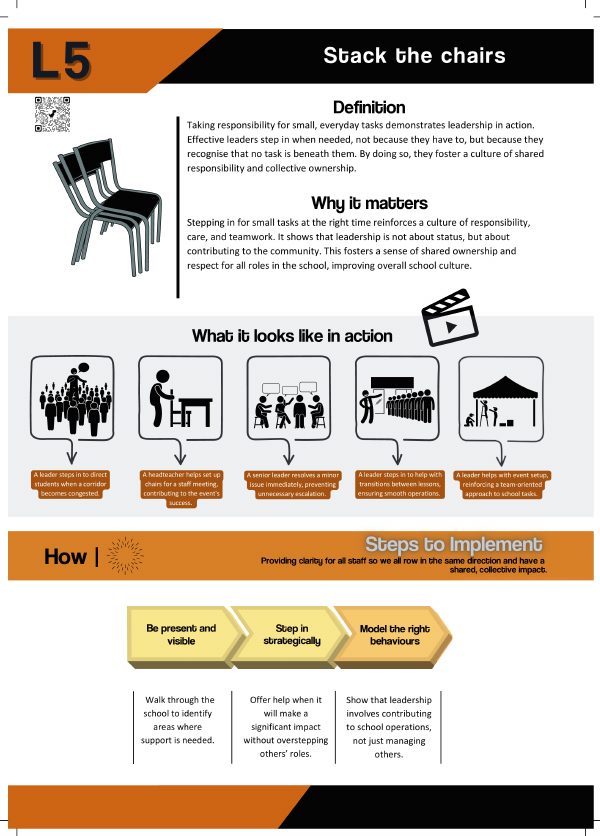
A leader steps in when a corridor is congested, the hall needs clearing or a pupil asks for help, because the moment genuinely matters. They watch for Andy Buck's 'monkey on your shoulder', helping alongside colleagues rather than quietly taking over their jobs.
A practical example
Clearing the hall after assembly
Walking past“The facilities team will sort the chairs out when they get here.”
Rolling up sleeves“The next class arrives in five minutes, so let's stack these chairs now. Thank you for starting on the back rows. It means the class can come straight in and start learning.”
The next class arrives in five minutes and the chairs are out.
Stack chairs alongside colleagues instead of leaving it for later.
Thank the colleague who started and say what it achieves.
Choose a pinch point, ask what help is needed, do one useful task without taking over, and thank the person who usually carries it.
L5 · Resources for your setting
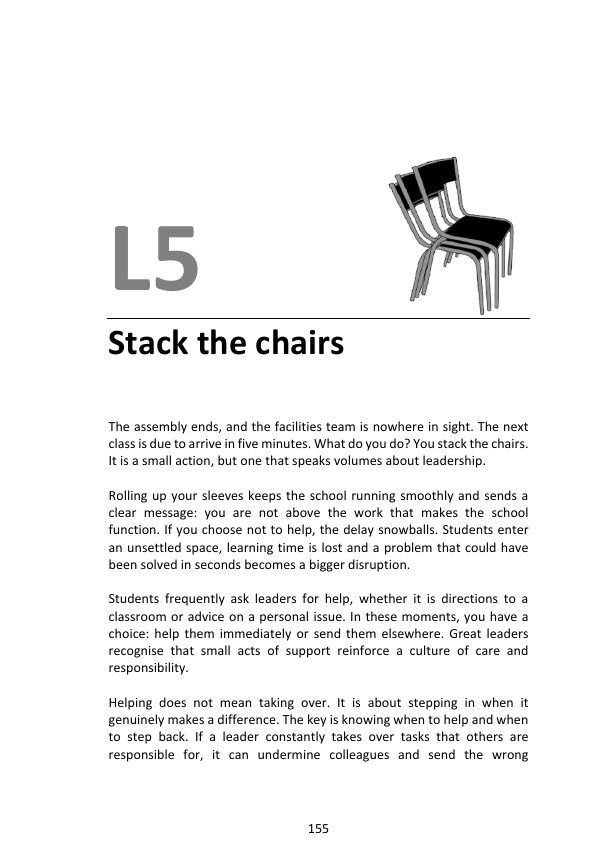
Put ‘Stack the Chairs’ into practice
Develop your own practice or lead the learning with your team. Use the chapter and workbook to explore the behaviour, then choose the resources that fit your next step.
Apply · Your leadership practice
Put it to work
Use the L5 Playbook to turn the behaviour into practical action on a real leadership challenge.
- Practical toolkit and coaching prompts
- A practice script to rehearse your approach
- A 90-day plan to guide your next steps
Members only · Explore membership →
Apply · Learning with your team
Lead a team session
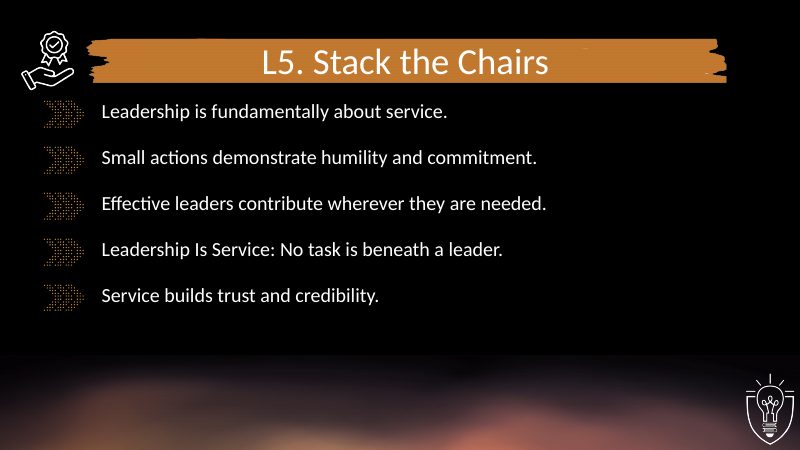
Use the L5 INSET PowerPoint to help colleagues explore the behaviour and plan how to put it into practice.
- Editable slides to adapt to your setting
- Speaker notes to support facilitation
- Discussion, rehearsal and planning
Members only · Explore membership →
Completed Playbooks
See L5 applied in eight leadership contexts
Choose your role to explore the challenge, the leader’s response and the intended result. Members can read the complete example and download an editable Word copy.
In a primary school
In a secondary school
Across schools
Selected completed example
In a primary school · Headteacher
Supporting the lunch transition
Khalid · Headteacher · 270-pupil infant school
Worked example at a glance
Supporting the lunch transition
The challengeThe lunch transition in the infant hall runs late twice a week, and leaders arrive only once the queue and the noise have already built.
What the leader doesThe headteacher arrives before the pressure point, does a useful practical task agreed with the midday team, then hands back so midday staff keep clear authority over lunch.
What success looks likeBy day 30 the lunch team should agree clear support and handback routines; by day 60 two recurring transition obstacles should be removed; by day 90 lunch should stay calm, with staff authority clear, without the headteacher present.
Lewis · Assistant Headteacher · 270-pupil infant school
Worked example at a glance
Removing duplicate assessment work
The challengeTeachers each lose around ninety minutes moving the same data between a tracking sheet and the reporting system, while leaders check completion rather than asking why it takes so long.
What the leader doesThe assistant headteacher gives practical, bounded help at the end of the cycle, removes the duplicate record and leaves assessment judgements with teachers rather than acting as an informal moderator.
What success looks likeBy day 30 one approved assessment record and escalation route should be in use; by day 60 administrative preparation time should fall without weaker moderation; by day 90 the next cycle should run with no duplicate record.
Dylan · Art and Design Lead and Year 2 teacher · 270-pupil infant school
Worked example at a glance
Setting up the art exhibition
The challengeWith 140 pieces still to mount, one colleague and the premises team carry almost all the setup, and leadership's contribution has never been said out loud, so it looks optional.
What the leader doesThe art lead takes an agreed share of the mounting, protects the specialist's and pupils' decisions about their own work and recognises every contributor accurately.
What success looks likeBy day 30 installation roles and pupil decisions should stay explicit; by day 60 a reusable mounting system should remove repeated preparation; by day 90 pupils and staff should report clear authorship and useful support.
Stephen · Headteacher · ages 11 to 16 coastal secondary school, 940 pupils
Worked example at a glance
Setting up and clearing down open evening
The challengeOperational colleagues have told the headteacher, politely, that senior leaders appear for the public hours of events but not for the setup or the clear-down.
What the leader doesThe headteacher joins the four o'clock setup and the nine o'clock clear-down, takes direction from operational colleagues and moves any praise onto the people who do this work every time.
What success looks likeBy day 30 every major event should include a bounded senior service role; by day 60 contributor recognition and close-down capacity should be explicit; by day 90 events should close safely without depending on a small, exhausted group.
Chris · Assistant Headteacher · ages 11 to 16 coastal secondary school, 940 pupils
Worked example at a glance
Supporting cover supervisors in a hard week
The challengeCover demand is running about 35% above normal, and offers of senior help arrive at the wrong moments, leaving supervisors less clear about who is in charge of the room.
What the leader doesThe assistant headteacher removes defined practical bottlenecks, agrees out loud when and why a senior leader is staying in a room and who is leading, and protects supervisors' authority and decision routes.
What success looks likeBy day 30 cover allocation, support and escalation routes should be explicit; by day 60 duplicate communication should end and paid capacity should cover predictable gaps; by day 90 cover supervisors should report safe, respected, manageable practice.
Dev · Staff and Student Wellbeing Lead · ages 11 to 16 coastal secondary school, 940 pupils
Worked example at a glance
Protecting breakfast check-ins
The challengeYear 7 breakfast numbers are up about 40%, and pastoral staff are serving food while trying to hold the safeguarding check-ins the provision exists for.
What the leader doesThe wellbeing lead takes on practical serving work so pastoral staff can focus on check-ins, keeps safeguarding responsibility with them and passes on anything a pupil discloses through the proper route.
What success looks likeBy day 30 breakfast support roles and safeguarding handbacks should be explicit; by day 60 the recurring supply bottleneck should be resolved; by day 90 pupils should report a reliable, stigma-free welcome and support.
Mohammed · Director of Performing Arts · ages 11 to 16 coastal secondary school, 940 pupils
Worked example at a glance
Supporting technicians through the production
The challengeThe same two technicians absorb every late request during the school production, their names appear nowhere, and the pattern repeats with every show.
What the leader doesThe director routes requests through one disciplined channel, offers safe practical help where technicians want it, backs their technical decisions in front of the cast and credits their specialist contribution.
What success looks likeBy day 30 every production task should have competent ownership and safe boundaries; by day 60 scope and paid capacity should match the technical plan; by day 90 the production should run safely with technicians' expertise visibly valued.
Jonathan · Trust Director of People and Wellbeing · nine-school trust
Worked example at a glance
Making central support practical
The challengeSchools say central support is request-heavy, and within the central team the practical work falls almost entirely to the most junior colleagues.
What the leader doesThe director asks central leaders to offer bounded practical help at school-facing events, hand tasks back to the event owner, credit overlooked work accurately and take structural action on recurring friction.
What success looks likeBy day 30 central leaders should offer bounded service at all nine school-facing events; by day 60 recurring operational friction should have named structural action; by day 90 operational colleagues should report stronger authority and practical support.
The complete Playbook is for members
Turn this example into action
Read the full toolkit, coaching and practice scripts, and 90-day plan. Members can view the PDF here and download an editable Word copy.
Further reading

Recommended book
Leaders Eat Last – Simon Sinek (2014)
This book reinforces your practice by emphasising how small, visible acts of service strengthen trust and model expectations.
References from the Everyone Succeeds book
- Buck, A. (2018) Leadership Matters 3.0: How Leaders at All Levels Can Create Great Schools. Woodbridge: John Catt Educational. Buy on Amazon ↗
Not sure where to start? Take the free leadership diagnostic to find your three priorities.
As an Amazon Associate, Everyone Succeeds earns from qualifying purchases.