

Yourself behaviour Y6
Prioritise What Matters
Fill your week with emails and quick wins and the big rocks never fit. Book the work only you can lead first.
Jump to Y6 resources ↓What this behaviour looks like
Big rocks first
A leader books the work only they can lead, such as curriculum planning, coaching colleagues or a weekly walkaround, before the week fills up. They separate urgent from important, say no to low-value requests and drop legacy events that no longer serve pupils.
A practical example
Protecting time for a curriculum review
Fitting it in“I will get to the English and maths sequencing review when things calm down. For now I will answer these premises questions and approve the orders.”
Booked in first“A 90-minute block is in my diary every week for the sequencing review, with a clear output, and purchasing goes to the business manager within the agreed limit. Routine requests wait or go to the agreed colleague. Genuine emergencies can interrupt; if they do, I rebook the block.”
The English and maths sequencing review gets my best time.
Book a weekly 90-minute block with a clear output.
Route routine requests elsewhere and rebook if emergencies interrupt.
Name one big rock, book a protected block for it and decide one thing you will delegate, move or stop to make room.
Y6 · Resources for your setting
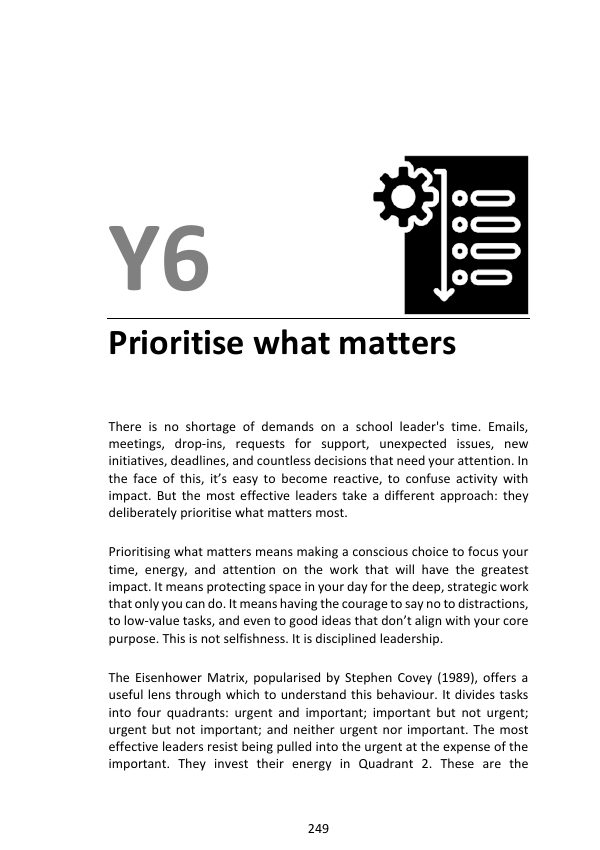
Put ‘Prioritise What Matters’ into practice
Develop your own practice or lead the learning with your team. Use the chapter and workbook to explore the behaviour, then choose the resources that fit your next step.
Apply · Your leadership practice
Put it to work
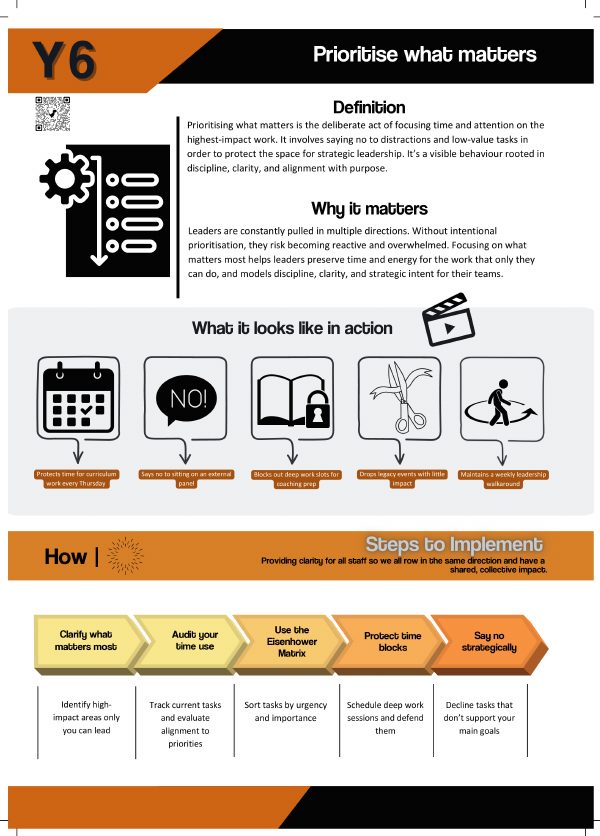
Use the Y6 Playbook to turn the behaviour into practical action on a real leadership challenge.
- Practical toolkit and coaching prompts
- A practice script to rehearse your approach
- A 90-day plan to guide your next steps
Members only · Explore membership →
Apply · Learning with your team
Lead a team session
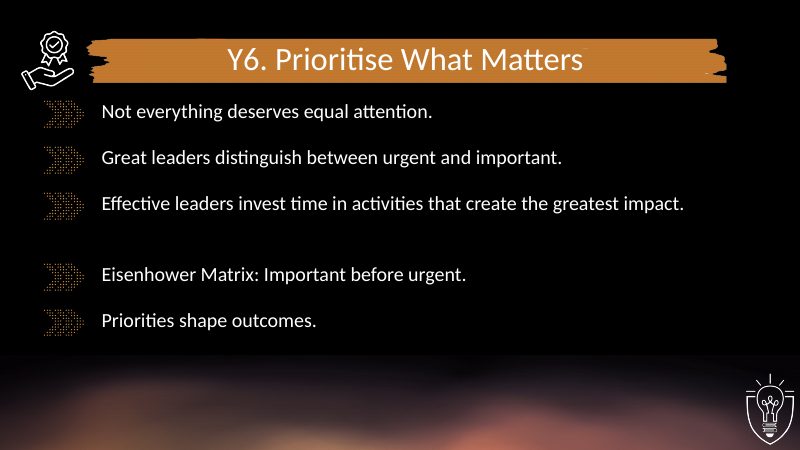
Use the Y6 INSET PowerPoint to help colleagues explore the behaviour and plan how to put it into practice.
- Editable slides to adapt to your setting
- Speaker notes to support facilitation
- Discussion, rehearsal and planning
Members only · Explore membership →
ES CoachApply · Online, with ES Coach
Complete the Y6 Playbook online
Work through the Playbook on your desk instead of on paper. A built-in coach supports you with every question: jot a few words and ES Coach suggests an answer for you to edit.
- ES Coach help under every question and table
- Saves as you type, and stays private to you
- Linked to your goal and your 90-day plan
Members only · Explore membership → · Sign in
Worked examples
See Y6 applied in eight leadership contexts
Choose your role to explore the challenge, the leader’s response and the intended result. Members can read the complete example and download an editable Word copy.
In a primary school
In a secondary school
Across schools
Selected worked example
In a primary school · Headteacher
Making room for the curriculum review
Pranav · Headteacher · 426-pupil primary school
Worked example at a glance
Making room for the curriculum review
The challengeA safeguarding referral and a two-day boiler failure have taken the curriculum block two weeks running, and the headteacher still absorbs routine premises and purchasing questions that others could hold.
What the leader doesThe headteacher moves the sequencing block to Monday, hands the boiler follow-up and routine approvals to the business manager while taking work off her list, and rebooks any lost block the same week.
What success looks likeBy day 30 the curriculum block should run in three weeks out of four; by day 60 each block should produce a written sequencing decision with a named owner; by day 90 delegated work should stay delegated and the review should have a finish date.
Stefan · Deputy Headteacher for staffing and professional development · 718-pupil primary school
Worked example at a glance
Protecting coaching for new phase leaders
The challengePersonally coordinating every cover change means coaching for new phase leaders keeps being displaced, so leadership capacity in the school is not growing.
What the leader doesThe deputy delegates daily cover to the office lead within agreed rules and a 7.45 exception checkpoint, publishes one live cover board and protects two coaching sessions each week.
What success looks likeBy day 30 the office lead should publish cover daily, escalating only agreed exceptions; by day 60 each new phase leader should have had at least eleven of twelve coaching sessions; by day 90 cover should stay safe and phase leaders should make deployment judgements.
Rhea · English Lead and Year 5 teacher · 344-pupil junior school
Worked example at a glance
Protecting the subject hour
The challengeNon-urgent resource questions arrive at the classroom door all week, breaking up the protected subject hour and pulling the English lead away from improving writing in Years 5 and 6.
What the leader doesThe English lead gathers resource questions for a Thursday check-in, points colleagues to an indexed resource map, closes communication during the protected hour and uses it to review pupils' writing.
What success looks likeBy day 30 resource questions should come to Thursday's check-in and be answered the same day; by day 60 two writing adjustments should be taught in Years 5 and 6; by day 90 recurring questions should stop because the guidance answers them.
Talia · Headteacher · ages 11 to 16 secondary school, 1,250 pupils
Worked example at a glance
Clearing the diary for attendance strategy
The challengeThirty-two inherited meetings a fortnight leave the headteacher working on persistent absence only in fragmented gaps, while every issue seems to need a headteacher meeting.
What the leader doesThe headteacher removes twelve meetings, shortens eight and delegates six, publishes where each decision now goes and protects Monday and Thursday blocks to design the attendance strategy.
What success looks likeBy day 30 removed meetings should stay gone with every decision on a clear route; by day 60 protected blocks should produce a written persistent-absence strategy with named owners; by day 90 persistently absent pupils should be missing measurably less school.
Vera · Assistant Headteacher for assessment · ages 11 to 18 secondary school, 1,610 pupils
Worked example at a glance
Protecting time for assessment validity
The challengeProducing every requested data cut on the day it is asked for fragments the assistant head's time, leaving little for making the assessment system valid and proportionate.
What the leader doesThe assistant head asks each request to name the decision it serves, runs a weekly clinic where subject leaders interpret data themselves, declines analysis with no credible use and protects Tuesday mornings for validity work.
What success looks likeBy day 30 every analysis request should arrive with a decision, owner and date; by day 60 the Tuesday block should run in seven weeks of eight and two assessments should be changed or removed; by day 90 subject leaders should answer routine questions themselves.
Usman · Head of Year 10 · ages 11 to 18 secondary school, 1,430 pupils
Worked example at a glance
Making time for pupils at greatest risk
The challengeReformatting tutor updates and handling low-level requests all day leave the head of year little time for the 24 Year 10 pupils most at risk of disengaging.
What the leader doesThe head of year stops cosmetic edits, uses one concise update template, delegates routine follow-up to tutors with clear thresholds and protects three morning contact blocks each week.
What success looks likeBy day 30 tutor updates should arrive complete without rewriting; by day 60 all three planned contacts should happen in at least five weeks out of six; by day 90 tutors should spot concerns earlier and attendance or belonging should improve for half the group.
Will · Head of Business · ages 11 to 16 secondary school, 890 pupils
Worked example at a glance
Saying no to protect curriculum time
The challengeOptional competitions, speakers and projects keep displacing department development time, and a new enterprise competition invitation lands in the busiest assessment half term.
What the leader doesThe head of department declines the competition this cycle while keeping the relationship, asks for next year's dates in writing and protects the Monday department block for reviewing pupils' writing.
What success looks likeBy day 30 the refusal should be sent with no hidden competition work; by day 60 the Monday block should run in six weeks of eight and produce two adjustments colleagues have taught; by day 90 applied writing should improve without anyone absorbing hidden hours.
Ophelia · Trust Director of School Improvement · eleven-school trust
Worked example at a glance
Protecting time for priority schools
The challengeSeven routine curriculum meetings a fortnight and repeated data requests crowd out the diagnostic work and coaching that the three schools in greatest need depend on.
What the leader doesThe director hands routine forums to school-improvement partners with clear escalation thresholds, replaces most meetings with written exception updates and protects two diagnostic blocks each week for priority schools.
What success looks likeBy day 30 partners should chair every routine forum, with only agreed escalations reaching the director; by day 60 diagnostic blocks should run in most weeks and each priority school should have a written diagnosis; by day 90 priority schools should move against their trajectories.
The complete Playbook is for members
Turn this example into action
Read the full toolkit, coaching and practice scripts, and 90-day plan. Members can view the PDF here and download an editable Word copy.
Further reading

Recommended book
The 7 Habits of Highly Effective People – Stephen Covey (1989)
This text strengthens the behaviour by showing how to focus on high-value work, reduce distraction and invest in long-term impact.
References from the Everyone Succeeds book
- Collins, J. (2001) Good to Great: Why Some Companies Make the Leap… and Others Don't. London: Random House Business Books. Buy on Amazon ↗
- Covey, S.R. (1989) The 7 Habits of Highly Effective People: Powerful Lessons in Personal Change. New York: Free Press. Buy on Amazon ↗
- McKeown, G. (2014) Essentialism: The Disciplined Pursuit of Less. London: Virgin Books. Buy on Amazon ↗
- Newport, C. (2016) Deep Work: Rules for Focused Success in a Distracted World. London: Piatkus. Buy on Amazon ↗
Not sure where to start? Take the free self-diagnostic to choose one to three behaviours to focus on.
As an Amazon Associate, Everyone Succeeds earns from qualifying purchases.