
An example delivery sequence
A practical guide to help you implement the Everyone Succeeds Leadership Framework with confidence, creating clarity and consistency.
A practical guide to help you implement the Everyone Succeeds Leadership Framework with confidence, creating clarity and consistency.
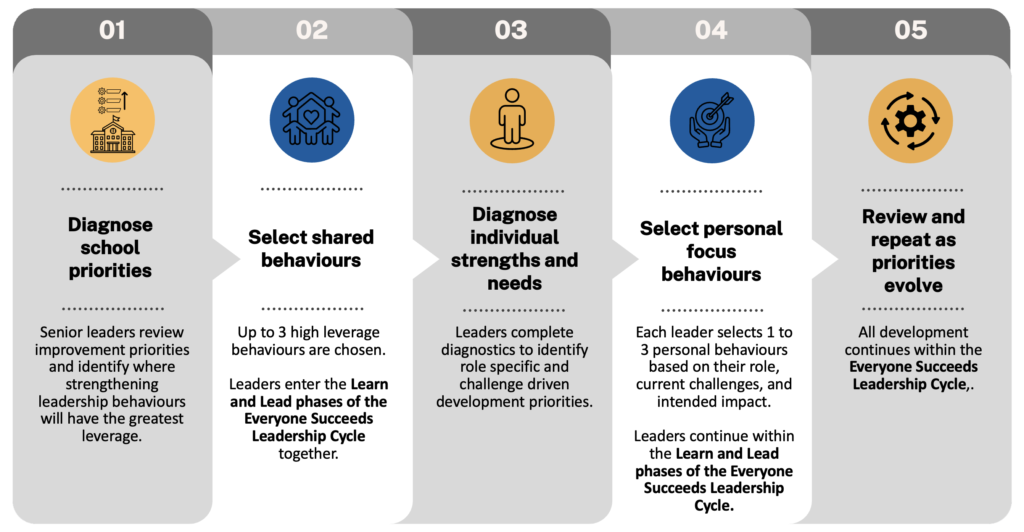
The sequence below illustrates one structured way a school might introduce the Everyone Succeeds Leadership Cycle across a first year. It follows the five step hybrid sequence and shows how those steps can unfold across a school year. The timing is indicative rather than fixed, and schools adapt it to suit their context, capacity and priorities.
An example model of delivery
The timeline below illustrates how the hybrid model can unfold over a school year.
Year one timeline
Step 1. Diagnose school priorities
June
Senior leaders review improvement priorities and identify where strengthening leadership behaviours will have the greatest leverage.
This typically involves:
- Reviewing the school development plan
- Identifying recurring leadership challenges
- Considering where greater behavioural consistency would unlock improvement
At this stage, the focus is clarity. Leaders agree where attention will make the biggest difference.
Step 2. Select shared behaviours
June to July
Up to three high leverage behaviours are selected as the collective focus.
Leaders then enter the Learn and Lead phases of the Everyone Succeeds Leadership Cycle together.
In practice, this often includes:
- Introducing the Leadership Cycle to all leaders
- Sharing the book and workbook
- Studying two or three behaviours in depth
- Rehearsing what these behaviours look like in meetings, line management and daily leadership
The aim is to build shared language and confidence before the start of the new academic year.
Linking behaviours to school priorities
Different behaviours are especially powerful at different points in the year.
- At the start of the year, behaviours that establish expectations, routines and consistency
- During development planning, strategic behaviours that provide clarity and direction
- During pressurised periods, behaviours that strengthen communication and prioritisation
- During change, behaviours that build shared understanding and momentum
Schools often find it helpful to use a seasonal behaviour lens when selecting their initial focus.
Step 3. Diagnose individual strengths and needs
November
Once shared behaviours are embedded in daily practice, leaders complete diagnostics to identify role specific and challenge driven development priorities.
This typically includes:
- Completing the Self Diagnostic
- Completing the 360 Diagnostic
- Reviewing the Combined Report
Leaders now have a clearer understanding of their strengths and their most important areas for growth.
Step 4. Select personal focus behaviours
December to April
Each leader selects up to two or three personal focus behaviours based on their role, current challenges and intended impact.
Leaders continue within the Learn and Lead phases of the Everyone Succeeds Leadership Cycle, now combining shared behaviours with personalised development.
In practice, this often includes:
- Working through a 90 Day Planner cycle
- Linking behaviours to real leadership challenges
- Using coaching conversations to refine application
- Rehearsing and reviewing behaviours deliberately
Many schools run two personalised cycles per year.
Step 5. Review and Repeat as priorities evolve
May onwards
All development continues within the Everyone Succeeds Leadership Cycle.
Progress is reviewed at agreed intervals. Some behaviours become embedded as everyday practice. New shared or personal priorities are selected as context evolves.
By the end of the first year, teams typically have:
- A shared leadership language
- Embedded routines for reflection and review
- Greater confidence in selecting behaviours deliberately
- A clear rhythm for ongoing development
Leadership development becomes cyclical rather than episodic.
Example first year timing summary
June: Diagnose school priorities and select shared behaviours. Introduce the Everyone Succeeds Leadership Cycle.
July: Study and rehearse the first shared behaviours. Build shared language and confidence before the new year.
September: Enter the Lead phase. Apply shared behaviours consistently in meetings, line management and daily leadership.
November: Complete the Self Diagnostic, 360 Diagnostic and review the Combined Report. Identify individual strengths and development priorities.
December: Select personal focus behaviours and begin the first 90 Day development cycle.
January to April: Continue within the Learn and Lead phases, applying both shared and personal behaviours in real leadership contexts.
May onwards: Review impact, embed successful behaviours and refine priorities for the following year.
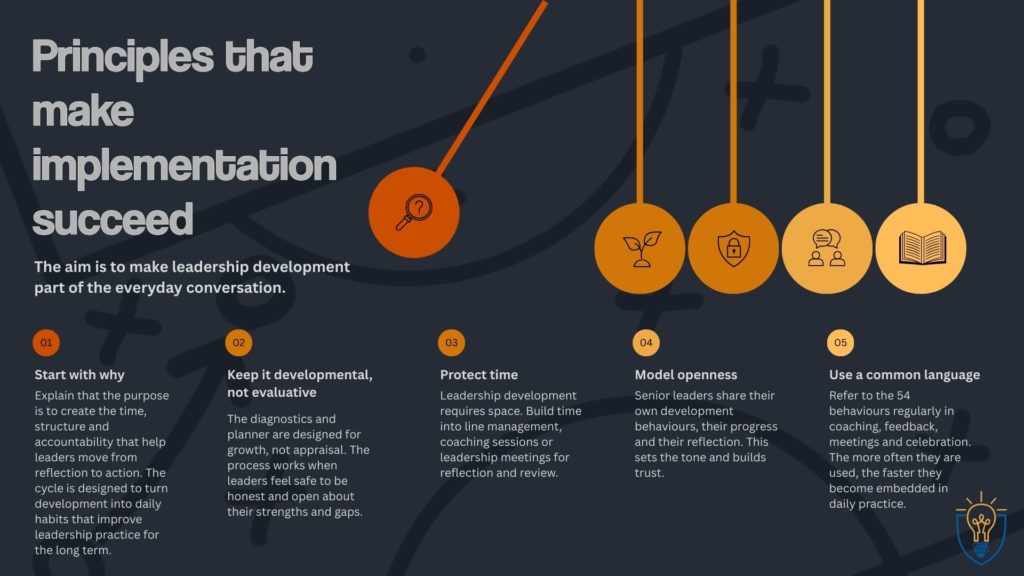
Principles that make implementation succeed
Start with why
Explain that the purpose is to create the time, structure and accountability that help leaders move from reflection to action. The cycle is designed to turn development into daily habits that improve leadership practice for the long term.
Keep it developmental, not evaluative
The diagnostics and planner are designed for growth, not appraisal. The process works when leaders feel safe to be honest and open about their strengths and gaps.
Protect time
Leadership development requires space. Build time into line management, coaching sessions or leadership meetings for reflection and review.
Model openness
Senior leaders share their own development behaviours, their progress and their reflection. This sets the tone and builds trust.
Use a common language
Refer to the 54 behaviours regularly in coaching, feedback, meetings and celebration. The more often they are used, the faster they become embedded in daily practice.
The aim is to make leadership development part of the everyday conversation.