
Annual Leadership Cycle
A practical guide to help you implement the Everyone Succeeds Leadership Framework with confidence, creating clarity and consistency.
A practical guide to implementing the Everyone Succeeds Leadership Framework with clarity and consistency.
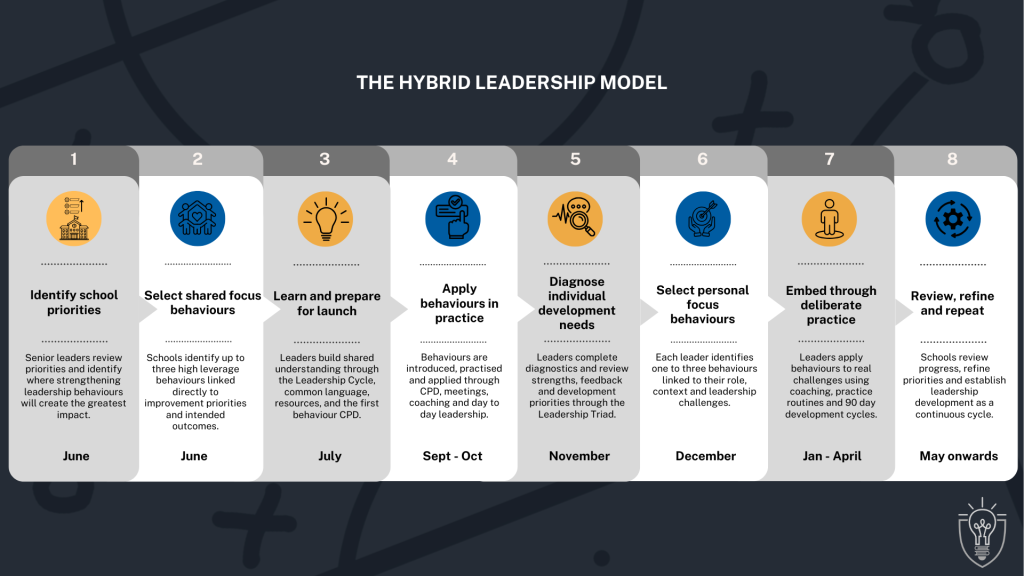
The sequence below illustrates one structured way a school might introduce the Everyone Succeeds Leadership Cycle across a first year. It follows the five-step hybrid model and shows how these steps unfold across an academic year.
The timing is indicative, not fixed. Schools adapt it to suit their context, capacity, and priorities. What matters is the clarity of phases and the discipline of moving from diagnosis to preparation to deliberate application.
An example model of delivery
The timeline below illustrates how the hybrid model can unfold over a school year.
Year one timeline
Phase 1. Diagnose school priorities
June
Senior leaders review improvement priorities and identify where strengthening leadership behaviours will have the greatest leverage.
This typically involves:
- Reviewing the school development plan
- Identifying recurring leadership challenges
- Considering where greater behavioural consistency would unlock improvement
At this stage, the focus is clarity. Leaders agree where attention will make the biggest difference.
Phase 2. Select shared behaviours
June
Up to three high-leverage behaviours are selected as the collective focus.
These behaviours are explicitly linked to school priorities and intended impact. The discipline here is focus. Fewer behaviours, applied consistently, lead to greater impact than broad, unfocused development.
Phase 3. Learn and prepare for implementation
July
Leaders begin the Learn phase and prepare for implementation.
In practice, this often includes:
- Introducing the Everyone Succeeds Leadership Cycle
- Sharing the book and workbook
- Establishing a common language across the team
- Delivering the first CPD session (Behaviour 1)
- Clarifying what this behaviour looks like in practice
The aim is not full implementation. It is preparation. Leaders build clarity and confidence so that September begins with consistency.
Phase 4. Lead: apply shared behaviours in practice
September to October
Leaders begin applying shared behaviours in a structured sequence, supported by staged CPD.
Each behaviour is taught explicitly before it becomes a focus for deliberate application:
- July → Behaviour 1 introduced and rehearsed
- September → Behaviour 2 introduced, Behaviour 1 applied
- October → Behaviour 3 introduced, Behaviours 1 and 2 applied
In practice:
- Each behaviour is taught through a focused CPD session
- Leaders rehearse and script what this looks like in their context
- Behaviours are then applied in meetings, line management, and daily leadership
This ensures that expectations are precise, consistent, and shared across the team. The focus is deliberate practice, not assumption. Behaviours are taught, rehearsed, and then embedded through consistent application.
Phase 5. Diagnose individual strengths and needs
November
Once shared behaviours are established in practice, leaders complete diagnostics to identify individual development priorities.
This typically includes:
- Completing the Self Diagnostic
- Completing the 360 Diagnostic
- Reviewing the Combined Report
- Completing the Leadership Triad
Diagnostics are intentionally timed to follow a period of shared practice, ensuring leaders reflect on real behaviour rather than abstract understanding.
Phase 6. Select personal focus behaviours
December
Each leader selects one to three personal focus behaviours based on their role, current challenges, and intended impact.
Leaders now combine shared behaviours with personalised development.
At this stage, leaders can access CPD materials, toolkits, and resources on the website to support their chosen behaviours.
Phase 7. Personal development cycles
January to April
Leaders continue within the Learn and Lead phases through structured cycles of deliberate practice.
In practice, this often includes:
- Working through a 90 Day Planner cycle
- Applying behaviours to real leadership challenges
- Using coaching conversations to refine practice
- Rehearsing and reviewing behaviours deliberately
Leaders complete one full 90-day cycle during this phase, with many schools beginning a second cycle depending on timing and capacity.
The shift here is from collective focus to individual precision, while maintaining the shared language established earlier in the year.
Phase 8. Review and repeat as priorities evolve
May onwards
Progress is reviewed and priorities are refined.
By the end of the first year, teams typically have:
- A shared leadership language
- Embedded routines for reflection and review
- Greater confidence in selecting behaviours deliberately
- A clear rhythm for ongoing development
Leadership development becomes cyclical rather than episodic.
From year one to year two and beyond
The model is designed as a continuous cycle, not a one-off programme.
At the end of the first year, schools return to Phase 1:
- Review impact of the year’s work
- Reassess school priorities
- Select the next set of shared behaviours
Diagnostics remain a tool used at key points, not a fixed annual starting point.
Over time, this creates a sustained rhythm of:
- collective focus
- individual development
- review and refinement
Leadership development becomes embedded in the ongoing life of the school.
Example first year timing summary
June: Diagnose priorities and select shared behaviours
July: Prepare for implementation and deliver CPD Session 1 (Behaviour 1)
September: Begin application and deliver CPD Session 2 (Behaviour 2)
October: Continue application and deliver CPD Session 3 (Behaviour 3)
November: Complete diagnostics and identify individual priorities
December: Select personal focus behaviours
January to April: Run personal development cycles
May onwards: Review impact and refine priorities
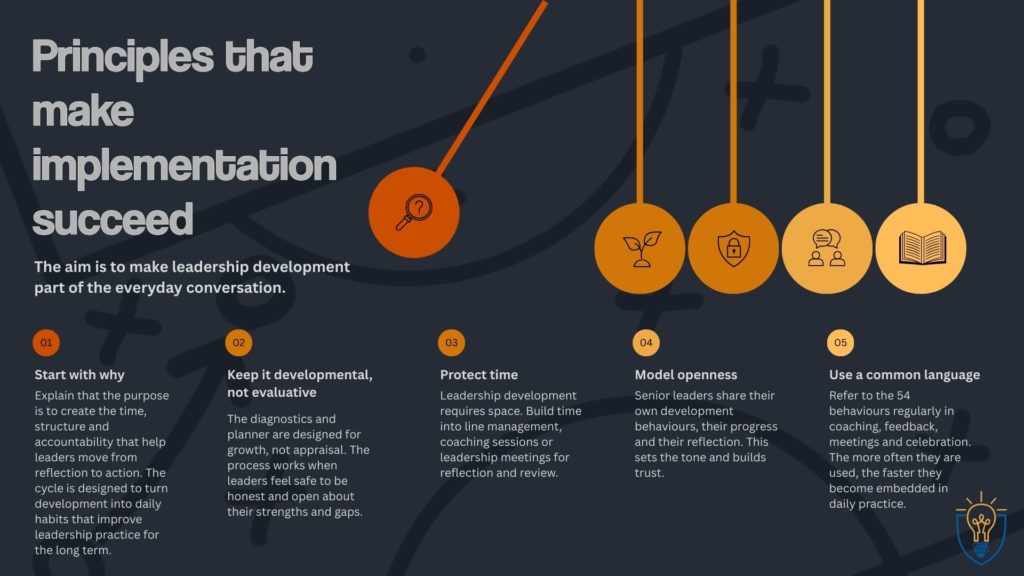
Principles that make implementation succeed
Start with why
Explain that the purpose is to create the time, structure and accountability that help leaders move from reflection to action. The cycle is designed to turn development into daily habits that improve leadership practice for the long term.
Keep it developmental, not evaluative
The diagnostics and planner are designed for growth, not appraisal. The process works when leaders feel safe to be honest and open about their strengths and gaps.
Protect time
Leadership development requires space. Build time into line management, coaching sessions or leadership meetings for reflection and review.
Model openness
Senior leaders share their own development behaviours, their progress and their reflection. This sets the tone and builds trust.
Use a common language
Refer to the 54 behaviours regularly in coaching, feedback, meetings and celebration. The more often they are used, the faster they become embedded in daily practice.
The aim is to make leadership development part of the everyday conversation.