

Using Everyone Succeeds on your own
A practical way to develop your leadership with clarity and consistency
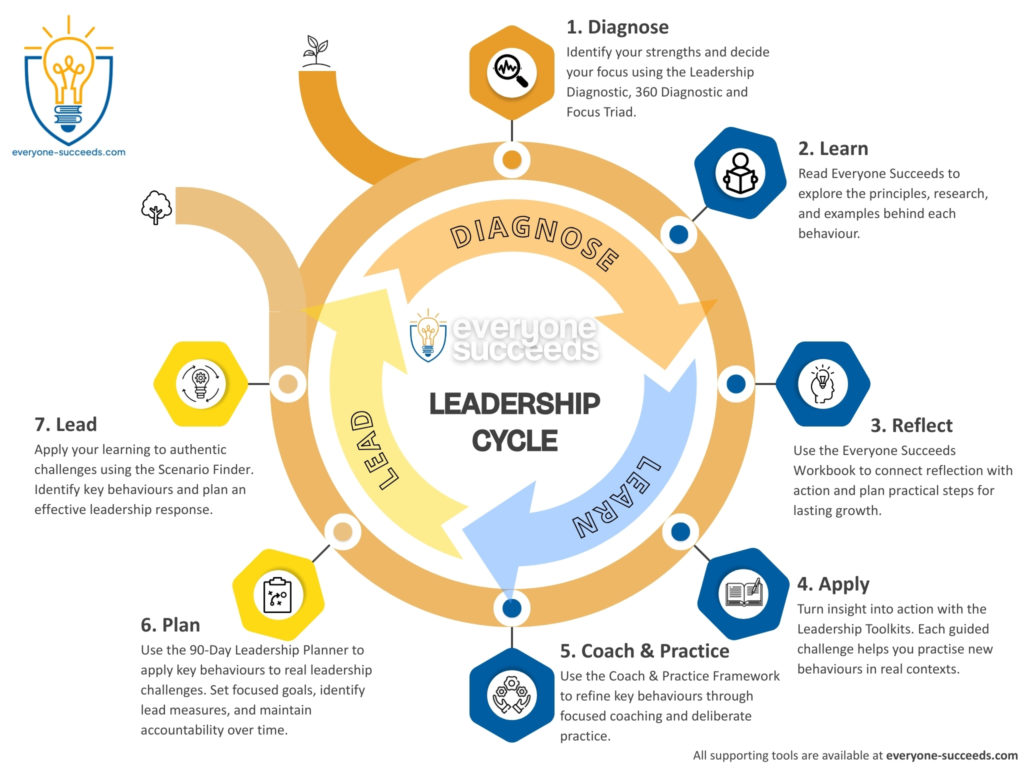
If you are using the book and workbook independently, this page shows how to apply the Everyone Succeeds Leadership Cycle in your own practice. You do not need to be part of a whole-school programme. The same approach works at individual level.
The key is to follow the cycle deliberately:
Diagnose → Learn → Lead
1. Diagnose
Understand your leadership starting point.
There are two ways to begin.
Option A. Start with a diagnostic
Complete one or more of:
Use the patterns that emerge to inform your judgement. The diagnostic does not choose your focus for you. It provides clarity. You decide which behaviour to prioritise.
Once you have insight, use the Leadership Focus Triad to confirm your focus and select one behaviour to begin with.
Diagnosis should create focus, not overload.
Option B. Start with the book
Read the book’s introduction and explore the structure of the 54 behaviours.
As you read, ask:
- Which behaviours describe your strengths?
- Which behaviours feel underdeveloped?
- Which behaviours would most improve your current leadership challenge?
Use the Leadership Focus Triad to identify three relevant behaviours, then select one as your starting point.
2. Learn
Build understanding and prepare for action
Once you have selected your behaviour, follow these three steps.
Read
Study the relevant chapter in the book carefully. Focus on:
- what the behaviour looks like in practice
- why it matters
- where it shows up in your day-to-day leadership
Reflect
Use the workbook section linked to that behaviour to:
- define what “better” looks like in your role
- identify common pitfalls
- analyse situations where you struggle
- plan deliberate actions
This is where insight becomes intention.
Practise
Strengthen your understanding using:
- The Leadership toolkits
- The coach & practice frameworks
Work through a realistic challenge linked to your chosen behaviour.
Learning is only complete when it changes how you act. Learning is not complete until it changes how you behave.
3. Lead
Apply your learning in real situations
This is where many leaders stop too early.
Plan deliberately
Use the 90 day leadership planner to:
- define a real leadership challenge
- set a clear goal
- identify measurable Key Results
- choose Lead Measures that predict success
Your chosen behaviour should sit at the centre of this plan.
Apply in practice
Use the Scenario Finder to explore how your behaviour applies in real situations.
Then act.
Practise deliberately:
- in meetings
- in line management
- in difficult conversations
Notice where you default to old habits. Adjust consciously.
Review at 30, 60 and 90 days
At each checkpoint ask:
- What is changing in my behaviour?
- What is changing in the responses of others?
- What evidence shows improvement?
At 90 days, decide:
- Deepen the same behaviour
- Or return to Diagnose and select your next priority
Development is cyclical, not linear.
How to pace yourself
The aim is not to work through all 54 behaviours quickly.
It is to strengthen one behaviour at a time, under real conditions, until it becomes habitual.
Three disciplined cycles over a year will transform your leadership more effectively than superficial engagement with many behaviours.
When to scale beyond yourself
If you later move into whole-school or trust implementation, the same cycle applies.
The difference is scale, not method.
The discipline you build individually becomes the foundation for collective leadership development.