

Leadership behaviour L4
Make It Happen
If you do not follow up, people assume it does not matter. Relentless, sustainable follow-through turns your key priorities into lasting change.
Jump to L4 resources ↓What this behaviour looks like
Follow-up is the signal
A leader sets a clear, ambitious priority for pupils and follows it up in training, lesson feedback and coaching until it is done. They adapt the method without lowering the goal, and pace the effort so colleagues stay persistent rather than exhausted.
A practical example
Finishing a stalled curriculum project
Hoping it lands“Can everyone try to get their units finished soon? Thanks for all your hard work on this.”
Making it happen“Each unit now has six named parts, each with an owner and a date, and ready means it has passed peer review. We will check progress together on Thursday. If something is blocking you, tell me today and I will help remove it.”
Each unit has six parts, each with an owner and date.
Ask each owner today what is blocking them, and help remove it.
Check progress together on Thursday; ready means passed peer review.
Write the intended result, owner, deadline and evidence of completion, name the biggest blocker, and put a midpoint check in your diary.
L4 · Resources for your setting
Put ‘Make It Happen’ into practice
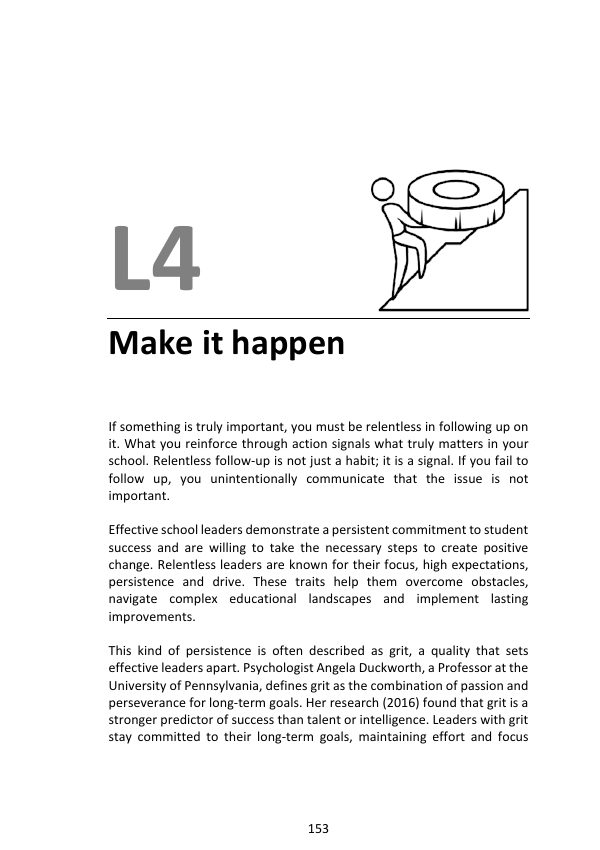
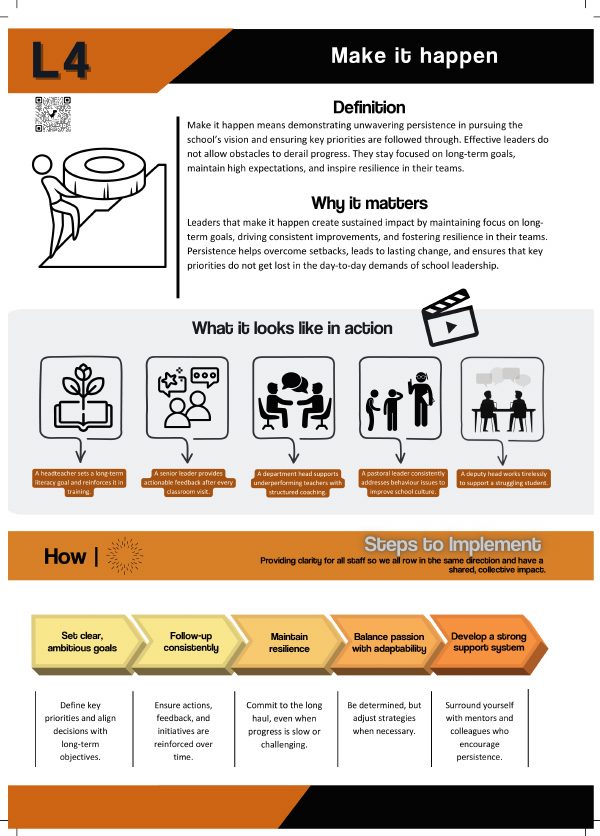
Develop your own practice or lead the learning with your team. Use the chapter and workbook to explore the behaviour, then choose the resources that fit your next step.
Apply · Your leadership practice
Put it to work
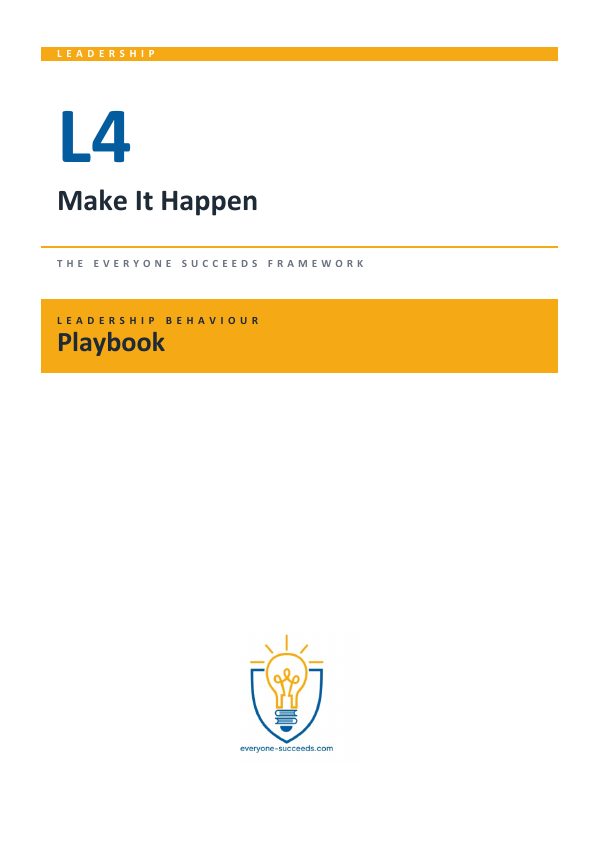
Use the L4 Playbook to turn the behaviour into practical action on a real leadership challenge.
- Practical toolkit and coaching prompts
- A practice script to rehearse your approach
- A 90-day plan to guide your next steps
Members only · Explore membership →
Apply · Learning with your team
Lead a team session
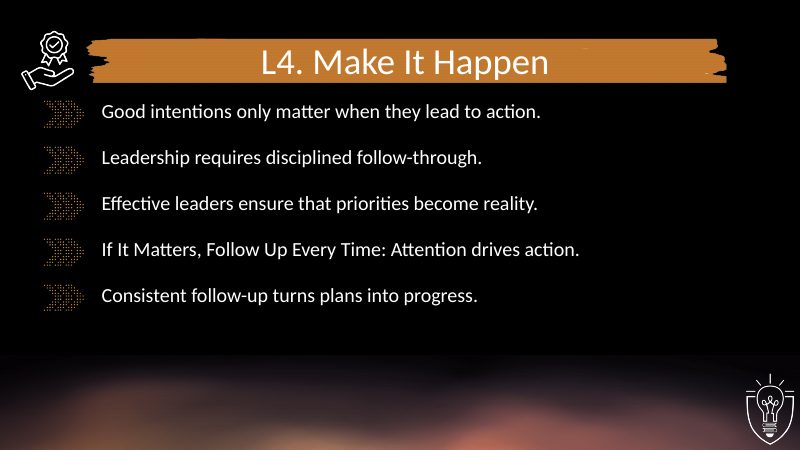
Use the L4 INSET PowerPoint to help colleagues explore the behaviour and plan how to put it into practice.
- Editable slides to adapt to your setting
- Speaker notes to support facilitation
- Discussion, rehearsal and planning
Members only · Explore membership →
Completed Playbooks
See L4 applied in eight leadership contexts
Choose your role to explore the challenge, the leader’s response and the intended result. Members can read the complete example and download an editable Word copy.
In a primary school
In a secondary school
Across schools
Selected completed example
In a primary school · Headteacher
Making first-day absence contact stick
Siobhan · Headteacher · 510-pupil primary school with a resource base
Worked example at a glance
Making first-day absence contact stick
The challengeThe first-day absence routine has been tightened twice before, and both attempts faded within a fortnight.
What the leader doesThe headteacher agrees with the office and safeguarding team a sequence they can run on a busy morning, rehearses every role and the call itself, and checks completion daily.
What success looks likeBy day 30 every role should have rehearsed the routine and cover plan; from the end of week six and through day 60 at least 95% of first contacts should happen by 9.30, with every risk handover confirmed; this should be sustained through day 90.
Pooja · Deputy Headteacher · 510-pupil primary school with a resource base
Worked example at a glance
Moving checking for understanding into practice
The challengeChecking for understanding has been trained but not adopted, and phase leaders expect another monitoring form rather than owning the practice in their phase.
What the leader doesThe deputy headteacher asks each phase to rehearse a subject example where pupil evidence shapes the next teaching decision, then reviews practice with phase leaders using pupil work rather than reported use.
What success looks likeBy day 30 every phase should rehearse an evidence-to-decision example; by day 60 full-sequence use should reach 70%; by day 90 at least 85% of sampled lessons, up from 44%, should show evidence accurately shaping teaching.
Yvonne · Science Lead and Year 5 teacher · 510-pupil primary school with a resource base
Worked example at a glance
Finishing the science resource overhaul
The challengeTwo internal deadlines have passed, and colleagues are quietly building their own materials because they cannot see what will be ready in time.
What the leader doesThe science lead breaks each unit into six named components with an owner, status and date, offers a colleague genuine authority over one unit and holds every unit to the same quality check.
What success looks likeBy day 30 every component should have an owner, status and date; by day 60 all sequences and assessment checks should pass peer review; by day 90 four units should be ready three weeks before teaching.
Lubna · Headteacher · ages 11 to 18 secondary school, 1,530 pupils
Worked example at a glance
Making disciplinary reading every department's work
The challengeThe reading strategy is understood but not yet reliable practice across departments, and some heads of department will argue, reasonably, that reading belongs to English.
What the leader doesThe headteacher asks every department to commit to its first disciplinary-reading routine with an owner and evidence, holding the entitlement firm while handing over real authority over method.
What success looks likeBy day 30 every department should identify a problem, routine, owner and evidence; by day 60 every department should have taught and reviewed its routine; by day 90 review should show stronger disciplinary reading in every department.
Selina · Deputy Headteacher · ages 11 to 18 secondary school, 1,530 pupils
Worked example at a glance
Getting a detention system ready to launch
The challengeThe launch of the centralised detention system has moved twice, two decisions are still open and it is unclear whether the parts genuinely connect.
What the leader doesThe deputy headteacher gives every component an owner, acceptance test and dependency, tests the whole process from the pupil side rather than trusting status reports, and agrees a no-launch trigger in advance.
What success looks likeBy day 30 every component should have an owner, acceptance test and dependency; by day 60 all four pupil pathways should pass tabletop testing; by day 90 the system should launch safely with at least 90% same-day completion.
Kim · Head of Year 11 · ages 11 to 18 secondary school, 1,530 pupils
Worked example at a glance
Reducing after-lunch lateness
The challengeAfter-lunch lateness in Year 11 stands at 14%, and tutors have heard several versions of this before, so another routine risks feeling like more work.
What the leader doesThe head of year launches a six-week routine that pairs each pupil action with a school action, gives repeatedly late pupils a plan and says honestly what tutors will stop doing in return.
What success looks likeBy day 30 every repeatedly late pupil should have a reciprocal plan; by the end of the six-week cycle after-lunch lateness should be below 7%, with school actions closing on time by day 60; by day 90 it should remain below 7%.
Cerys · Head of Physical Education · ages 11 to 18 secondary school, 1,530 pupils
Worked example at a glance
Turning a participation figure into decisions
The challengeThe same Key Stage 3 participation figure of 82% has been reported for two terms, with wider gaps for pupils with SEND and disadvantaged pupils, but nobody owns the barriers.
What the leader doesThe head of PE gives every barrier behind the figure a named adult and a first action, and shows one concrete example where access changes in a real activity without lowering the thinking.
What success looks likeBy day 30 every class should identify its barriers and one response; by day 60 meaningful participation should reach 88%; by day 90 it should reach 92%, with SEND and disadvantage gaps below five points.
Rashida · Trust Director of School Improvement · eight-school trust
Worked example at a glance
Resetting curriculum reviews
The challengeThree schools did not complete the first curriculum-entitlement review cycle, and the central team's own feedback was slower than the standard it asked of schools.
What the leader doesThe director owns the central delay first, gives every school an owner, evidence plan and protected review time, and commits to returning actionable feedback within five working days.
What success looks likeBy day 30 every school should have an owner, evidence plan and protected review time; by day 60 all submitted reviews should receive feedback within five working days; by day 90 eight credible reviews should feed priority actions into school plans.
The complete Playbook is for members
Turn this example into action
Read the full toolkit, coaching and practice scripts, and 90-day plan. Members can view the PDF here and download an editable Word copy.
Further reading
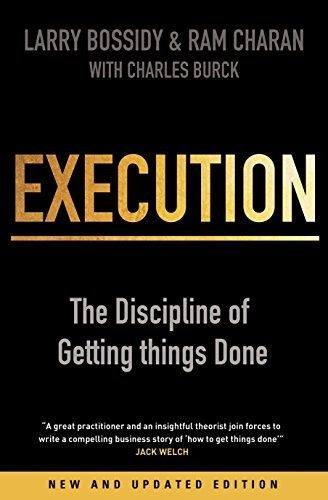
Recommended book
Execution: The Discipline of Getting Things Done – Larry Bossidy & Ram Charan (2002)
This text helps you apply the behaviour by showing how clarity, ownership and disciplined follow-through lead to consistent delivery.
References from the Everyone Succeeds book
- Duckworth, A. (2016) Grit: The Power of Passion and Perseverance. New York: Scribner. Buy on Amazon ↗
- Dweck, C.S. (2006) Mindset: The New Psychology of Success. New York: Random House. Buy on Amazon ↗
Not sure where to start? Take the free leadership diagnostic to find your three priorities.
As an Amazon Associate, Everyone Succeeds earns from qualifying purchases.