

Introduce in your school
Turn leadership into a lever for whole-school improvement
Most leadership development in schools lacks consistency, follow-through, and measurable impact.
Everyone Succeeds changes this by turning leadership into observable, practised behaviours that can be developed, embedded, and sustained.
This page shows how to introduce the framework in your school, with a clear model that creates alignment, builds ownership, and drives lasting impact.
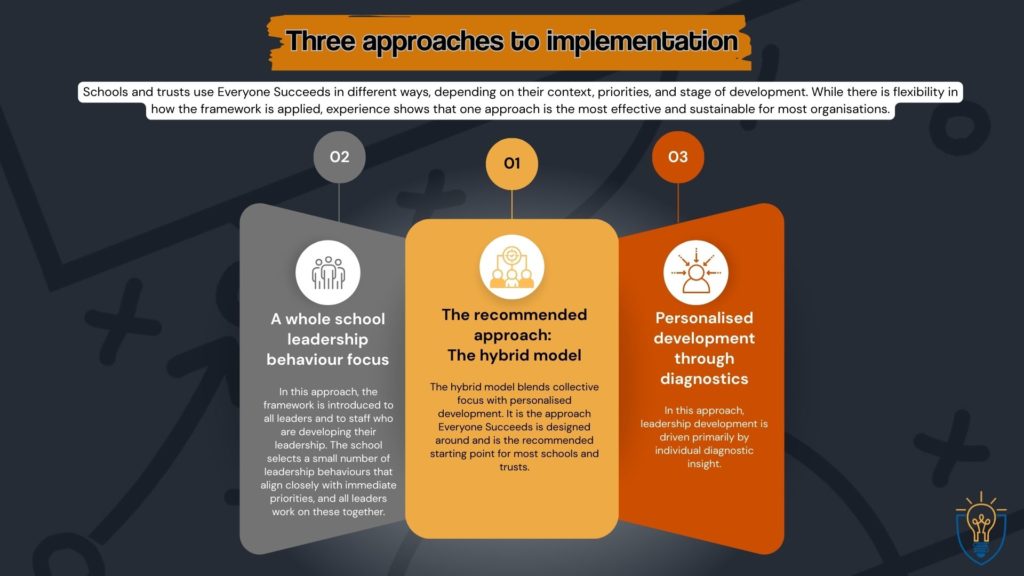
The recommended approach: Whole school and individual – the hybrid model
A deliberate, school-wide approach that combines shared strategic priorities with personalised leadership development.
This model builds collective alignment first, then deepens individual ownership.
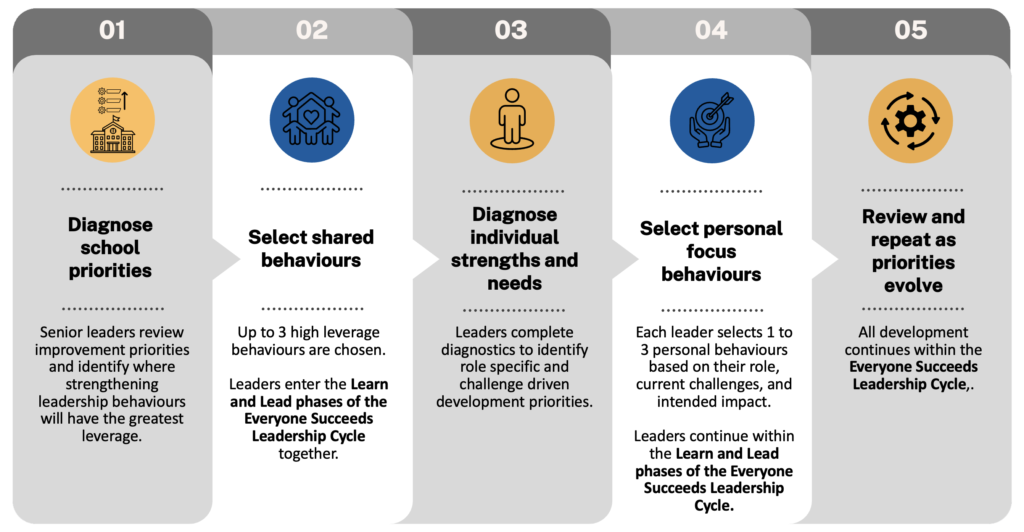
Why this approach works:
- Schools that focus only on whole-school priorities often lack individual ownership.
- Schools that focus only on individual development lack alignment.
The hybrid model solves both. It creates shared direction first, then builds personal responsibility within it.
How it works
Phase 1. Collective alignment
Senior leaders identify key school priorities and select up to 3 high-leverage leadership behaviours.
These behaviours are chosen because strengthening them will unlock multiple priorities.
All leaders learn and practise these behaviours together, building shared language, consistency, and expectation.
Phase 2. Personalised development
Once shared behaviours are established, leaders complete diagnostics to identify strengths and development priorities.
Each leader then selects up to 3 personal focus behaviours, based on:
- Their current role
- The challenges they are facing
- The impact they are seeking to have
These behaviours are directly linked to real leadership responsibilities, not abstract development.
Leaders continue within the Learn and Lead phases of the Everyone Succeeds Leadership Cycle, applying behaviours to real challenges through structured planning and coaching.
Phase 3. Review and Repeat
All development continues within the Everyone Succeeds Leadership Cycle.
Progress is reviewed at agreed intervals. Some behaviours become embedded as everyday practice, and new priorities are selected as the context evolves.
Leadership development becomes cyclical rather than episodic.
Resources used:
- Self Diagnostic and Combined Reports
- Book
- Workbook
- Toolkits
- Coach and Practice Frameworks
- 90 Day Planner
- Scenario Finder
Explore the Annual Leadership Cycle →
Other ways to start
These approaches can be effective entry points, particularly where capacity or readiness varies. Most schools using these approaches move to the hybrid model over time.
Option 2: Whole school
A structured team approach that builds shared language and behavioural consistency within a defined leadership group.
Best for:
- SLT development
- Middle leader alignment
- Structured CPD
Structure:
- Senior leaders diagnose shared priorities within the defined leadership group.
- The team selects up to 3 shared behaviours.
- Leaders enter the Learn and Lead phases of the Everyone Succeeds Leadership Cycle together.
- Reflection, modelling, and Review and Repeat are built into meeting routines.
Resources used:
- Book
- Workbook
- Coach and Practice Frameworks
- Scenario Finder
Often used as a starting point before moving to the hybrid model.
Option 3: Personalised development
A flexible starting point that allows leaders to engage independently before wider implementation.
Best for:
- Trialling the framework
- Coaching conversations
- Gradual introduction
How it works:
- Leaders complete diagnostics or use the Leadership Focus Triad.
- Each leader selects up to 3 personal focus behaviours.
- Development takes place through coaching and structured reflection
Resources used:
- Coach and Practice Frameworks
- Book
- Workbook
- Leadership Focus Triad
Typically used as an entry point before whole-school implementation.