
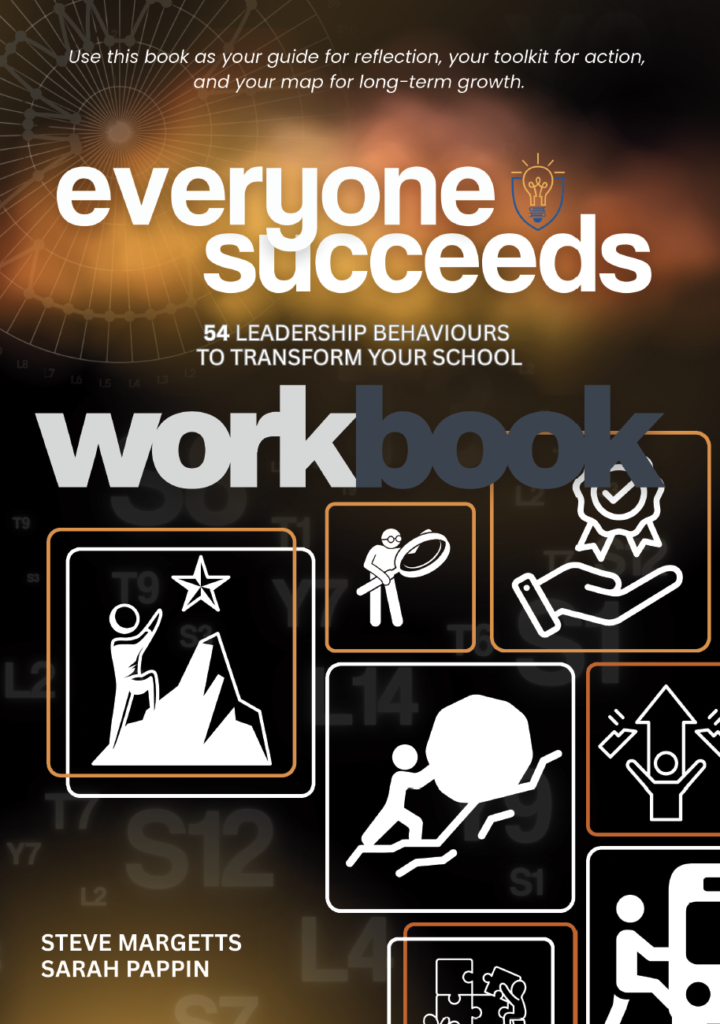
Everyone Succeeds Workbook
54 behaviours to transform your school
Understanding great leadership is only the first step. The harder work is turning that understanding into consistent action, especially in the reality of busy schools, competing priorities, and complex teams.
The Everyone Succeeds Workbook exists to bridge that gap.
Designed as the practical companion to Everyone Succeeds: 54 Leadership Behaviours to Transform Your School, the workbook helps leaders move from insight to implementation, one deliberate step at a time.
Where the book explains and codifies the behaviours, the workbook supports you to practise them, reflect on them, and embed them within your own role, team, and school context.
What each behaviour looks like in practice
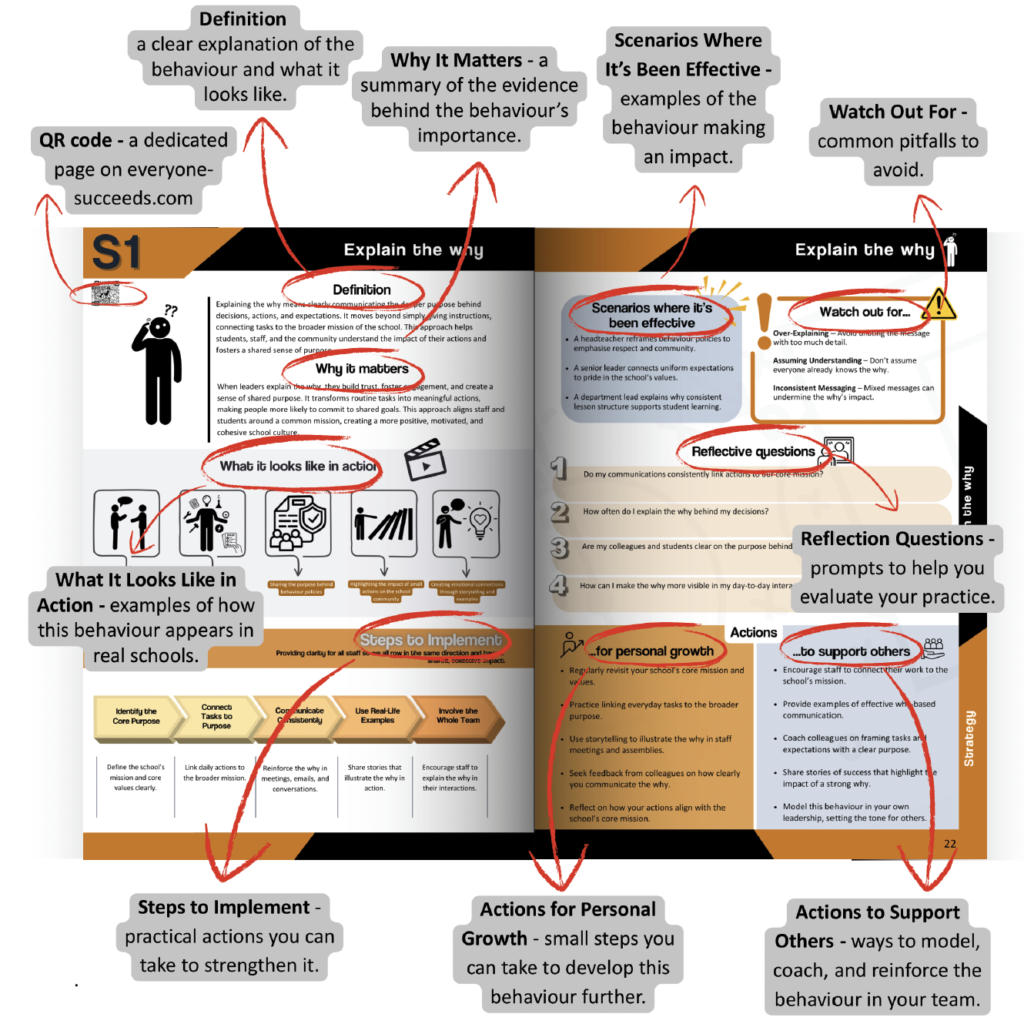
Every behaviour in the Everyone Succeeds Workbook is broken down into a clear, practical structure that supports understanding, reflection, and action.
Rather than leaving leaders to interpret ideas in isolation, each behaviour is explored from multiple angles, helping you see not just what the behaviour is, but how it shows up in real schools, what to watch out for, and how to strengthen it over time.
Built for reflection, coaching, and sustained improvement
The workbook is designed to be written in, revisited, and returned to over time. It works as a personal development tool, a coaching resource, and a shared framework for leadership teams.
Used thoughtfully, it helps leaders slow down, reflect with purpose, and take small, deliberate steps that compound into meaningful leadership impact across a school or trust.
About the authors
Steve Margetts
I have been the Principal of Torquay Academy since January 2014. Over that time, I have been privileged to work alongside exceptional leaders, teachers, and support staff who have helped to transform the school into one the local community is proud of, while significantly improving outcomes for the children we serve.
That, however, is not how my headship began.
I took up my first headship in January, and by the end of the summer term, the school had narrowly avoided being placed into special measures following an Ofsted inspection. That summer, GCSE outcomes fell to an all-time low, with just 28% of students achieving a pass in English and Maths. Several year groups were less than half full, confidence was fragile, and the margin for error felt vanishingly small.
Eight months into my first headship, there were moments when I questioned both my decision to take the job and my own ability to lead meaningful change. I retained a strong belief that improvement was possible and that failure was not inevitable, but leadership in those circumstances was demanding. In those moments, it was not always clear what effective leadership behaviour actually looked like day to day.
That uncertainty came to a head during a visit from Sir David Carter, then Regional Schools Commissioner for the South West. I approached the visit with real apprehension, expecting scrutiny and confirmation of the doubts I was already carrying. Instead, I experienced something very different. Through his ability to instil belief, he helped me see possibilities where I had only seen limitations.
Following the visit, David sent me a handwritten note. It reinforced the confidence he had placed in me and the belief he had encouraged me to hold in myself. I keep that note on my desk to this day, not just because of who wrote it, but because of what it represents. A reminder of the power leaders have to shape how others see themselves at moments when confidence is at its lowest.
My interest in leadership had begun earlier in my career. I completed a Postgraduate Diploma in School Leadership before taking on my first leadership role and later returned to academic study to complete an MBA in 2023. Alongside this, I have visited schools across the UK and the USA, learning from leaders working at every level and in every context.
A significant influence on my thinking was Doug Lemov. Meeting Doug and working with him on teaching and learning on several occasions challenged how I thought about professional practice and improvement. His work on codifying great teaching prompted a question that stayed with me. If effective teaching behaviours could be identified, named, and practised, why not leadership?
This book is the result of that question. It draws on years of observation, practice, reflection, and learning to identify the behaviours that highly effective school leaders consistently demonstrate. It is written for leaders who know that leadership is demanding, often isolating, and sometimes overwhelming, but who believe that improvement is possible when behaviour is made deliberate, visible, and practised with intent.
Sarah Pappin
I am driven by a determination to eradicate the disadvantage gap in education. Over the course of my career, working in schools serving communities where opportunity is unevenly distributed, I have become convinced that place matters. Context shapes aspirations and culture shapes confidence. The quality of school leadership is the fulcrum upon which that gap rises or falls. Structures and resources matter, but leadership shapes belief, ambition and ultimately what becomes possible for young people.
I have been fortunate to work alongside inspirational headteachers throughout my career, including at Torquay Academy under Steve Margetts, where I saw leadership enacted with clear vision and consistency. Being part of the school’s transformational journey showed me what happens when actions are deliberate and aligned to a shared purpose. Strong leadership does not simply improve outcomes; it reshapes identity, restores confidence and expands what a community believes it can achieve.
That experience strengthened my ambition to pursue headship. More children in more schools deserve the same clarity of vision and strength of leadership and I am committed to playing my part in that work.
Through my MSc in Education Leadership and Management and my participation in Cohort 5 of the SW100 Leadership Programme, I have sought to refine both the moral and practical foundations of my leadership. Visiting some of the most exceptional schools in the country has allowed me to see patterns of excellence across contexts. I have observed how effective leaders align purpose, people, and practice, and how sustained, disciplined and intentional action secures exceptional outcomes.
I believe that when leadership is guided by a shared vision, rooted in place, and enacted with purpose, the lives of young people and the communities we serve can and will be transformed.
My contribution to Everyone Succeeds has focused on communicating that thinking in ways that are accessible, practical, and actionable. My aim is to enable more leaders to grow, practise with purpose and build great schools. Great schools are not accidents. They are built by leaders who act deliberately, consistently and with clarity.
