
Annual Leadership Cycle
A practical guide to help you implement the Everyone Succeeds Leadership Framework with confidence, creating clarity and consistency.
Everyone Succeeds can be introduced in several ways, depending on the needs of your school and the experience of your leadership team. While it is possible to begin with either a whole-school focus or individual development through diagnostics, experience shows that combining both creates the greatest impact.
This page explains how to introduce the framework deliberately, using a clear sequence that builds shared understanding, protects leaders from overload, and turns development into everyday leadership practice.
Worked scenarios: what this looks like in practice
Leaders often understand the principles of a framework but struggle to picture how it unfolds in a real school, across a real year, with real pressures.
The scenarios below show how different schools have used the same Everyone Succeeds framework, behaviours and annual cycle to address very different challenges. They are not prescriptions. They are worked examples designed to support professional judgement and help leadership teams adapt the approach to their own context.
Example scenarios
- Improving behaviour and consistency
- Improving teaching and learning
- Leading through turbulence and change
- Sustaining excellence in a high-performing school
- New headteacher joining a school
You may find it helpful to read the scenario closest to your current context before exploring the detailed guidance below.
The guidance below explains the different approaches schools take, the recommended model of delivery, and a clear year one timeline that underpins each scenario.
Three approaches to implementation
Schools and tru
The recommended model of delivery
The hybrid model builds confidence, creates shared expectations and brings personalised development in at the right time. It is the strongest and most sustainable way to embed the Everyone Succeeds cycle from the start. It enables leaders to give energy to whole school priorities while also developing their own areas for growth.
Year one timeline
Step 1. Introduce Everyone Succeeds to all leaders (June)
Explain the Leadership Cycle. Share the book and workbook. Introduce the first small set of behaviours that align with September priorities. Give leaders time to read, discuss and take part in practice activities using the toolkits and Coach and Practice sheets.
Step 2. Leaders deepen understanding and rehearse key behaviours (June to July)
Leaders study two or three behaviours in depth. They use the workbook to explore what these behaviours look like in action and take part in practice sessions. This builds confidence ahead of the September return.
Linking behaviours to school priorities
Different behaviours are especially helpful at different points in the school year.
- At the start of the year, behaviours that set expectations, routines and consistency are most powerful
- During school development planning, strategic behaviours provide clarity and direction
- During busy or pressurised points in the year, behaviours that support communication, prioritisation and decision making help maintain focus
- During periods of change, behaviours that create shared understanding and momentum support teams
Schools often find it helpful to use a seasonal behaviour menu to guide choices.
Step 3. Apply the chosen behaviours in daily leadership (September to October)
Leaders begin the Lead phase. They embed the behaviours in team meetings, line management, modelling and feedback. Senior leaders revisit the behaviours during briefings and coaching meetings.
Step 4. Complete the diagnostics (November)
All leaders complete the self diagnostic, the 360 diagnostic and the combined report. Leaders now have a clear understanding of their strengths and their most important development priorities.
Step 5. Begin personalised development paths (December to April)
Leaders choose up to three behaviours from their combined diagnostic and work through a full 90 day cycle. This runs again in the spring term, giving leaders two cycles of personalised development each year.
Step 6. Repeat the cycle and refine (May onwards)
Teams begin a new year with confidence in the cycle, a shared language and a clear understanding of the behaviours that will strengthen leadership across the school.
Summary
- June: Introduce the cycle. Learn the first whole school behaviours.
- September: Begin the Lead phase. Apply the behaviours in real practice.
- November: Run the diagnostics. Receive combined reports.
- December: Begin the next Learn phase. Combine whole school and personal behaviours.
- January: Begin the next Lead phase. Apply both streams of behaviours.
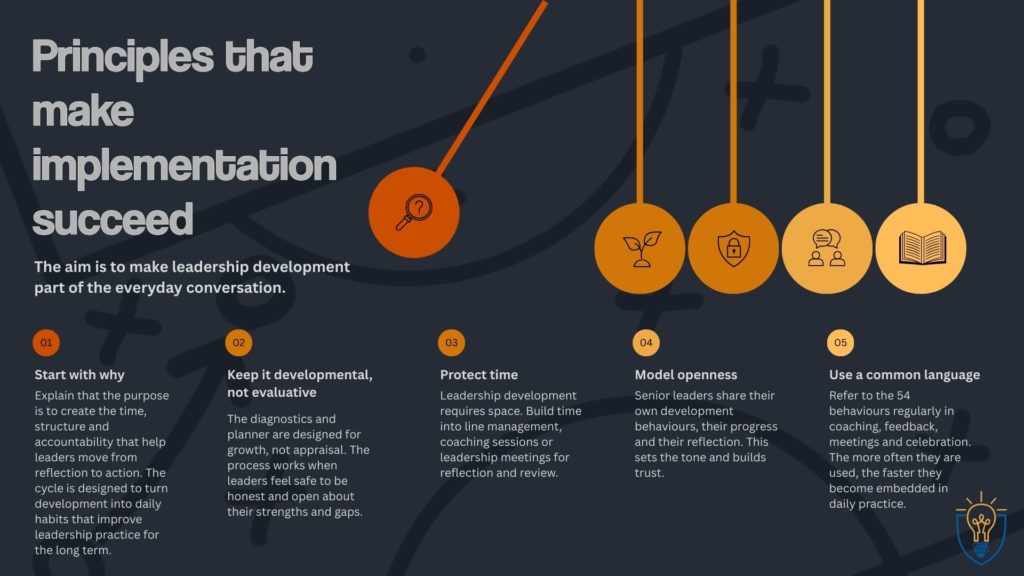
Principles that make implementation succeed
Start with why
Explain that the purpose is to create the time, structure and accountability that help leaders move from reflection to action. The cycle is designed to turn development into daily habits that improve leadership practice for the long term.
Keep it developmental, not evaluative
The diagnostics and planner are designed for growth, not appraisal. The process works when leaders feel safe to be honest and open about their strengths and gaps.
Protect time
Leadership development requires space. Build time into line management, coaching sessions or leadership meetings for reflection and review.
Model openness
Senior leaders share their own development behaviours, their progress and their reflection. This sets the tone and builds trust.
Use a common language
Refer to the 54 behaviours regularly in coaching, feedback, meetings and celebration. The more often they are used, the faster they become embedded in daily practice.
The aim is to make leadership development part of the everyday conversation.