

Teams behaviour T9
Go Back and Check
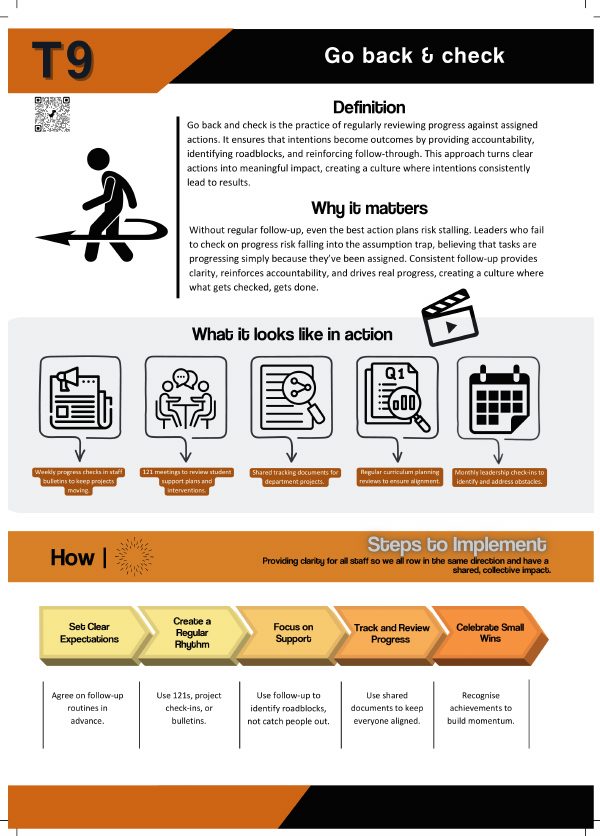
Assigning a task does not mean it is done. Agree predictable check-ins from the start, so follow-up feels like support and plans become results.
Jump to T9 resources ↓What this behaviour looks like
What gets checked, gets done
A leader agrees when and how progress will be checked as soon as an action is set, through one-to-ones, bulletins or shared trackers. Each check looks at the difference for pupils, removes obstacles, celebrates small wins and ends with a clear decision.
A practical example
Following up a reading intervention
Assuming it's done“We agreed the new reading intervention last month, so I'm sure it's up and running by now.”
Going back to check“As agreed, we're reviewing the reading intervention in today's one-to-one. Talk me through the first three weeks. What's working for the pupils, and what's getting in the way? Then let's decide together whether we keep it, adjust it or stop.”
The check was agreed in advance for today's one-to-one.
Ask what is working for pupils and what is in the way.
Decide together to keep, adjust or stop the intervention.
Choose one live action, agree a review point inside a meeting that already happens, and plan how you will open the check and confirm what happens next.
T9 · Resources for your setting
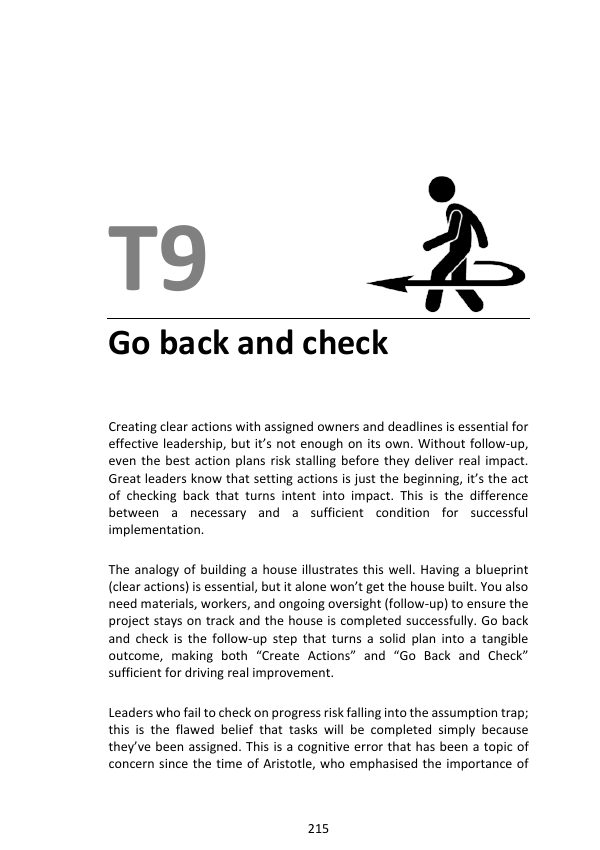
Put ‘Go Back and Check’ into practice
Develop your own practice or lead the learning with your team. Use the chapter and workbook to explore the behaviour, then choose the resources that fit your next step.
Apply · Your leadership practice
Put it to work
Use the T9 Playbook to turn the behaviour into practical action on a real leadership challenge.
- Practical toolkit and coaching prompts
- A practice script to rehearse your approach
- A 90-day plan to guide your next steps
Members only · Explore membership →
Apply · Learning with your team
Lead a team session
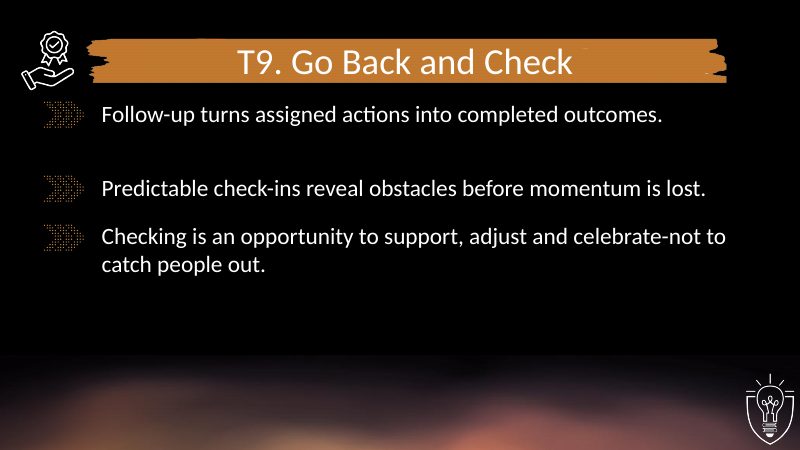
Use the T9 INSET PowerPoint to help colleagues explore the behaviour and plan how to put it into practice.
- Editable slides to adapt to your setting
- Speaker notes to support facilitation
- Discussion, rehearsal and planning
Members only · Explore membership →
ES CoachApply · Online, with ES Coach
Complete the T9 Playbook online
Work through the Playbook on your desk instead of on paper. A built-in coach supports you with every question: jot a few words and ES Coach suggests an answer for you to edit.
- ES Coach help under every question and table
- Saves as you type, and stays private to you
- Linked to your goal and your 90-day plan
Members only · Explore membership → · Sign in
Worked examples
See T9 applied in eight leadership contexts
Choose your role to explore the challenge, the leader’s response and the intended result. Members can read the complete example and download an editable Word copy.
In a primary school
In a secondary school
Across schools
Selected worked example
In a primary school · Headteacher
Checking family attendance conversations
Kerry · Headteacher · 207-pupil primary school
Worked example at a glance
Checking family attendance conversations
The challengeThe attendance lead agreed to hold barrier conversations with twelve priority families, but no review point was set. Previous checks counted calls made without asking what families said.
What the leader doesThe headteacher uses ten minutes of Monday's meeting to review the tracker privately, listens for what families said and whether barriers moved, recognises specific practice and gives school-controlled barriers an owner there and then.
What success looks likeBy day 30 all twelve families should have a clear status and every school action an owner and date; by day 60 80% of school-controlled barriers should be removed on time; by day 90 priority pupils' attendance should improve.
Nathan · Deputy Headteacher for teaching · 636-pupil primary school
Worked example at a glance
Reviewing a feedback trial without inspection
The challengeEvery class agreed to trial a verbal-feedback code in one English sequence. Past initiatives looked consistent in books while teachers and pupils used the symbols differently.
What the leader doesThe deputy head holds phase reviews using three pupil examples, asks what pupils did next, removes genuine barriers without doing teachers' work for them, and records a retain, adapt, retest or stop decision for each phase.
What success looks likeBy day 30 every class should complete the trial and each phase should reach an evidence-based decision; by day 60 agreed essentials should be secure in 80% of sampled sequences; by day 90 pupil correction should improve without extra marking time.
Molly · Geography Lead and Year 5 teacher · 418-pupil primary school
Worked example at a glance
Following up a fieldwork resource audit
The challengeThe original action said only 'review equipment'. The geography lead needs to check progress without completing the inventories personally or implying that every missing item will be bought.
What the leader doesThe geography lead uses a ten-minute standing item to review each phase's evidence, closes audits that are usable for the next unit, sorts access and storage barriers and sends spending needs to senior leaders as costed proposals.
What success looks likeBy day 30 all phase audits should be complete or rescheduled against the next unit; by day 60 safety, access and priority replacements should be resolved; by day 90 every fieldwork unit should have usable resources without duplicate purchasing.
Miranda · Headteacher · 1,610-pupil secondary school
Worked example at a glance
A midpoint review of a strategy draft
The challengeThe deputy's disadvantaged strategy is due on 12 November. Past follow-up relied on informal reminders, although parts of the work waited on the headteacher's own decisions about priorities, staffing and evidence.
What the leader doesThe headteacher uses a scheduled one-to-one to test one complete chain from need to action, cost and measure, makes the pending decisions there and then, and leaves authorship of the strategy with the deputy.
What success looks likeBy day 30 every priority should have a defensible chain from need to measure, with all headteacher decisions made; by day 60 governors should approve the strategy; by day 90 lead measures should show delivery reaching the intended pupils.
Sara · Assistant Headteacher for curriculum operations · 1,220-pupil secondary school
Worked example at a glance
Checking curriculum evening plans early
The challengeIn previous years, curriculum-evening checks happened after invitations went out, so room clashes, unavailable staff and inaccessible information were fixed through last-minute goodwill.
What the leader doesThe assistant head runs a twenty-minute exception review a week before plans are due, takes on rooms, staffing and translation as whole-school problems, and leaves each faculty plan approved, recovering, revised or escalated.
What success looks likeBy day 30 every faculty plan should have a clear decision and every central dependency an owner and deadline; by day 60 family information should be accurate and accessible; by day 90 family participation should improve across groups.
Bilal · Year 8 Pastoral Lead · 990-pupil secondary school
Worked example at a glance
A safe check on peer-mentoring nominations
The challengeTutors agreed to nominate Year 8 mentees and mentors by 15 October. Similar work has slipped when consent and timetable barriers surfaced at matching, and sensitive concerns were discussed too widely.
What the leader doesThe pastoral lead holds a private fifteen-minute tracker review, classes every nomination as ready, awaiting action, unsuitable or deferred, sends safeguarding issues straight to the DSL and never pressures tutors to fill places.
What success looks likeBy day 30 every nomination should have a safe status; by day 60 all launched matches should have consent, training and a first-week review; by day 90 pupils should report useful, voluntary support with no unresolved safeguarding concern.
Joel · Head of Physical Education · 920-pupil secondary school
Worked example at a glance
Following up personal invitations to clubs
The challengeEach PE leader agreed to invite five underrepresented pupils to extracurricular activity. There is no shared way to tell a respectful invitation from pressure, or a declined offer from a barrier the school should remove.
What the leader doesThe head of PE runs a five-minute scan of the invitation record, assigns owners to kit, transport and timing barriers, follows up any missed invitations privately and sets a separate date to check actual participation.
What success looks likeBy day 30 every invitation should have a recorded choice and every removable barrier an owner; by day 60 80% of interested pupils should attend a first session; by day 90 sustained participation and belonging should grow among underrepresented pupils.
Vikram · Trust Director of Primary Education · eight-school trust
Worked example at a glance
A midpoint check on moderation evidence
The challengeEight headteachers agreed to upload moderated writing sets by 20 October. Previous actions were only discussed at the next termly meeting, so gaps were found too late and central staff repaired them.
What the leader doesThe director runs a twelve-minute item using the shared folder, asks to see one commentary rather than accept 'on track', provides the specific support needed and records a clear decision for each school, without public ranking.
What success looks likeBy day 30 every school should have a recorded midpoint decision, with any support delivered within two working days; by day 60 all eight should contribute usable evidence or a recorded exception; by day 90 local moderation judgement should strengthen.
The complete Playbook is for members
Turn this example into action
Read the full toolkit, coaching and practice scripts, and 90-day plan. Members can view the PDF here and download an editable Word copy.
Resources for this behaviour
Templates and checklists from the resource library that put T9 into practice.
Further reading
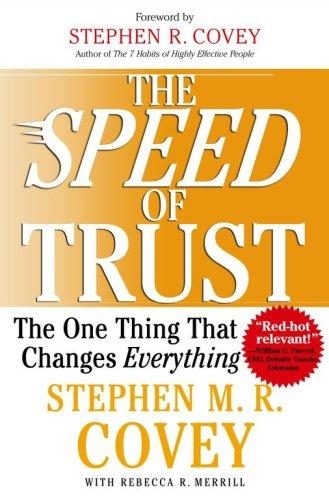
Recommended book
The Speed of Trust – Stephen M.R. Covey (2006)
This book deepens your practice by showing how follow-up builds credibility and strengthens accountability.
References from the Everyone Succeeds book
- Locke, E.A. and Latham, G.P. (2002) 'Building a practically useful theory of goal setting and task motivation: A 35-year odyssey', American Psychologist, 57(9), pp. 705–717. Read free ↗
Not sure where to start? Take the free self-diagnostic to choose one to three behaviours to focus on.
As an Amazon Associate, Everyone Succeeds earns from qualifying purchases.