

Leadership behaviour L10
Pass the Baton
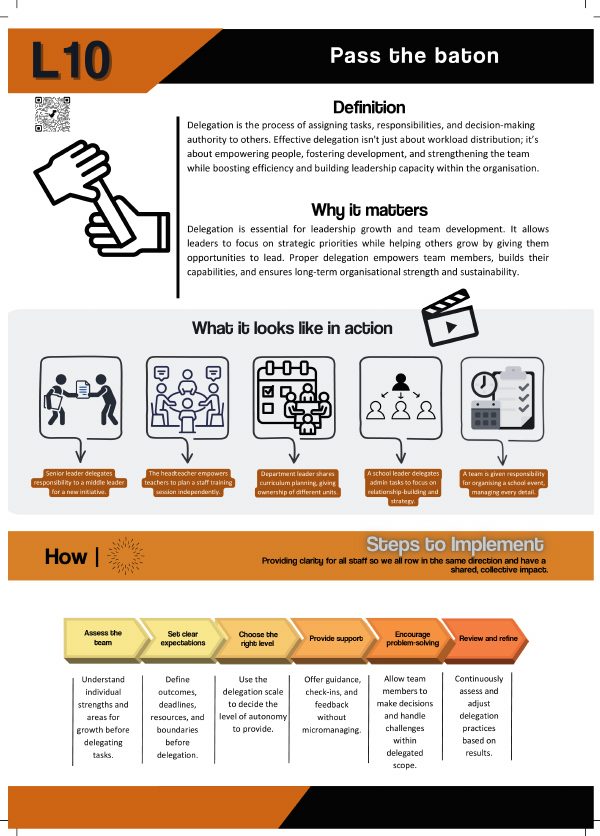
Delegation is not offloading. Match responsibility to each person's readiness, set clear expectations and you gain capacity while growing tomorrow's leaders.
Jump to L10 resources ↓What this behaviour looks like
Match authority to readiness
A leader assesses each colleague's competence and commitment, chooses the right level of delegation and sets out the outcome, deadlines, resources and boundaries. They make the colleague's authority public, check in without micromanaging and stretch people towards full ownership.
A practical example
Handing over a school event
Handing out tasks“Could you sort out the festival stalls for me? Just check with me before you decide anything.”
Passing the baton“The summer festival is yours, and success is a safe afternoon families enjoy. You decide stalls, rota and spending within budget; safety sign-off stays with me. We will meet fortnightly about risks, and I will tell everyone you are leading it.”
Choose someone ready for the responsibility, with support to grow.
Stalls, rota and spending are theirs; safety sign-off stays reserved.
Meet fortnightly about risks; tell everyone who is leading.
Choose one outcome you are holding too tightly, write a five-part brief for the right colleague, and plan two short coaching check-ins.
L10 · Resources for your setting
Put ‘Pass the Baton’ into practice
Develop your own practice or lead the learning with your team. Use the chapter and workbook to explore the behaviour, then choose the resources that fit your next step.

Apply · Your leadership practice
Put it to work
Use the L10 Playbook to turn the behaviour into practical action on a real leadership challenge.
- Practical toolkit and coaching prompts
- A practice script to rehearse your approach
- A 90-day plan to guide your next steps
Members only · Explore membership →

Apply · Learning with your team
Lead a team session
Use the L10 INSET PowerPoint to help colleagues explore the behaviour and plan how to put it into practice.
- Editable slides to adapt to your setting
- Speaker notes to support facilitation
- Discussion, rehearsal and planning
Members only · Explore membership →
ES CoachApply · Online, with ES Coach
Complete the L10 Playbook online
Work through the Playbook on your desk instead of on paper. A built-in coach supports you with every question: jot a few words and ES Coach suggests an answer for you to edit.
- ES Coach help under every question and table
- Saves as you type, and stays private to you
- Linked to your goal and your 90-day plan
Members only · Explore membership → · Sign in
Worked examples
See L10 applied in eight leadership contexts
Choose your role to explore the challenge, the leader’s response and the intended result. Members can read the complete example and download an editable Word copy.
In a primary school
In a secondary school
Across schools
Selected worked example
In a primary school · Headteacher
Handing the festival to the office manager
Farah · Headteacher · 360-pupil primary academy
Worked example at a glance
Handing the festival to the office manager
The challengeThe headteacher has held almost every decision about the school festival, which slows it down and leaves the colleague doing the work without the authority.
What the leader doesThe headteacher makes the office manager's authority public and redirects decisions within that remit, while retaining responsibility for reserved matters and conduct.
What success looks likeBy day 30 the new lead should accept the brief and protected time; by day 60 a representative team should deliver a safe event plan; by day 90 the festival should meet its attendance and inclusion outcomes.
Deepa · Deputy Headteacher · 360-pupil primary academy
Worked example at a glance
Letting a teacher lead an enquiry
The challengeThe deputy headteacher organises every detail of curriculum work personally, even when a teacher is ready to lead it.
What the leader doesThe deputy headteacher hands a teacher a research-lesson enquiry, states his process authority to the team out loud and protects the boundary that the work cannot become a judgement about any teacher.
What success looks likeBy day 30 the lead and three teachers should agree the protected enquiry; by day 60 two research lessons should generate contrasting pupil evidence; by day 90 the team should identify a credible improvement.
Niamh · Science Lead and Year 5 teacher · 360-pupil primary academy
Worked example at a glance
Handing over the science resources audit
The challengeThe science lead has run the resources audit single-handedly every year and has never let anyone else make a decision inside it.
What the leader doesThe science lead gives the audit to an early-career teacher paired with the technician, makes clear who holds curriculum judgement and who can stop on safety grounds, and asks questions rather than deciding when they disagree.
What success looks likeBy day 30 the new owner should accept authority and complete the sample audit; by day 60 the full inventory should map safe resources to every science unit; by day 90 a costed plan within £2,200 should be approved.
Adele · Headteacher · ages 11 to 18 secondary school, 1,340 pupils
Worked example at a glance
Handing over the induction redesign
The challengeThe headteacher has become the bottleneck on an induction redesign that suits an operational colleague far better than it suits the headteacher.
What the leader doesThe headteacher gives the colleague the redesign with his authority made public to HR, safeguarding and operations, names the decisions the headteacher reserves and distinguishes his ownership from others' advisory expertise.
What success looks likeBy day 30 the new lead should accept a published brief and a protected day; by day 60 a role-inclusive prototype should be tested; by day 90 the final ninety-day induction model should be approved.
Ayesha · Deputy Headteacher · ages 11 to 18 secondary school, 1,340 pupils
Worked example at a glance
Handing over a subject information evening
The challengeA colleague is ready to lead the evening, but the deputy headteacher coordinated the last two and faculties still expect to deal with the deputy.
What the leader doesThe deputy headteacher publishes the colleague's decision rights to faculties and prepares him with words for what he may and may not promise families when a subject leader wants a guarantee.
What success looks likeBy day 30 the new lead should accept the brief and an inclusive design; by day 60 all subject messages should pass the common accuracy standard; by day 90 at least 80% of families should access useful information.
Zara · Inclusion and Reintegration Lead · ages 11 to 18 secondary school, 1,340 pupils
Worked example at a glance
Passing on the mentoring programme
The challengeThe inclusion lead personally manages mentoring matches, training and review, despite having a tutor who is ready to lead the programme.
What the leader doesThe inclusion lead hands the programme to the tutor with safety boundaries rehearsed, not just explained, and uses coaching questions rather than stepping in when mentors stray from the guide.
What success looks likeBy day 30 the tutor should accept authority and forty pupils should be selected safely; by day 60 at least 85% of mentoring meetings should take place; by day 90 most pupils should show improved attendance or engagement.
Beatrice · Head of Business · ages 11 to 18 secondary school, 1,340 pupils
Worked example at a glance
Sharing the curriculum review
The challengeThe head of business has kept the curriculum review under personal control, leaving two experienced teachers' expertise out of planning.
What the leader doesThe head of business asks a colleague to own the review, agrees the criteria together and sends challenges back to the new owner rather than quietly rewriting the recommendation.
What success looks likeBy day 30 the colleague should accept the brief and complete the audit; by day 60 two priority units and one assessment should be tested; by day 90 the final recommendation should be ready for implementation.
Samira · Trust Director of Leadership Development · seven-school trust
Worked example at a glance
Handing over an attendance network
The challengeThe director chairs and follows up every network meeting personally, which is why no school leader has ever owned the trust's attendance work.
What the leader doesThe director hands a school leader real ownership of the network with a written brief, protected capacity and a first milestone, and makes it safe for her to decline if her school's capacity makes it unsafe.
What success looks likeBy day 30 the new owner should accept a written brief with protected capacity; by day 60 every school should complete two agreed attendance tests; by 18 December persistent absence should fall below 16%, reported by school and pupil group.
The complete Playbook is for members
Turn this example into action
Read the full toolkit, coaching and practice scripts, and 90-day plan. Members can view the PDF here and download an editable Word copy.
Resources for this behaviour
Templates and checklists from the resource library that put L10 into practice.
Further reading

Recommended book
Turn the Ship Around! – L. David Marquet (2012)
This text strengthens your practice by showing how distributing responsibility grows confidence, clarity and ownership across a team.
References from the Everyone Succeeds book
- Blanchard, K., Zigarmi, P. and Zigarmi, D. (2013) Leadership and the One Minute Manager: Increasing Effectiveness Through Situational Leadership II. Rev. edn. New York: William Morrow. Buy on Amazon ↗
- Grove, A.S. (1995) High Output Management. 2nd edn. New York: Vintage Books. Buy on Amazon ↗
- Hersey, P., Blanchard, K.H. and Johnson, D.E. (2012) Management of Organizational Behavior: Leading Human Resources. 10th edn. Upper Saddle River, NJ: Pearson. Buy on Amazon ↗
- Hyatt, M. (2019) Free to Focus: A Total Productivity System to Achieve More by Doing Less. Grand Rapids, MI: Baker Books. Buy on Amazon ↗
- Landsberg, M. (2015) The Tao of Coaching: Boost Your Effectiveness at Work by Inspiring and Developing Those Around You. London: Profile Books. Buy on Amazon ↗
- Yukl, G. (2010) Leadership in Organizations. 7th edn. Upper Saddle River, NJ: Prentice Hall. Buy on Amazon ↗
Not sure where to start? Take the free self-diagnostic to choose one to three behaviours to focus on.
As an Amazon Associate, Everyone Succeeds earns from qualifying purchases.