

Leadership behaviour L8
Don't Drop the Ball
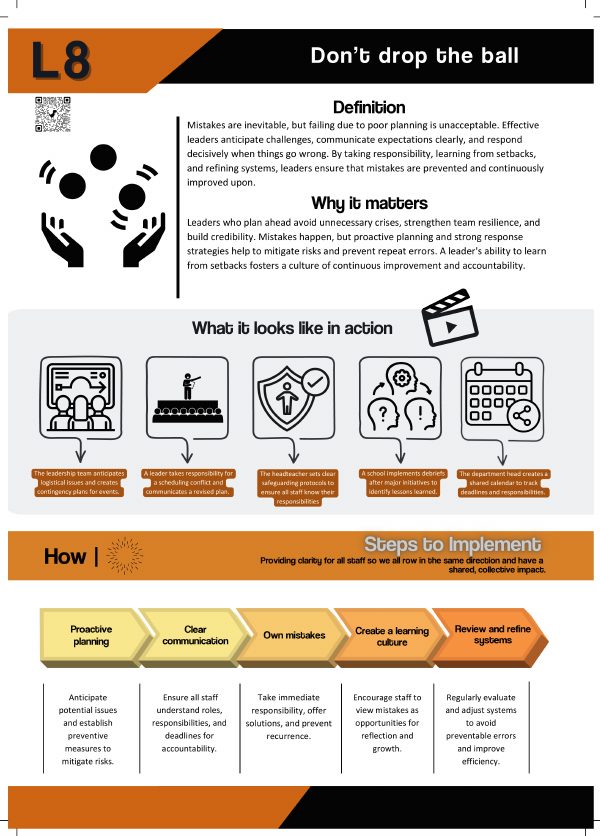
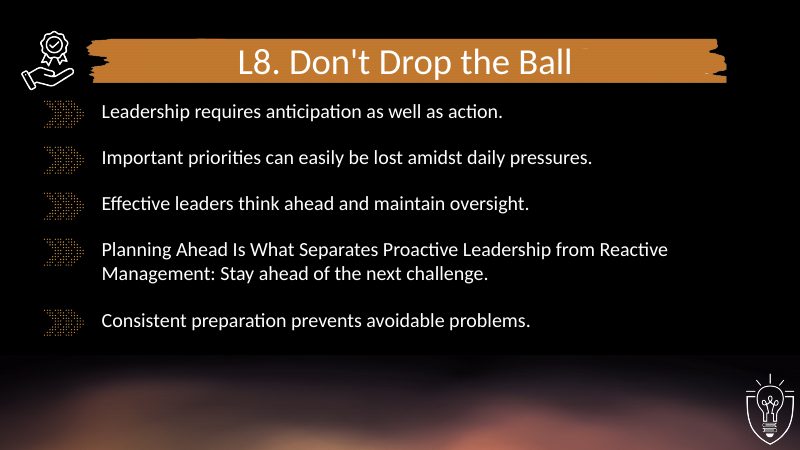
Most people accept mistakes, but not poor planning. Anticipate problems, keep your promises and, when something slips, own it and put it right fast.
Jump to L8 resources ↓What this behaviour looks like
Plan ahead, own mistakes
A leader anticipates risks, makes every commitment clear with an owner and a date, and updates colleagues and families before they ask. When a promise slips, they own it without excuses, fix it quickly and change the system so it does not recur.
A practical example
Putting right a late promise to families
Explaining it away“Sorry for the delay with the timetable. It has been a very busy few weeks.”
Owning the recovery“I promised you the SEND timetable three weeks ago and it is still not out. That was my responsibility, and I am sorry. I will publish it by 4.00 p.m. on Thursday, and I have added a check a week before future SEND deadlines so any delay is shared with you early.”
The SEND timetable promised three weeks ago is still not out.
Apologise sincerely and say it was your responsibility.
Publish by 4.00 p.m. Thursday and add a check before future deadlines.
List what you owe others and check the one most at risk. If something has slipped, own it, give a firm date and change one step so it does not happen again.
L8 · Resources for your setting
Put ‘Don't Drop the Ball’ into practice
Develop your own practice or lead the learning with your team. Use the chapter and workbook to explore the behaviour, then choose the resources that fit your next step.


Apply · Your leadership practice
Put it to work
Use the L8 Playbook to turn the behaviour into practical action on a real leadership challenge.
- Practical toolkit and coaching prompts
- A practice script to rehearse your approach
- A 90-day plan to guide your next steps
Members only · Explore membership →
Apply · Learning with your team
Lead a team session
Use the L8 INSET PowerPoint to help colleagues explore the behaviour and plan how to put it into practice.
- Editable slides to adapt to your setting
- Speaker notes to support facilitation
- Discussion, rehearsal and planning
Members only · Explore membership →
Worked examples
See L8 applied in eight leadership contexts
Choose your role to explore the challenge, the leader’s response and the intended result. Members can read the complete example and download an editable Word copy.
In a primary school
In a secondary school
Across schools
Selected worked example
In a primary school · Headteacher
Publishing a late SEND timetable
Catherine · Headteacher · 286-pupil rural primary federation
Worked example at a glance
Publishing a late SEND timetable
The challengeThe headteacher promised families a SEND communication timetable three weeks ago, and it still has not been published.
What the leader doesThe headteacher owns the delay, publishes an accurate timetable in every required format by Thursday, decides what the SENCO and office can stop so the recovery is not hidden work, and sets up a calendar showing risk early.
What success looks likeThe timetable should be issued accurately by 4.00 p.m. Thursday, with parent representatives confirming access within a week; by day 60 the next SEND communication should reach its protected checkpoints; by day 90 families should report predictable review communication.
Rosie · Deputy Headteacher · 286-pupil rural primary federation
Worked example at a glance
Honouring missed observation follow-ups
The challengeSeven teachers gave up a lesson to be observed and then heard nothing, because follow-ups are the first thing cancelled when something urgent lands.
What the leader doesThe deputy headteacher confirms all seven follow-ups within six working days, defines what a complete follow-up means and makes every future follow-up bookable at the point of observation.
What success looks likeAll seven delayed follow-ups should be completed well within six working days; by day 60 the next twelve cycles should meet the ten-day standard; by day 90 teachers should report reliable, useful coaching.
Molly · Curriculum Lead and Year 6 teacher · 286-pupil rural primary federation
Worked example at a glance
Correcting a wrong letter home
The challengeA letter the curriculum lead approved went to Year 4 families with the wrong date and kit list, and teachers took twenty-six family calls while they were teaching.
What the leader doesThe curriculum lead owns the approval plainly with the Year 4 team, sends one verified correction to every family that afternoon, withdraws the old letter and agrees a short source check with colleagues.
What success looks likeEvery Year 4 family should receive one verified correction by 2.30 p.m. that day, with acknowledgements confirmed within two days; by day 60 four further communications should pass the critical-detail check; by day 90 avoidable factual corrections should fall to zero.
Gemma · Headteacher · ages 11 to 18 secondary school, 1,610 pupils
Worked example at a glance
Correcting a results figure
The challengeThe headteacher gave governors a results figure with more confidence than the evidence allowed, and governors were the ones who had to correct it.
What the leader doesThe headteacher corrects the figure for every audience that heard it, removes the old number everywhere and requires a validation record for every public data claim, so seniority never bypasses checking.
What success looks likeEvery audience should have the verified correction by noon the next day, with no superseded figure published by the week's end; by day 60 three public data releases should use full validation records; by day 90 governors should report stronger confidence in data assurance.
Nora · Deputy Headteacher · ages 11 to 18 secondary school, 1,610 pupils
Worked example at a glance
Giving back lost consultation time
The challengeThe timetable proposal went out five days late, halving the thinking time staff had been promised.
What the leader doesThe deputy headteacher restores ten genuine working days by moving the whole decision chain, publishes what is fixed and open, and protects the timetabler's build time so no other team pays for the delay.
What success looks likeBy day 30 staff should have ten genuine working days; by day 60 the revised timetable should reach a safe build milestone; by day 90 staff should judge the consultation meaningful and delivery should remain viable.
Naomi · Inclusion and Reintegration Lead · ages 11 to 18 secondary school, 1,610 pupils
Worked example at a glance
Getting a reintegration plan right
The challengeLast time, a pupil's reduced timetable did not reach every teacher, and he ended up distressed in his first lesson back.
What the leader doesThe inclusion lead has every teacher confirm the corrected plan before the pupil returns, makes sure he and his family know what will happen and introduces a readiness check so returns never depend on an unconfirmed email.
What success looks likeThe pupil's plan should be live and understood before the return the next day, and reviewed after week one; by day 60 twenty reintegrations should complete the forty-eight-hour readiness check; by day 90 handover reliability should reach 100%.
Rina · Head of Chemistry · ages 11 to 18 secondary school, 1,610 pupils
Worked example at a glance
Recovering a late practical order
The challengeThe practical order went in twelve days late after two reminders from the technician went unheeded, leaving two groups short of preparation time.
What the leader doesThe head of chemistry orders the correct materials and agrees a safe preparation plan that day, without the senior technician absorbing the recovery in unpaid hours, and moves ordering onto a shared tracker.
What success looks likeBy day 30 correct materials and a safe capacity plan should be confirmed; by day 60 two further examination orders should meet every checkpoint; by day 90 no practical time or safety should be lost through ordering failure.
Deborah · Trust Director of Safeguarding · six-school trust
Worked example at a glance
Recovering a late safeguarding response
The challengeA school waited four working days for safeguarding advice the trust commits to giving in one, and had to chase the central team for it.
What the leader doesThe director gives the school complete, verified written advice by the next afternoon, keeps the headteacher informed before she has to ask and gives every urgent request a named owner, verifier and status point.
What success looks likeBy day 30 urgent requests should have an owner, verifier and status point; by day 60 six consecutive urgent cases should meet the response standard; by day 90 schools should no longer have to chase overdue safeguarding advice.
The complete Playbook is for members
Turn this example into action
Read the full toolkit, coaching and practice scripts, and 90-day plan. Members can view the PDF here and download an editable Word copy.
Resources for this behaviour
Templates and checklists from the resource library that put L8 into practice.
Further reading

Recommended book
The Speed of Trust – Stephen M.R. Covey (2006)
This text supports the behaviour by illustrating how reliability and follow-through build credibility and strengthen relationships.
Not sure where to start? Take the free self-diagnostic to choose one to three behaviours to focus on.
As an Amazon Associate, Everyone Succeeds earns from qualifying purchases.