

Culture behaviour C4
Maintain Consistency
Consistency is the multiplier that turns routines into culture. Keep expectations the same in every room, so pupils feel secure and teachers can teach.
Jump to C4 resources ↓What this behaviour looks like
The same experience everywhere
A leader keeps the agreed way visible to staff and pupils, samples what really happens across classes and follows up drift early. Routines are revisited after holidays or exams, and fair, predictable expectations help pupils feel secure and belong.
A practical example
Returning to a routine after a holiday
Assuming it holds“Welcome back, everyone. You all know the end-of-day routine, so let's just pick up where we left off.”
Revisiting it together“Let's watch the end-of-day routine again and name the three steps that matter most. It had started to vary between classes before the break, so we will rehearse it now. This week I will visit every class at home time, then coach any slipping step and share what is working.”
Name the three end-of-day steps that matter most.
Visit every class at home time this week.
Coach any slipping step and share where it works well.
Write down what must stay the same, sample it in three places this week and plan one follow-up: coaching, re-teaching or recognition.
C4 · Resources for your setting
Put ‘Maintain Consistency’ into practice
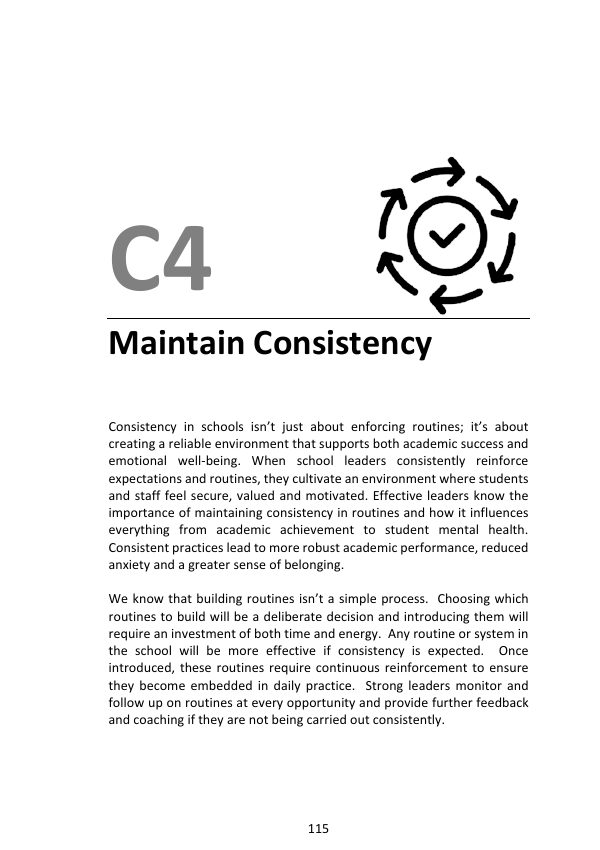
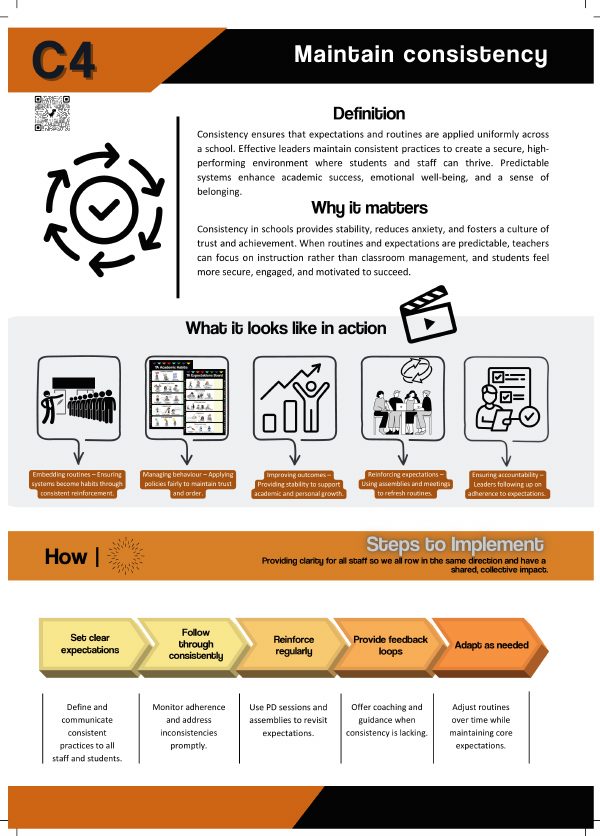
Develop your own practice or lead the learning with your team. Use the chapter and workbook to explore the behaviour, then choose the resources that fit your next step.
Apply · Your leadership practice
Put it to work
Use the C4 Playbook to turn the behaviour into practical action on a real leadership challenge.
- Practical toolkit and coaching prompts
- A practice script to rehearse your approach
- A 90-day plan to guide your next steps
Members only · Explore membership →
Apply · Learning with your team
Lead a team session
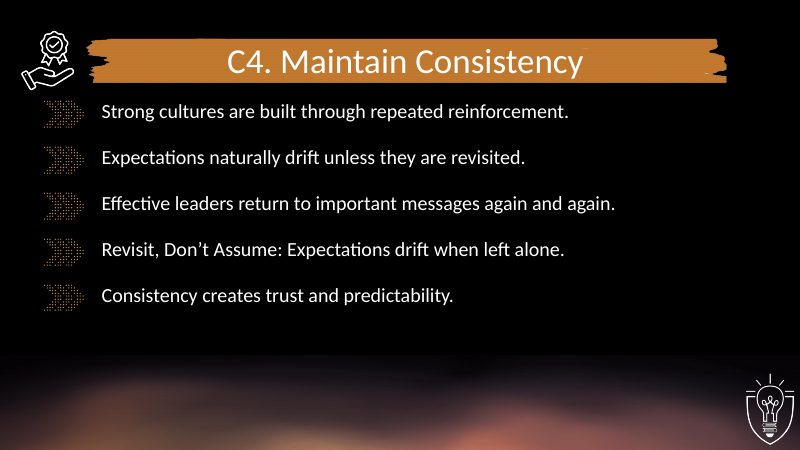
Use the C4 INSET PowerPoint to help colleagues explore the behaviour and plan how to put it into practice.
- Editable slides to adapt to your setting
- Speaker notes to support facilitation
- Discussion, rehearsal and planning
Members only · Explore membership →
ES CoachApply · Online, with ES Coach
Complete the C4 Playbook online
Work through the Playbook on your desk instead of on paper. A built-in coach supports you with every question: jot a few words and ES Coach suggests an answer for you to edit.
- ES Coach help under every question and table
- Saves as you type, and stays private to you
- Linked to your goal and your 90-day plan
Also in the online Playbook, with PDF and Word copies: a worked example for school business managers and central trust teams, following a trust data and IT lead.
Members only · Explore membership → · Sign in
Worked examples
See C4 applied in eight leadership contexts
Choose your role to explore the challenge, the leader’s response and the intended result. Members can read the complete example and download an editable Word copy.
In a primary school
In a secondary school
Across schools
Selected worked example
In a primary school · Headteacher
First-day absence follow-up
Amina · Headteacher · 300-pupil primary school with a resource base
Worked example at a glance
First-day absence follow-up
The challengeA pupil with an unexplained absence was not contacted until 10.17, and first calls slip whenever the colleague making them is also covering reception.
What the leader doesThe headteacher changes reception cover before asking for faster calls, rehearses the first-day sequence with teachers, office staff and the cover DSL, and personally checks one register each week.
What success looks likeBy day 30 registers should close by 9.05 with first contact by 9.30 every day; by day 60 high-risk pupils should be prioritised and every action recorded; by day 90 the standard should hold on short-staffed mornings too.
Greg · Assistant Headteacher · 630-pupil primary school
Worked example at a glance
The same response at lunch and in lessons
The challengeAt lunch, adults use five different warning phrases, so the same behaviour meets a different response depending on who is on duty.
What the leader doesThe assistant headteacher rehearses reminder, warning and repair language with midday supervisors and teachers together on the playground, using the real radios and handover card, and joins lunch duty twice weekly.
What success looks likeBy day 30 all adults should use the same reminder, warning and repair language; by day 60 same-day logging and handover should reach 90%; by day 90 pupils should find responses more predictable, with handover failures halved.
Laura · Science Lead and Years 3 and 4 Phase Leader · 280-pupil primary school
Worked example at a glance
Science feedback pupils act on
The challengeSome teachers write one sharp scientific prompt and protect time for a response, while others praise effort in long comments that pupils rarely act on.
What the leader doesThe science lead models choosing the most important scientific gap and writing one prompt, protects three minutes for pupils to revise, and samples the original explanation, prompt and revision together.
What success looks likeBy day 30 every sample should carry one scientific prompt with time to respond; by day 60 at least 85% of moderated pupils should strengthen the link between evidence and conclusion; by day 90 independent revision should be more accurate.
Simon · Headteacher · 1,250-pupil secondary school
Worked example at a glance
Reliable instructional coaching
The challengeIn 41% of sampled coaching cycles there was no follow-up within ten working days, and trust falls wherever coaching starts to feel like appraisal.
What the leader doesThe headteacher keeps coaching evidence outside appraisal, has coaches rehearse one observable move and book follow-up before the conversation ends, and judges leaders on protected time and completion, not private notes.
What success looks likeBy day 30 every teacher should have a focused cycle with follow-up booked; by day 60 at least 85% of sampled cycles should include one rehearsed action step; by day 90 follow-up within ten working days should reach at least 90%.
Leila · Deputy Headteacher · 1,100-pupil secondary school
Worked example at a glance
Completing the on-call chain
The challengeOn-call arrives quickly, but destinations are missing from 18% of records and the teacher's restorative conversation often slips during assessment weeks and staff absence.
What the leader doesThe deputy headteacher walks one recent case through the whole chain, rehearses each handover with a named owner, protects daily conversation slots and stops treating a low removal count as the measure.
What success looks likeBy day 30 every on-call record should show the destination and conversation owner; by day 60 same-day checks and teacher conversations should both reach 90%; by day 90 repeat removals should fall by a quarter.
Yasmin · Head of Year 10 · 1,450-pupil secondary school
Worked example at a glance
Applying lateness thresholds on time
The challengeFamily contact happens anywhere between the third and eighth late mark, and pupils describe very different tutor tones for the same lateness.
What the leader doesThe head of year rehearses the three-late conversation and five-late family call with tutors, helps them separate what the pupil controls from what school can change, and checks that agreed support is completed.
What success looks likeBy day 30 tutors should act on the day each threshold is reached; by day 60 at least 90% of pupils who are late again should have a co-produced plan; by day 90 Year 10 late marks should fall by 35%.
Martin · Head of Humanities · 920-pupil secondary school
Worked example at a glance
Reliable assessment judgements
The challengeA blind sample placed the same Year 8 response two bands apart, and two Key Stage 3 teams missed the last moderation point altogether.
What the leader doesThe head of humanities has colleagues judge anonymised responses independently, cite the evidence and resolve disagreements, then agrees the smallest reliable sample and joins Key Stage 3 teams to moderate alongside them.
What success looks likeBy day 30 all teams should use the common task, conditions and rubric; by day 60 every Key Stage 3 team should moderate before grades are submitted; by day 90 judgements should align within one rubric band.
Edward · Trust Attendance and Safeguarding Lead · seven-school trust
Worked example at a glance
Consistent attendance assurance
The challengeFour schools use different definitions of persistent absence, and in one school a high-risk case went through four weekly meetings without a named owner.
What the leader doesThe lead agrees six core indicators, one weekly review record and a named action, owner and date for every priority case, then coaches each school on its smallest missing step and rechecks ten days later.
What success looks likeBy day 30 all seven schools should use the same definitions and review record; by day 60 every high-risk case should have a named action and safeguarding decision; by day 90 at least six schools should see fewer pupils cross into persistent absence.
The complete Playbook is for members
Turn this example into action
Read the full toolkit, coaching and practice scripts, and 90-day plan. Members can view the PDF here and download an editable Word copy.
Resources for this behaviour
Templates and checklists from the resource library that put C4 into practice.
Further reading

Recommended book
Great by Choice – Jim Collins & Morten Hansen (2011)
The “20 Mile March” concept: consistent discipline outperforms bursts of intensity.
Not sure where to start? Take the free self-diagnostic to choose one to three behaviours to focus on.
As an Amazon Associate, Everyone Succeeds earns from qualifying purchases.